


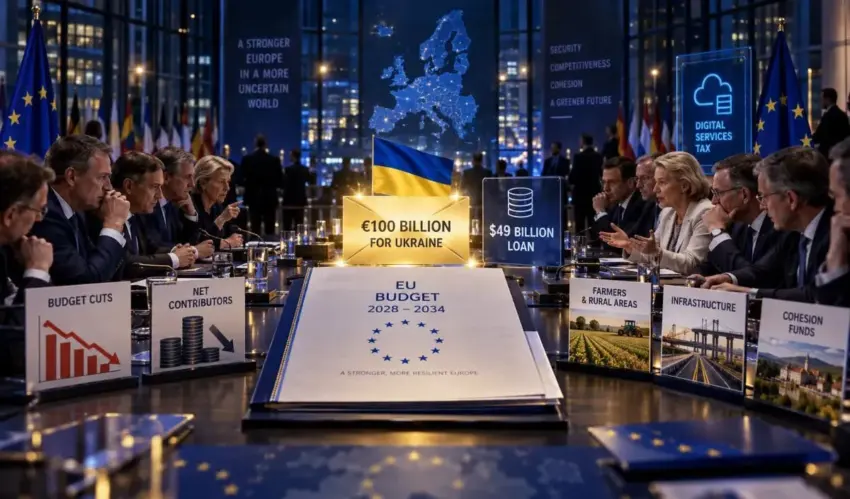
AI illustration
EU leaders were unable to reach an agreement on the next seven-year budget and a new $49 billion loan to Ukraine after more than 12 hours of talks in Brussels. This was reported by the Associated Press.
France and Ukraine cannot wait
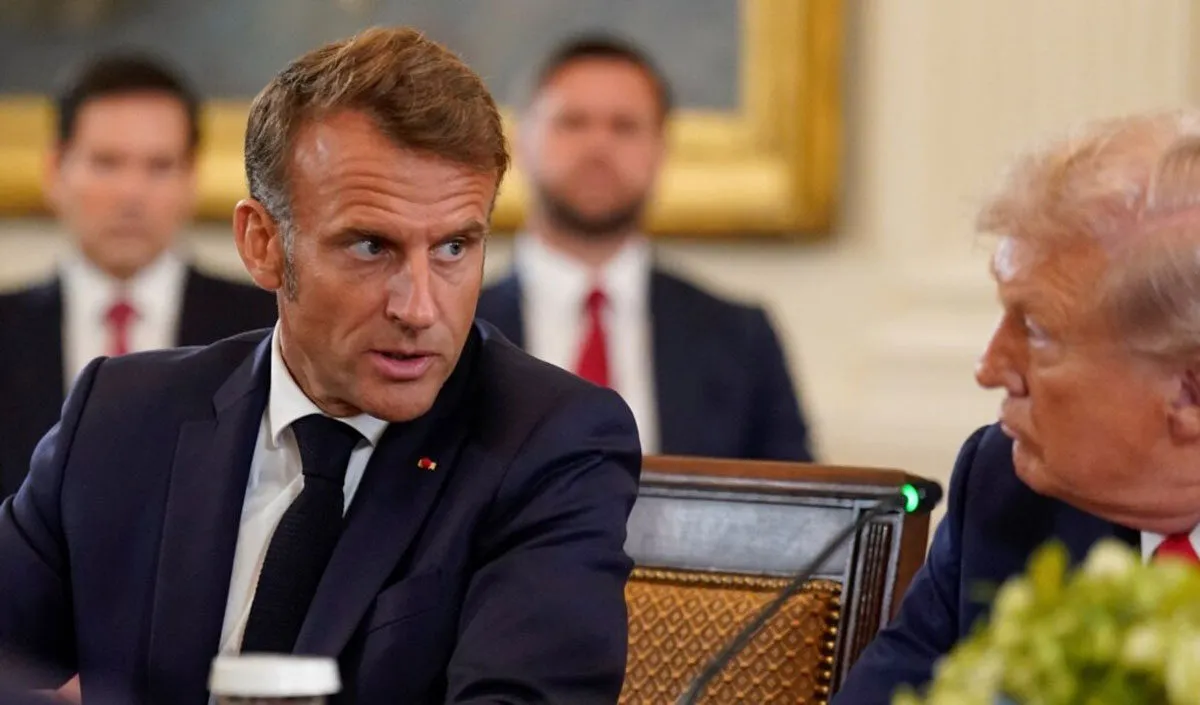
French President Emmanuel Macron has set a deadline for an agreement – the end of the year. He said he is ready to sign a “good agreement” when leaders meet again on 17–18 December.
After 31 December, the official added, he would be unable to “resume discussions on the budget and finalise it”, as this would be “too close to the presidential elections in France” in April. Macron also noted that the country is mired in debt and that the far right is likely to win the elections.
This refers to the EU budget for 2028–2034. It is modest in comparison with national budgets and is funded mainly by the 27 member states, based on the size of their economies. It is expected to amount to between 1 per cent and 1.2 per cent of the EU’s average gross national income.
Ukraine is a key part of the budgetary puzzle. The spending package provides for €100 billion ($110 billion) for the government in Kyiv over seven years.
EU leaders also need to resolve the issue of a new loan and whether the costs of servicing it will be covered by the budget.
Earlier this month, Merz threatened to block the budget agreement unless all member states ‘without exception’ made a ‘collective commitment’ regarding Ukraine (Bulgaria, the Czech Republic, Hungary and Slovakia oppose the use of funds for military aid to Ukraine). Merz reiterated the warning and said that “we will discuss this in detail in bilateral talks”.
No consensus
Czech Prime Minister Andrej Babiš insisted that “funding for Ukraine must be discussed separately”, and that the priority for Europe should be “the lives of our citizens”.
Hungarian Prime Minister Péter Magyar wrote on social media that he had seen “zero results” on Thursday, and suggested that an agreement by Christmas “also seems unlikely”.
During the negotiations, some leaders called for austerity, whilst others defended traditional areas of spending that account for the bulk of the budget. The majority want to increase funding for important new priorities and aid to Ukraine; meanwhile, the conflict has been ongoing for almost five years.
German Chancellor Friedrich Merz stated:
“Europe needs sound finances. We cannot and must not take on any more debt.”
At the same time, he acknowledged that there are “a number of tasks that we must carry out reliably”.
Germany is among the main net contributors to the EU budget, alongside Austria, the Netherlands and Sweden. Dutch Prime Minister Rob Jetten said that the budget “needs to be modernised and reduced” if the parties are to reach an agreement, and that he is prepared for a “marathon”.
A large group of countries, led by France and Italy, is staunchly defending funding for farmers and infrastructure projects in relatively poorer EU countries. Czech Prime Minister Andrej Babiš stated:
“Solidarity means roughly the same standard of living across different regions. Unfortunately, we do not have a motorway to Austria, and we need to build hospitals.”
The President of the European Council, António Costa, called on leaders to approach the debates with “an open mind, a constructive attitude and a spirit of compromise”. He said that an agreement was needed “by the end of this year, and this requires unanimity”.
This story was translated with the assistance of artificial intelligence.
Follow our updates
Have information for the newsroom? Share it with Logos-Press










Comments
0No comments yet. You can start the conversation.
Comments are open to readers with a Logos Press account.
Sign in to comment