


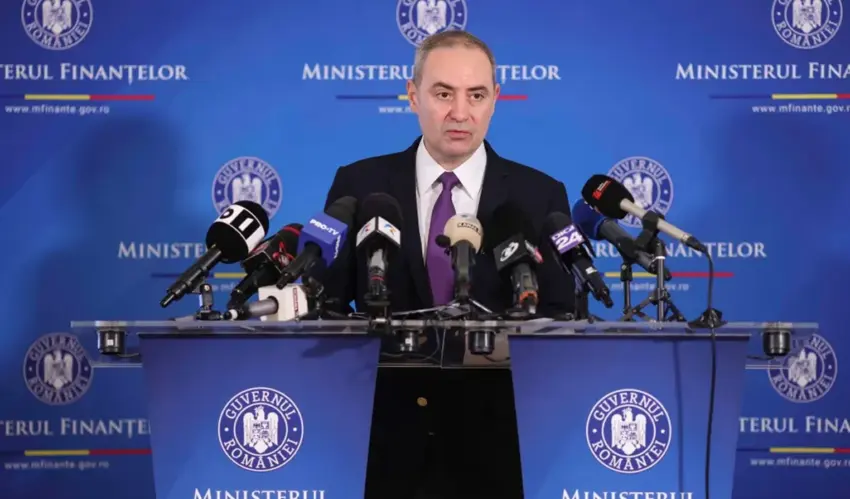
Alexandru Nazare Photo: Inquam Photos / Octav Ganea
This was stated by Romania’s Finance Minister Alexandru Nazare, who presented a report on the state of public finances, according to HotNews.
The deficit remains the main challenge
According to the Romanian Ministry of Finance, the country’s budget deficit reached 9.2 per cent of GDP in 2024 and fell to 7.8 per cent in 2025. For 2026, the government is targeting a figure of 6.2 per cent of GDP under the cash-based methodology and 6 per cent under the European ESA methodology.
However, according to the European Commission’s autumn forecast, without additional measures, the deficit in 2027 could reach 5.8 per cent of GDP. This means that fiscal consolidation will require further decisions regarding government revenue and expenditure.
The end of grant funding under the PNRR is creating additional pressure: in 2026, this amounts to around 36.3 billion lei, but these grants will cease in 2027. However, for the period 2027–2029, Romania will retain access to a portion of the European funding allocated for the 2021–2027 period.
Government liabilities constrain the budget
Among the risks highlighted by the minister are obligations arising from court rulings regarding the payment of outstanding salaries to magistrates. The total amount stands at around 20.5 billion lei, including payments scheduled for 2027–2029.
At the same time, the Ministry of Finance expects to reduce the state’s borrowing requirements: from 279 billion lei in 2026 to 248 billion lei in 2027. According to Nazar’s assessment, this could ease pressure on the financial market and create conditions for cheaper loans.
The Minister emphasised that the 2027 budget must be adopted in a timely manner, provide for a further reduction in the deficit, and be based on improving the efficiency of tax collection, the quality of public spending and the prioritisation of investments.
Follow our updates
Have information for the newsroom? Share it with Logos-Press





















Comments
0No comments yet. You can start the conversation.
Comments are open to readers with a Logos Press account.
Sign in to comment