


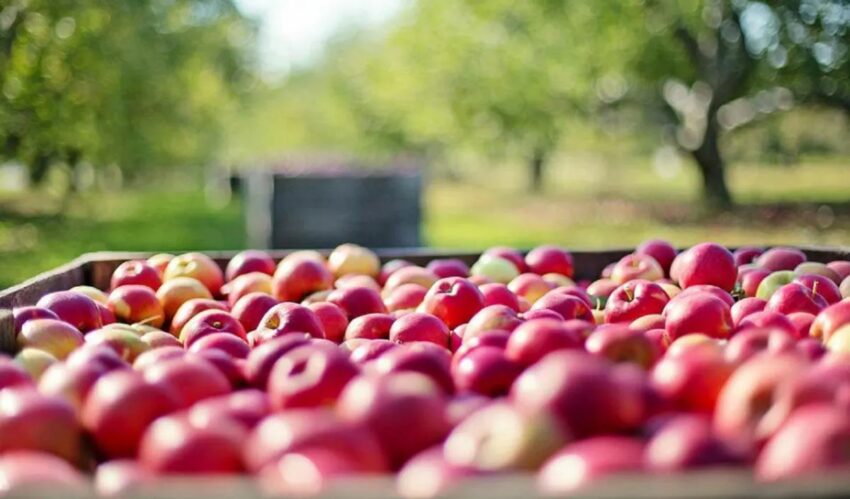
At the major international conference Prognosfruit-2026, the Moldovan delegation presented a cautious but fairly optimistic forecast for this year’s apple harvest – 526,000 tonnes (+17.5 per cent compared with last year’s domestic production of 447,000 tonnes).
However, the autumn rainfall in Moldova has had a favourable effect on the size of late-season apple varieties. As a result, experts from the country’s fruit-growing organisations have seen this as an opportunity to revise their estimate for the 2026 apple harvest upwards – to 590,000–600,000 tonnes.
This is already ‘grandmaster level’. The apple harvest in Moldova has only exceeded this figure once in the current decade – in 2021 (around 648,000 tonnes). As heads of fruit-growing enterprises note, the quality of the fruit this year is also quite good – there were no large-scale hailstorms.
Overall, the bumper 2026 apple harvest in Moldova should, logically, be sufficient not only for the domestic ‘fresh market’ and for the export of ‘dessert’ apples throughout the long marketing season – lasting until next summer – but also for industrial processing.
Late start to the 2026 apple processing campaign
Taking as a ‘roadmap’ the prospect of a slight shortage of new-crop apples in Europe due to the relatively low potential harvest in some EU ‘apple-growing’ countries, Moldovan fruit growers were expecting brisk external sales, as well as more generous price offers, including from processors.
However, since the start of the processing season, the purchase price for industrial apples from the 2026 harvest in Moldova has settled in the range of 2–2.3 lei/kg and has changed little throughout the autumn.
‘Price fluctuations’ are observed only in cases involving urgent sales of apples ‘in the orchard or from crates at the edge of the orchards’ to intermediary firms (in which case the price may fall below 2 lei/kg). Or when large consignments of raw produce are delivered over considerable distances ‘to the factory gates’ as part of a long-term partnership between the farmer and the processor (in which case the price could occasionally be slightly above 2.3 lei/kg).
According to representatives of the Speranța Con Association of Fruit and Vegetable Processors, it was only in November – when it became clear that a rise in prices for industrial apples was not to be expected – that Moldovan apple concentrate factories began operating at full capacity. What is more, many of them are unable to process the entire flow of raw produce ‘straight from the lorries’.
As a result, some fruit-growing agricultural enterprises are having to pile up apples in ‘kagats’ – ‘heaps at the edge of the orchard’. This does not mean that the produce will necessarily go to waste ‘in the absence of sales channels’. This is, in principle, a normal part of the production process, albeit not a particularly desirable one – storing overripe or mechanically damaged apples on the ground in the rain does nothing to improve their quality.
There are no incentives for an increase in the purchase price
Stefan Golubchuk, chairman of the Speranța Con association, noted in a comment to Logos Press that at the start of this summer’s processing season, the price of Moldovan apple concentrate on the European market fluctuated between 1.3 and 1.4 thousand euros per tonne. However, it has now fallen to 1–1.1 thousand euros per tonne.
What is worse of all is that, at this price, there is virtually no demand for Moldovan concentrate. At least, that is what the heads of canning companies claim. Warehouses of finished products for export are full. For this reason, some enterprises are even limiting their purchases of raw materials. This is a bad sign.
The fact is that, according to industry operators’ estimates, by the end of the second ten-day period of November, around 240–250 thousand tonnes of apples from the 2026 harvest had been processed in Moldova. At the same time, according to forecasts by experts from fruit-growing associations, by the end of this year, around 300–310 thousand tonnes of apples from the new harvest will arrive at apple concentrate production plants.
Consequently, the supply of industrial-grade apples from the new harvest is estimated to be a further 50–70 thousand tonnes. This means that the processing season will almost certainly extend into December. And this means that, given the winter conditions – with deteriorating ‘open-air’ storage conditions and logistical challenges – the task of processing tens of thousands of tonnes of apples is by no means straightforward.
Follow our updates
Have information for the newsroom? Share it with Logos-Press






















Comments
0No comments yet. You can start the conversation.
Comments are open to readers with a Logos Press account.
Sign in to comment