

Following this logic, it makes sense for both farmers and businesspeople in Moldova to give it their all—both mentally and physically—in order to repeat, or better yet, surpass this success in August. That is, until the “corridors of solidarity” with the European Commission regarding the transit of grain and oilseeds from Ukraine through the Republic of Moldova and Romania are fully opened.
By way of comparison: in July of last year, wheat exports from Moldova were 74% lower (86,400 metric tons). Overall, July 2026 grain exports were the highest for that month in the past five years. It is important to note that July is the first month of the wheat export marketing season; in a symbolic sense, it “sets the tone” for the entire season.
Wheat exports from Moldova by season, average prices.

The significant wheat exports in July reflect the high harvest of 2026. Most likely, the harvest in Moldova will exceed 1.5 million metric tons. Moreover, despite a somewhat chaotic start to the harvest campaign (when, due to climate change, the harvest dates for first-group field crops shifted and became mixed up), significant volumes of new-crop commercial wheat became available to traders for export as early as the first weeks of the 2026/27 marketing season.
A key factor in export trends was that, despite a sharp increase in wheat supply from farmers, the average export price rose compared to the figure at the start of the previous marketing season: 3.76 lei/kg in July 2026, compared to 3.63 lei/kg in July 2025. Although, of course, a 4% increase in the starting price seems negligible compared to the 30–40% rise in farmers’ production costs this year.
Nevertheless, it is encouraging that market operators have actively engaged in international trade, even if they’ve had to “grit their teeth” to do so.
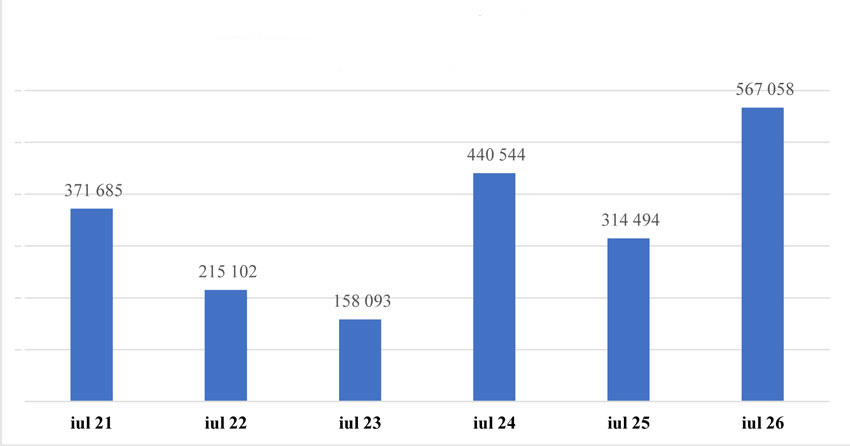
As a result, wheat exports in July exceeded the aforementioned 567 million lei in financial terms—the highest figure for July in six years.
Value of wheat exports from Moldova by season, in mln. lei
Logistics Did Not Let Us Down
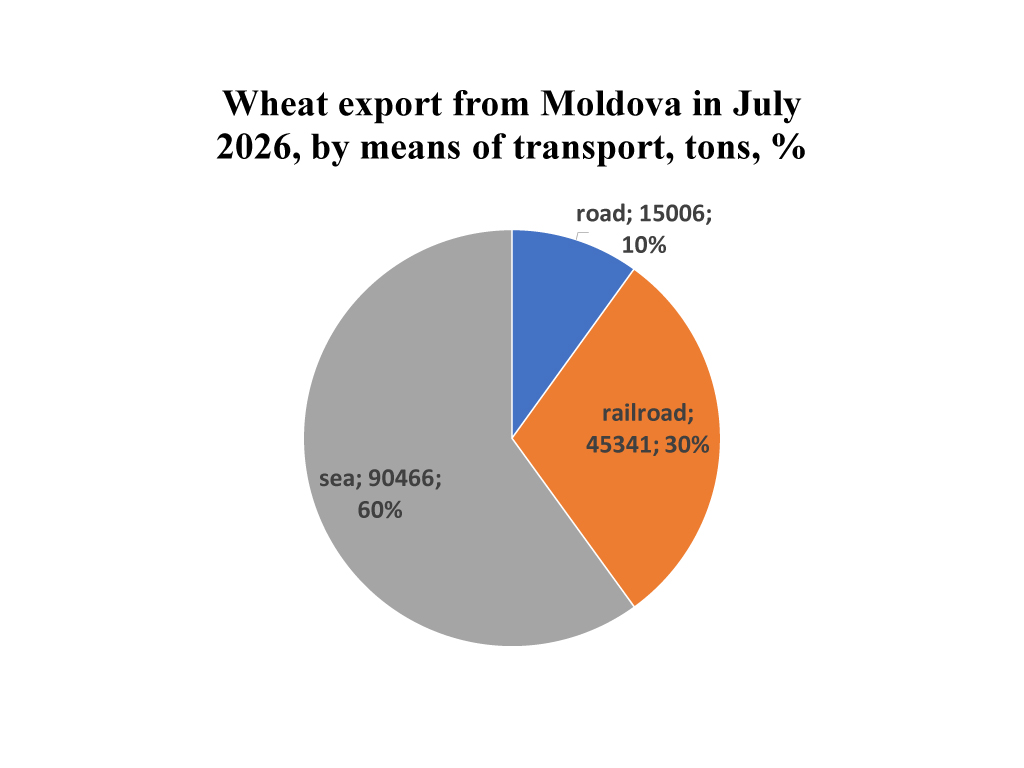
“In July, water, rail, and road transport all functioned quite well in Moldova,” notes agromarketing expert Yuri Riza. “More than 90,000 metric tons were exported from Moldova via waterways, more than 45,000 metric tons via rail, and only about 15,000 metric tons via road. It’s important to note that these figures refer specifically to locally produced wheat.” Wheat imports into the Moldovan market in July totaled just 52 metric tons. The export breakdown shows that traders clearly preferred the cheapest modes of transport and the simplest routes in July.”
Market Leaders
Although more than two dozen companies exported wheat from Moldova in July 2026, the vanguard of the exporter pool was formed by the traditional top three: RUSAGRO-PRIM SRL (over 46,000 metric tons, more than 30% of total exports), OROM-IMEXPO SRL (over 30,000 metric tons, 20%), AGRO-NOVA PRIM SRL (over 21,000 metric tons, 14%). This trio accounted for 64.8% of all Moldovan wheat exports last month.
Wheat Exporters from the Republic of Moldova for July 2026
|
No. |
Company |
Quantity, t |
| 1 | “RUSAGRO-PRIM” SRL |
46,130 |
| 2 | “OROM-IMEXPO” SRL |
30,340 |
| 3 | “AGRO-NOVA PRIM” SRL |
21,276 |
| 4 | S.R.L. “GBA TRADE” |
15,889 |
| 5 | SRL “TERRASEM-GRUP” |
6,600 |
| 6 | SRL “M.L.EXIMTRANS” |
4,937 |
| 7 | S.R.L. “CARVIDON-TRADE” |
4,401 |
| 8 | “AVVATERRA-SM” S.R.L. |
2,979 |
| 9 | SC “TREI V GRUP” SRL |
2,944 |
| 10 | SRL “TRANSAGROLUX” |
2,753 |
| 11 | SRL “VADALEX GRAINS” |
2,494 |
| 12 | “ROSTAN” SRL |
2,491 |
| 13 | “ECOTRANSIVI” S.R.L. |
1,709 |
| 14 | SRL “ANCOM-AGRO” |
998 |
| 15 | SRL “GRAINS PARK” |
907 |
| 16 | “MIDAGROTRANS” SRL |
647 |
| 17 | SRL “AGROMASTER PRIM” |
637 |
| 18 | “OILAGRO” S.R.L. |
578 |
| 19 | SRL “BIOAGROLEND” |
445 |
| 20 | FPC “GRAP” SRL |
439 |
| Other companies |
1,218 |
|
| TOTAL |
150,813 |
|
Potential Problem
The issue is that starting in the second half of August of this year, during a certain (presumably the “peak”) period of the 2026/27 marketing season, part of Moldova’s transport logistics capacity will be redirected to the transit of Ukrainian agricultural raw materials to Romania. This will obviously reduce and slow down the export traffic of Moldovan wheat and other agricultural products.
Furthermore, it can be assumed that the opening of a major supply channel for Ukrainian wheat through Romanian ports will put downward pressure on prices for grain from the Black Sea region in its buyer markets. This is especially true if Ukrainian exporters receive logistics services from competitors in Romania and the Republic of Moldova at a significant discount.
Follow our updates