Illustration: Erik Carter
This trend has been driven not only by technological changes but also by geopolitics, notes *The Economist*. Following the imposition of sanctions against Russia, restrictions on Iran, and increased financial pressure on China, many countries have begun to view national payment systems as a component of economic security.
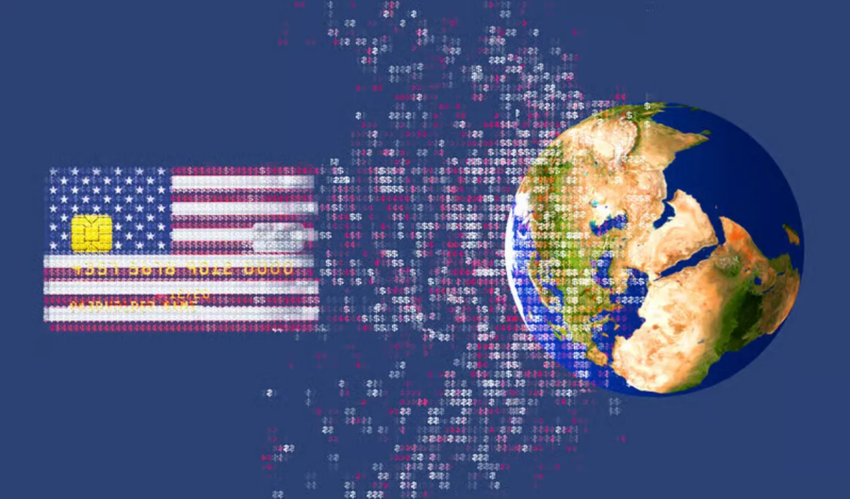
And this is becoming a new geopolitical reality, the publication writes. “While the United States is pursuing a course that Treasury Secretary Scott Bessent recently described as ‘the economic strategy of the 21st century,’ — a policy under which access to the dollar and the U.S. economy ‘is no longer unconditional’ — other countries are responding in kind. As a result, the global financial system is breaking down into regional and national segments. The process begins with payment systems and poses serious challenges for Visa and Mastercard,” states the article in The Economist.
It is not only Iran, Russia, China, and other countries “unfriendly” to the U.S. that are concerned.
In January 2026, Aurore Lalucq, chair of the European Parliament’s Committee on Economic and Monetary Affairs, warned that a hostile U.S. could cut off Europe’s access to payment infrastructure at any moment.
“No one should say later that you weren’t warned,” the British publication quoted her as saying.
A few weeks later, a meeting of British bank executives reportedly took place in London to discuss the creation of a British counterpart to Visa and Mastercard. “It is important for all of us that digital payments remain under our control,” European Central Bank President Christine Lagarde said in a radio interview earlier this year.
Major Competitors
Visa and Mastercard already face significant competition in the payments market. Their market shares are distributed roughly as follows:
| Payment System | Country | Estimated Share of Global Card Transactions* | Main Market |
| Visa | United States | ≈39% | More than 200 countries |
| Mastercard | United States | ≈24% | Over 210 countries |
| UnionPay | China | ≈32–34% | China, Asia, Africa, Middle East |
| JCB | Japan | <2% | Japan, Southeast Asia |
| American Express | United States | <2% | United States, premium segment |
| Discover / Diners Club | U.S. | <1% | North America |
* Based on the number of card transactions processed. The figures are estimates and are based on data from the Nilson Report, industry statistics, and payment system reports, as there is no single global calculation methodology.
China has already created a full-fledged alternative
UnionPay is currently considered the main competitor to Western payment systems.
While UnionPay cards were initially accepted almost exclusively within China, today the acceptance network spans more than 180 countries. In many countries across Asia, Africa, and the Middle East, UnionPay cards are already accepted on virtually the same footing as Visa and Mastercard.
The system’s development is driven by China’s government policy aimed at reducing dependence on the U.S. financial infrastructure.
The Revolution in Payment Ecosystems
At the same time, experts are increasingly noting that the market no longer depends solely on traditional card payment systems. Competition is shifting toward digital payment ecosystems that operate entirely without traditional card networks.
For those looking for ways to diversify payment routes, there are several options.
The first is to create their own national systems. For example, several European projects that had been in the early stages for many years are now gaining momentum.
The Single Euro Payments Area (SEPA) now encompasses 41 countries. A coalition of European banks and fintech companies has backed the Wero project. This is a digital wallet system designed to integrate national instant payment systems, including the Dutch iDeal platform. The European Central Bank also plans to launch the digital euro by 2029.
The major players are:
| Platform | Country | Feature |
| Alipay | China | Over a billion users, QR payments, and a financial ecosystem |
| WeChat Pay | China | Payment integration with the country’s largest messaging app |
| Pix | Brazil | A government-run instant payment system that has already become the primary method for domestic transfers |
| UPI | India | A national instant payment infrastructure that processes billions of transactions every month |
| Apple Pay | United States | A digital wallet built on top of Visa and Mastercard |
| Google Pay | United States | A similar digital wallet model |
Another global trend is the development of digital currencies and the involvement of central banks in many countries in this process (CBDC—Central Bank Digital Currency).
China has been testing the digital yuan for several years. Dozens of central banks, including the European Central Bank, are implementing pilot projects for digital currencies.
If such systems become widely adopted, some domestic payments could be processed without the involvement of international card networks.
How will this affect the markets?
Visa and Mastercard are unlikely to lose their leadership positions in the coming years. However, their monopoly is gradually being eroded from several fronts at once:
– national card systems;
– government instant payment systems;
– digital wallets;
– central bank digital currencies;
– regional payment platforms.
That is precisely why the discussion is increasingly shifting away from replacing Visa or Mastercard with a single new system and toward a transition to a multipolar global payment infrastructure, where the dominance of American companies will no longer be so absolute.
How this will affect the U.S. economy and the dominance of the dollar is another matter entirely.
Follow our updates
Have information for the newsroom? Share it with Logos-Press