

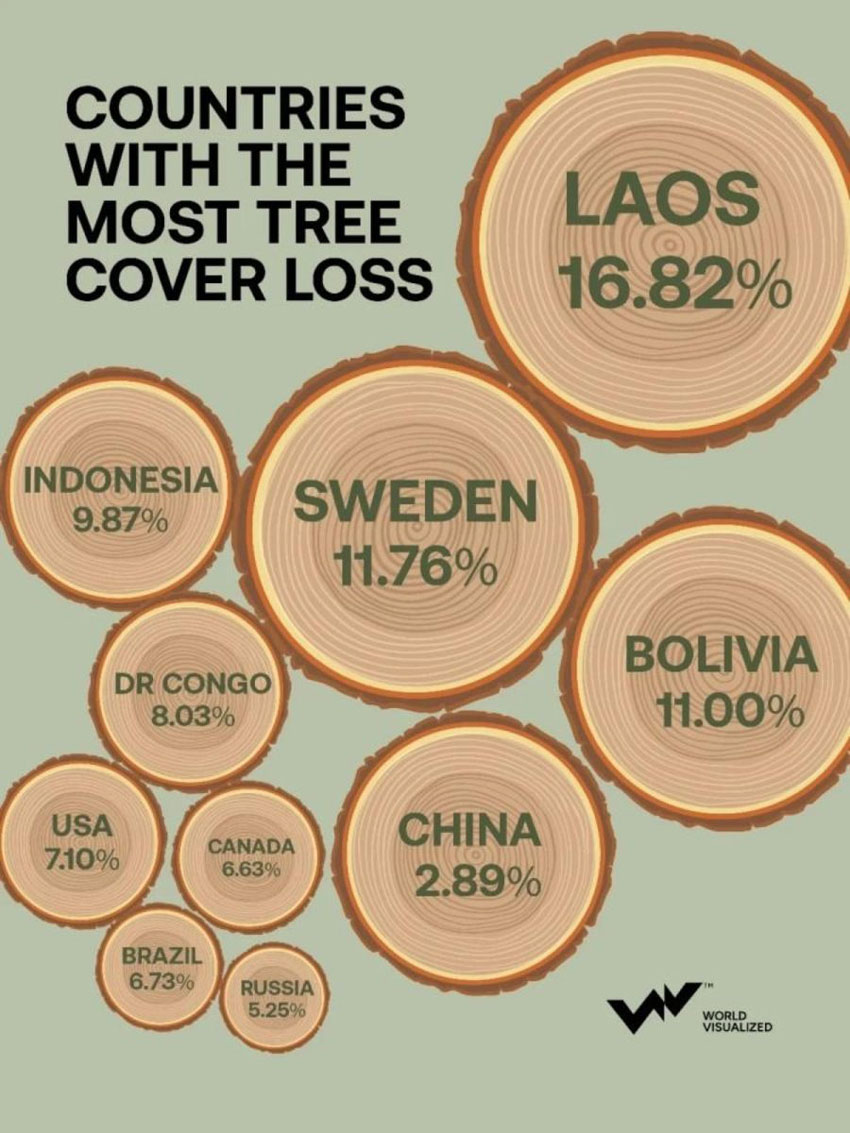
As of early 2026, Laos ranks first in the world in terms of forest cover loss over the previous year, having lost 16.82% of its forests. It is followed by Sweden (11.76%) and Bolivia (11%). Other major contributors to global deforestation include Indonesia, the Democratic Republic of the Congo, Brazil, the United States, Canada, Russia, and China. Collectively, these countries account for a significant share of global forest loss, and the consequences extend far beyond their national borders.
According to Market vs Media, Russia has lost more than 4.2 million hectares of its forest cover, and Brazil has lost over 3.3 million hectares. Every year, about 10 million hectares of forest disappear worldwide, with 96% of these losses occurring in tropical regions—areas with the highest levels of biodiversity and the most critical carbon reserves. However, not all of these losses are irreversible: some are linked to seasonal logging and wildfires. Wildfires alone caused the loss of 6.7 million hectares in 2024, nearly double the figure from the previous year.
The global trend of deforestation is a cause for serious concern. Since the early 2000s, the scale of forest cover loss has nearly doubled: from 13.4 million hectares in 2001 to 29.6 million hectares in 2024. In total, the planet has already lost more than 517 million hectares of forest cover—about 13% of its total area at the turn of the millennium.
Why are forests disappearing?
The causes of deforestation vary greatly depending on the region of the world. The rapid decline of forests in Laos is linked to the expansion of agricultural land and mineral extraction. In Sweden, the high rate is primarily due to industrial logging: a significant portion of the felled forests is subsequently restored, but the process itself still seriously disrupts the carbon balance of ecosystems.
The situation in Bolivia is particularly alarming. While Brazil has managed to reduce the rate of deforestation in the Amazon by 36% thanks to stricter controls, deforestation in Bolivia continues to accelerate due to the expansion of soybean plantations and more frequent forest fires.
The economic consequences of deforestation are also becoming increasingly evident. Forest loss threatens commodity markets linked to the production of palm oil, beef, and soy, and is attracting increasing attention from investors who are redirecting capital toward funds.
Carbon credit markets are gaining popularity, but without stronger incentives for countries with large forest resources, such as the Democratic Republic of the Congo and Laos, irreversible forest loss could accelerate, jeopardizing the achievement of global climate goals.


