

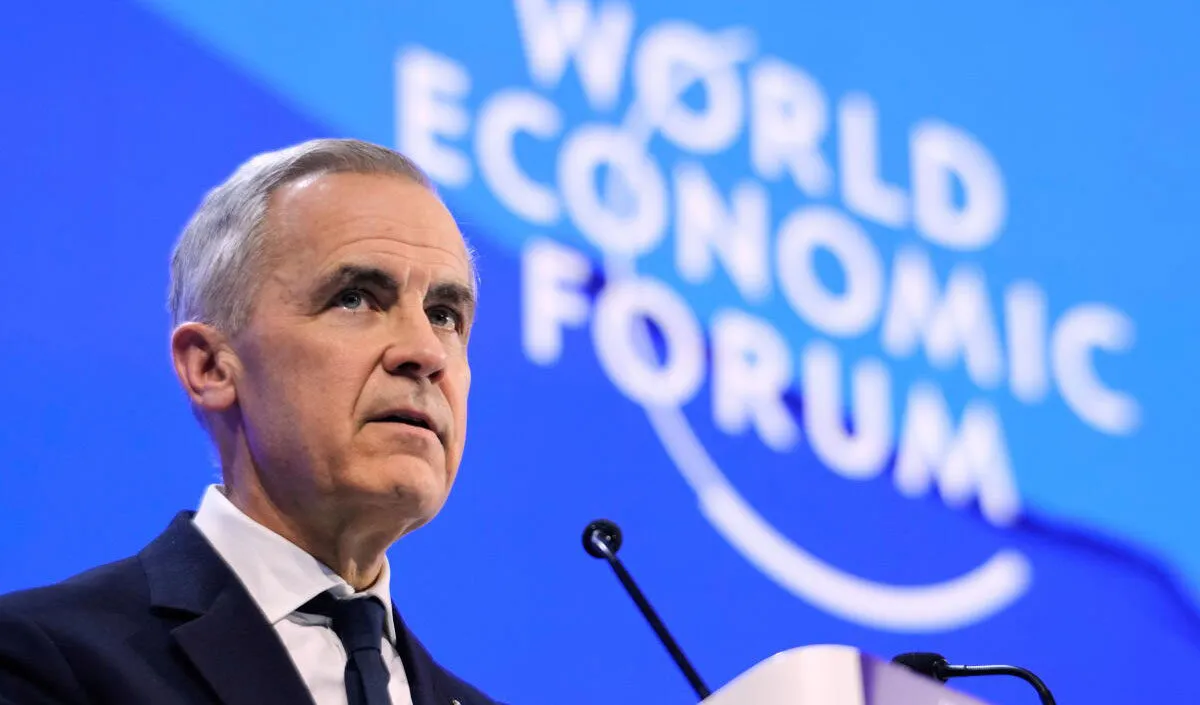
Mark Carney (Markus Schreiber / Accociated Press)
But when it came to defining this path, Carney’s speech outlined two projects of very different scope.
The first involves pursuing the relatively limited goal of enabling the world’s middle powers to resist bullying by its great powers. The second, more far-reaching project would have them work together to build an improved international order in which rules-based multilateralism still plays a meaningful role.
Middle powers have made significant progress on the first, more self-interested project, helping each other bolster critical capabilities and collaborating to reduce risky dependencies. For democratic countries like Canada, Carney suggested, this may often require working through issue-specific coalitions of the willing, including with partners that might not share “all of our values.”
Even governments that have long favored close cooperation with fellow democracies have eagerly invested in more pragmatic alliances. France, for example, has struck a deal with the United Arab Emirates to deepen AI cooperation. The European Union, for its part, has forged raw-materials partnerships with Kazakhstan and South Africa and signed 12 new bilateral security and defense agreements, including with Norway and Moldova.
Multilateralism and fairness are not gaining support
But while middle-power governments have quickly tried to insulate themselves from the whims and diktats of the great powers, they have made little headway on Carney’s call to “build something bigger, better, stronger, more just.” And beyond the West, his vision of a middle-power-led international order has so far found few takers. Many leaders in the Global South are instead focused on forging partnerships that would allow their countries to navigate the chaos unleashed by the breakdown of the existing multilateral order.
Western leaders, too, have been reluctant to act on Carney’s vision. Despite their lofty promises to defend multilateralism and the rules-based order, European leaders have largely been silent on US President Donald Trump’s repeated violations of international law. Rather than closing the massive funding gaps facing multilateral organizations and development programs, European governments have followed the Trump administration’s lead and slashed their foreign-aid budgets.
Nor do voters seem particularly enthused. In nine of the 11 middle-power countries surveyed in July for the Munich Security Conference—Brazil, Germany, France, Italy, Indonesia, Japan, South Africa, Turkey, and the United Kingdom—fewer than half of respondents expected their governments to do more to tackle global challenges like climate change and humanitarian emergencies. Only in Canada and India did most respondents expect more activism in these fields from their governments.
Many observers hope that this inertia will prove temporary and that, once middle powers have shored up their defenses, they will turn to rebuilding the international order. But governments overly focused on strengthening their own capabilities may end up emboldening the very actors whose behavior prompted these efforts in the first place. Many governments, for example, see buying American weapons as the easiest way to bolster their militaries, thereby reinforcing US leverage.
‘Strategic silence’ is becoming the norm
There are other risks as well. Regime-blind cooperation could quickly lead to strategic silence. As more countries adopt “pragmatism,” turning a blind eye to partners’ violations of human rights and international law may become the new normal. Tellingly, in March, German Chancellor Friedrich Merz responded to the US and Israeli attacks on Iran by saying, “This is not the moment to lecture our allies.”
Moreover, the growing reliance on issue-specific coalitions of the willing risks accelerating the international order’s fragmentation. Just as global challenges, from economic growth and climate change to security and migration, are becoming harder to disentangle, governments are retreating into issue-specific silos. As multilateralism gives way to a patchwork of separate initiatives and ad-hoc clubs, contradictions and tensions are bound to grow. Cooperation in self-empowered clubs will also fail to generate inclusive outcomes, fueling the same grievances that discredited the old order.
Lastly, an overly narrow focus on strengthening individual countries’ relative power could entrench a zero-sum view of geopolitics. Governments may conclude that, to compete effectively, they, too, need to bend international rules and norms. And as this relative-gains approach takes hold, middle powers may become less willing to give up sovereignty in pursuit of common goals.
Those leaders who embrace Carney’s vision as the only viable way forward for their countries cannot afford to wait until they have secured their own positions to draw up a blueprint for the international order they want to build. They need to start now, ensuring that the roads they build today can eventually converge into Carney’s “third path.”

Sophie Eisentraut
is Head of Research and Publications at the Munich Security Conference.
© Project Syndicate, 2026.
www.project-syndicate.org
Follow our updates
Have information for the newsroom? Share it with Logos-Press











Comments
0No comments yet. You can start the conversation.
Comments are open to readers with a Logos Press account.
Sign in to comment