

Natalia Pugaru
The new mechanism will be part of the national program of employment and combating informal employment for 2027-2030. As part of the reform, it is planned to digitalize the processes in the National Employment Agency to simplify interaction with employers and reduce bureaucracy. The system will be integrated with European platforms. This was said at the Chamber of Commerce and Industry within a discussion on the competitiveness of Moldovan companies in the current labor market conditions.
“Many entrepreneurs and employers complain about the difficulties in interacting with the agency: too much paperwork, bureaucracy – you have to explain why you did not hire a person, why you accepted and so on. We want to simplify these procedures as much as possible and completely digitalize the interaction between the agency and business,” said Natalia Pugaru, Minister of Labor and Social Protection.
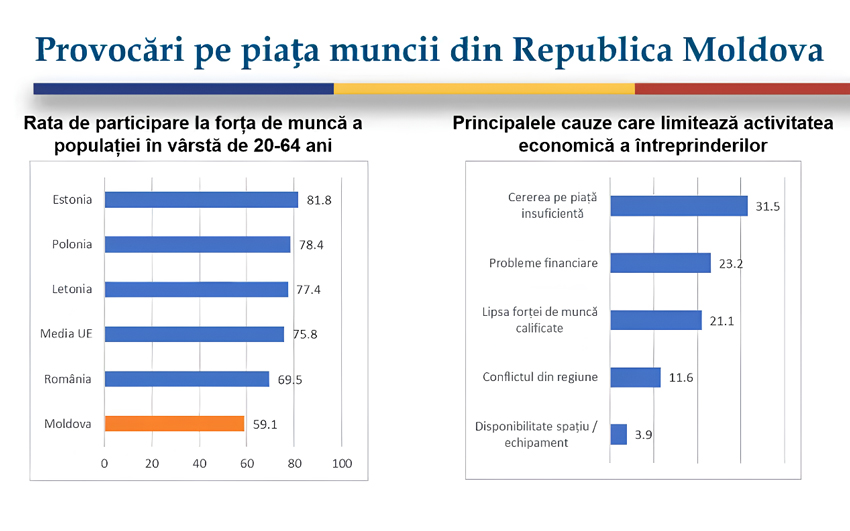
The program also provides for increasing the employment rate of the population to the European level of 70%. Now the level of participation of the population aged 20-64 in the labor market in Moldova is about 59%. For comparison, in the EU this indicator is about 75%, in Romania – about 60%, and in the Baltic States – even higher: in Estonia – about 80%, in Lithuania – 77%.
Wage changes in the Republic of Moldova
“The question arises: what the other 40% of people of working age are doing. On the one hand there is low employment, on the other hand there is a shortage of human resources. It is this imbalance that is our main concern. If the employment rate were high, then we could talk about importing labor. But now it is important to understand: how to activate the very 40% of the population? Where are these people? Why are they not working? What is their skill level? These are the questions we are looking for answers to,” Plougarou said.
From the good news, the level of informal employment has decreased from 23% in 2023, 20% in 2024 to 17% in 2025.


