



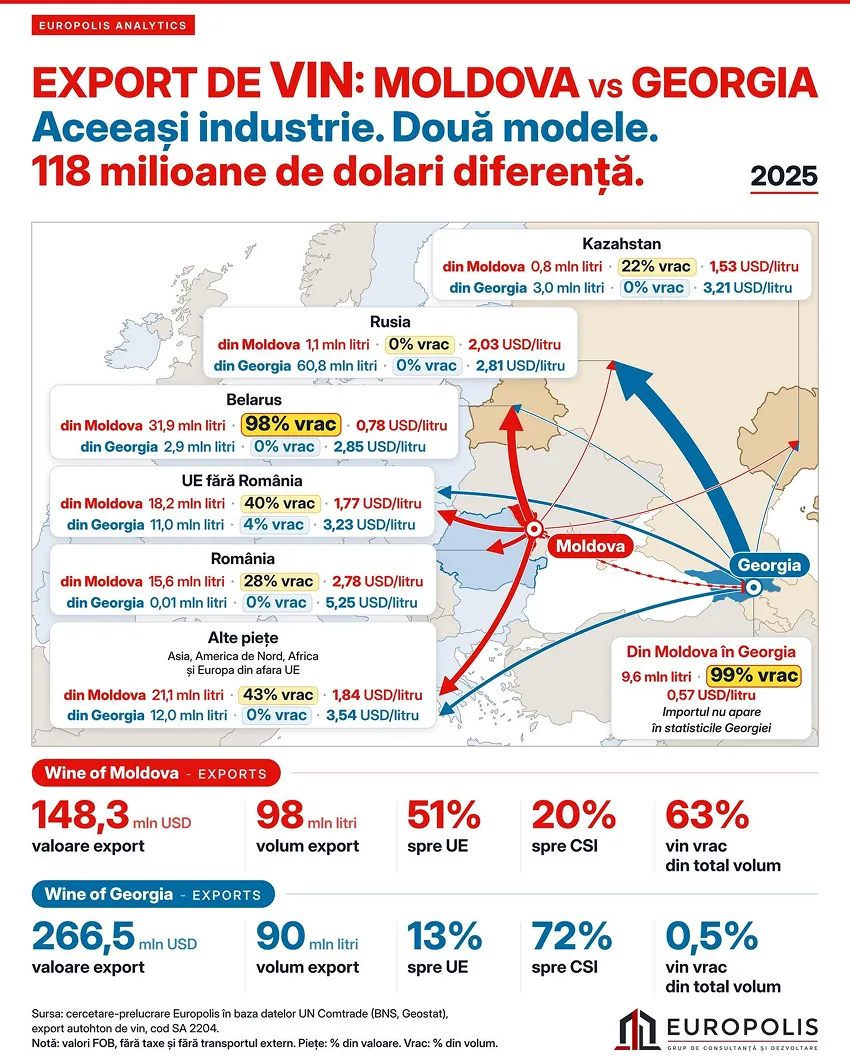
These figures are cited by Gennady Ivashchenko, founder and chief consultant of the consultancy firm Europolis, in his social media post. He emphasises that a difference of almost $120 million in a single year, despite higher export volumes, requires explanation.
“It’s tempting to think that Georgian wine is sold at a much higher price. But the figures tell a more interesting story,” the expert stresses. And he provides specific figures.
Over the past eight years, Moldova has narrowed a significant portion of the price gap for bottled wine: from 60 per cent to 93 per cent of the Georgian price. However, the average is skewed upwards by Romania, which buys our bottled wines for $3.5 per litre. In the rest of the European Union, Moldovan wines are sold at a price amounting to 72 per cent of the Georgian price per bottle.
The main reason for the price gap, as the data shows, lies in the sale of wine in bulk. For Moldovan produce, this accounts for 63 per cent, whilst for Georgia it is less than 1 per cent, the author notes.
To Belarus alone, we export nearly 32 million litres, predominantly in bulk, at a price of less than a dollar per litre. Some of the wine is bottled there under other brands.
A historical explanation for the different business models
Gennady Ivashchenko emphasises that the two wine-producing countries of the post-Soviet space, Moldova and Georgia, were equally dependent on the Russian market. However, they have taken different paths and developed different business models for promoting their wine products.
In 2006, Russia imposed a devastating embargo on Moldovan and Georgian wines. In 2013, Georgia returned to the Russian market. Moldova faced a second embargo.
“We had to forge links with other markets. In 2017, the EU accounted for 32 per cent of the value of Moldovan wine exports. Today, that figure stands at 51 per cent,” notes the expert.
At the same time, Georgia still derives almost two-thirds of its revenue from the Russian market. This is a significant commercial advantage, but it also entails a corresponding dependence. “We know from our own experience how costly a single ‘geopolitical decision’ by Rospotrebnadzor can be,” states the author of the post.
He also notes that Moldova has managed to diversify its markets and recover thanks to pricing. However, the transformation of the export model is still far from complete.
“Bulk exports are a legitimate business. Not every litre needs to be bottled. The question is where we can derive the greatest benefit: through our own brands, competitive bottling and direct access to distribution,” writes Ivashchenko. “Today, we essentially have two wine economies within a single country: one that creates international brands, and the other that supplies wine for other people’s brands. And the strategic question is not who produces the best wine, but who will be bottling Moldovan wine in 10 years’ time – us, or our buyers?”
Follow our updates
Have information for the newsroom? Share it with Logos-Press





















Comments
0No comments yet. You can start the conversation.
Comments are open to readers with a Logos Press account.
Sign in to comment