

Presumably, to boost its chances of active and profitable trade, the “Moldova Fruct” Association published an optimistic article on the reputable industry portal Freshplaza. Its main points can be summarized as follows for potential buyers.
First, the challenging weather conditions of spring and early summer “affected early varieties, but…the outlook for mid-season and late varieties is much better,” and these varieties constitute the main export resource for Moldova’s sweet cherry segment. Farmers and traders have the highest expectations for late-season varieties (“Kordia,” “Regina”). Producers report having “fruit of uniform quality, high density, and large size—with a diameter of more than 28 mm.”
Second, the delay of several weeks in the harvest and the start of sales of the main export varieties “may create a favorable window for selling Moldovan produce at a time when the cherry season in Spain, Italy, and other European countries is coming to an end.” The supply of premium-quality sweet cherries to the European Union market decreases during this period, which “may sustain buyer interest in Moldovan sweet cherries.”
Third, Moldovan fruit industry operators “are investing in modern orchards and post-harvest infrastructure,” as well as in quality management: “producers hold GLOBALG.A.P., SMETA, and IFS certifications… and meet market requirements regarding size grading, traceability, product safety, and packaging.”
Fourth, there are substantial volumes of product available. “In 2025, Moldova exported 12,000 metric tons of sweet cherries. In the European Union market, the main export destinations, aside from Romania, were Latvia, Poland, the Netherlands, Italy, and Germany.” Moldova has 5,700 hectares of sweet cherry orchards and ranks among the top 15 exporters of this fruit.
In addition, it is worth noting that, as Logos Press previously reported, citing data from the Moldova Fruct association, Moldovan sweet cherry exports totaled approximately 14,000 metric tons in 2024. Of this total, 2,300 metric tons were exported to EU countries and 11,300 metric tons to CIS countries. In 2023, Moldova exported more than 16,000 metric tons of sweet cherries: 2,600 metric tons to the EU and 13,700 metric tons to CIS countries and Ukraine. In 2022, 14,200 metric tons of sweet cherries were shipped from Moldova abroad. That year saw an explosive growth in shipments of this fruit to the European Union for the first time—nearly 2,000 metric tons, 12 times more than the previous year.
There’s a “window” in the market, but the market isn’t empty
In a comment to Logos Press, Vitalie Obrezanu, head of Fresh Time SRL, noted that the sales outlook for mid- and late-season sweet cherries looks truly optimistic ahead of the start of the sales season. At the same time, the fruit business is always subject to all sorts of random factors, and this component cannot be ruled out of forecasts this year either.
In particular, the quantity and quality of the late-season harvest (generally considered “export-grade” sweet cherries) are generally good, but still vary.
According to the cited source, some self-pollinating cherry varieties produced a large number of fruits, but their diameter is smaller than desired. Moreover, the same varieties in other regions showed the opposite pattern. Apparently, much of this year’s agricultural season is determined by a combination of local factors.
Incidentally, one of the key factors is precipitation during the cherry harvest period. Over the past week or two, there has been no precipitation in many of Moldova’s “cherry-growing regions.” Consequently, there is currently no cracking (cracking of the berries)—a problem that is extremely detrimental to quality (and price)—in medium and some late-season cherry varieties. But precipitation is forecast, so anything is still possible.
Vitaly Obrezhanu also points out the important fact that, although the European market is not flooded with Italian and Spanish cherries during this period, it is not entirely empty either. There is a supply of Turkish and Greek cherries (from storage) available on the market.
In other words, the European market is selective about quality and cost-conscious. It is not worth counting on this situation changing significantly in the near future.
In particular, it is unlikely that there will be high demand for cherries of, so to speak, older varieties (such as “Krupnoplodnaya”). And judging by traders’ expectations regarding selling prices, only Germany and a few other Northern European countries will be able to afford high-quality Moldovan sweet cherries of popular European varieties. Neighboring Romania typically focuses on cheaper products.
Russia and some other CIS countries, according to the cited source, should not be ruled out just yet either. For instance, a certain amount of early Moldovan cherries was shipped to the Russian market, “but their quality was quite mediocre.”
Now, shipments of late-season, export-quality cherries from Moldova to the east will apparently depend on a number of factors: again, quality, logistical challenges, price, etc.
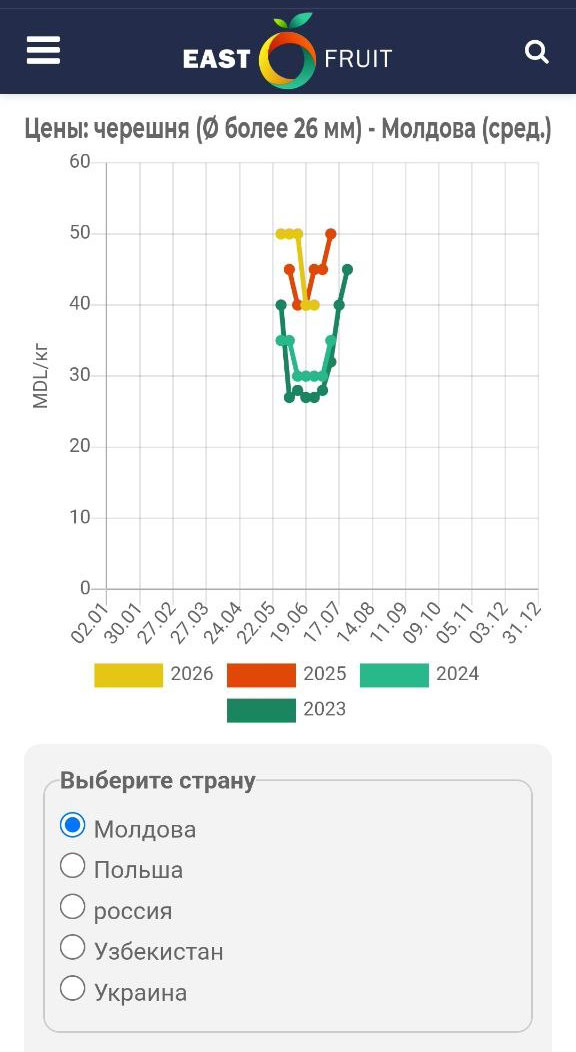
According to monitoring by the EastFruit portal, as of the end of last week, the average wholesale price for large (diameter over 26 mm) sweet cherries in Moldova was about 40 lei/kg ($2.25/kg). In other words, it was slightly more expensive than in Ukraine ($2.23/kg) and significantly cheaper than in Poland ($3.18/kg).
Interestingly, late June through early July marks the “low point of the season” for sweet cherry sales, from which prices begin to rise—as exports of mid- and late-season sweet cherries increase—and return to the price level seen at the start of the season.
Traders expect a similar market trend this season as well. They hope to see the wholesale price of export-quality cherries rise to a range of 50–60 lei/kg. However, it is not yet certain that foreign markets will be willing to absorb them at that price.
So it’s possible that some quantity of expensive but high-quality sweet cherries will end up on the local market in July—as a “niche” product alongside cheaper seasonal fruits and berries.


