


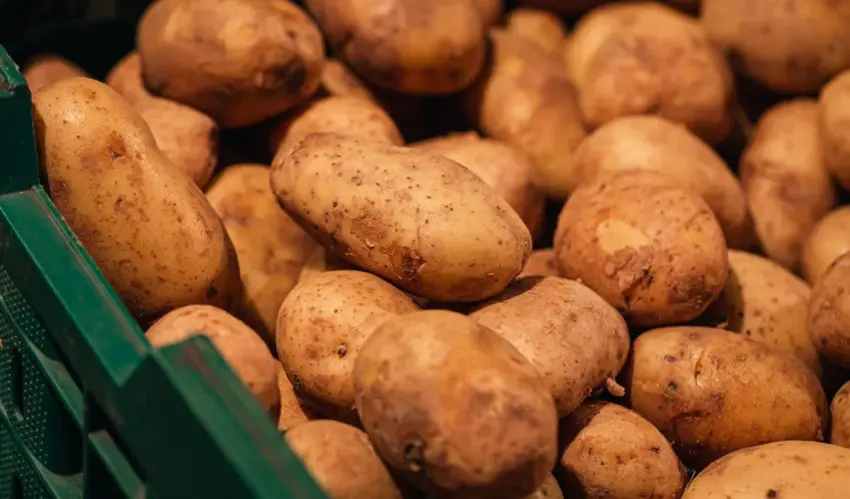
By the start of the last ten days of this month, the lower limit of the ‘psychological comfort zone’ for them was 8 lei/kg. However, wholesale buyers were only willing to pay this price to farmers in isolated cases – for the highest-quality potatoes intended for washing, packaging and sale through supermarket chains.
As a result, a significant number of local potato growers held back on sales, and a slight shortage of this commodity even developed on the wholesale market.
According to Sergei Alba, an expert at Expert Agroteh, restricting sales in the hope of raising purchase prices is a risky strategy for the vast majority of Moldovan potato growers.
On the one hand, the rationale behind it is clear: this year in Moldova, both the area under cultivation and the yield of this crop have fallen. Potato production has declined by roughly the same margin in many European countries. In this context, a rise in potato prices by the end of this year is inevitable, as reported by Logos Press.
On the other hand, farmers’ reluctance to sell their potatoes has prompted traders and retailers to seek cheaper alternative supplies. These have been found.
In November, Moldova is actively exporting apples, including to CIS markets. Belarus serves as a key ‘entry point’ to this market from the west. In that country (and in Russia), this year’s potato harvest is good and prices are moderate. As a result, Moldovan traders have gained a logistical advantage through ‘return freight’: apples out, potatoes (and carrots) back. This has significantly reduced logistics costs, despite the rather long transport distance to Belarus.
Consequently, high-quality Belarusian potatoes are already being offered on the Moldovan market at 7–7.5 lei/kg.
In the neighbouring Ukrainian market, according to EastFruit’s monitoring, wholesale potatoes in November cost $0.06–0.07/kg less than in Moldova. However, in this case, the impact of the ‘reverse loading’ factor is virtually non-existent – Moldovan traders have little of their own agri-food produce to offer the Ukrainian market (perhaps only table grapes).
Consequently, despite the relatively short delivery distance, transport logistics for purchasing Ukrainian potatoes are quite expensive. Nevertheless, Ukrainian potatoes are also being imported into the Moldovan market, but, according to market operators, the volume is small compared to the flow of goods from Belarus.
The time factor in potato storage
Experts state that, overall, the generally low quality of Moldovan potatoes over the last two seasons (due to cost-cutting on seed potatoes and certain fertilisers) does not facilitate their long-term storage. Furthermore, Moldova clearly lacks sufficient capacity in specialised, high-tech vegetable storage facilities.
As a result, commercial stocks of locally produced potatoes are guaranteed to run out by February, and the quality of the produce deteriorates sharply. Market operators claim that it is already very difficult to find high-quality local potatoes in Moldova for washing and packing in February–March. Consequently, the hopes of most farmers to ‘make good money from potatoes’ during the colder months are, by and large, not supported by adequate agricultural or storage technologies. For local retailers, the problem is traditionally ‘solved by imports’ – perhaps slightly more expensive, but of higher quality.
In this context, according to Sergey Alba, a sensible marketing strategy for potato (and root vegetable) producers would likely be to focus on the most active sales during the autumn period – even at the comparatively low prices prevailing at that time. Attempting to delay sales in the hope of a winter-spring rise in prices carries significant risks: spoilage and losses of produce during storage, a reduction in consumers’ purchasing power (a perennial problem in many Eastern European countries) and heavy imports (not always at predictably high prices).
Follow our updates
Have information for the newsroom? Share it with Logos-Press























Comments
0No comments yet. You can start the conversation.
Comments are open to readers with a Logos Press account.
Sign in to comment