

flickr.com
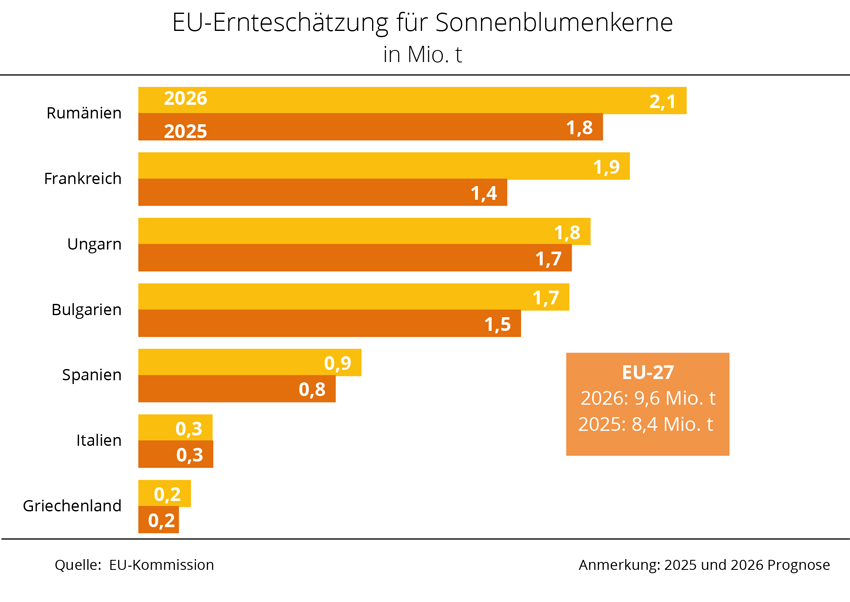
The growth of European sunflower production will be provided mainly by three countries – Romania, France and Bulgaria, ufop writes with reference to the forecast of the European Commission.
Romania will strengthen its position as the leader of “sunflower fields” in the European Union
It is expected that the crop-2026 in this country will amount to 2.1 million tons – this is about 18% more than the figure for 2025. The projected increase in production will largely ensure the expansion of planted areas – up to 1.2 million hectares.
According to a study by the Agricultural Market Information Company (mbH), a significant increase in sunflower yields is also expected in other EU countries in Southern and Southeastern Europe. First of all, in addition to Romania, we are talking about Hungary, Bulgaria, Spain and Greece.
The rest of Europe will also increase sunflower crops
France, which is the second largest producer in the EU, is expected to increase sunflower production to 1.9 million tons. Incidentally, this is the largest increase in the potential yield of this crop in the EU – plus 33%.
The European Commission forecasts sunflower production in Germany at the level of 175 thousand tons (plus 32 thousand tons to the figure for 2025). This is a new record for the country. The area under sunflower cultivation in Germany is expected to reach 77 thousand hectares (62 thousand hectares last year).
Compared to the major sunflower seed producers, Germany continues to play a relatively minor role in the EU. However, the repeated increase in the crop forecast reflects the growing interest of farmers in diversifying their crop rotations, especially to include an additional summer crop.
How will the expansion of the raw material base of the EU oilseed complex affect Moldova’s agribusiness?
Firstly, the increase in sown areas by 5%, according to the idea of the European Commission analysts, promises to be transformed into a 12.5% increase in the 2026 sunflower harvest.
At first glance – this is enviable optimism in the context of the energy crisis, which directly affects the provision of European agriculture with productive resources (this is partly the level of – agro-technologies). In the context of potential drought, as well as other possible weather anomalies, the forecast of a significant increase in the sunflower harvest, in general, looks doubtful. Especially since it is based on a significant increase in production in Romania and Bulgaria, countries with vulnerable agriculture in the context of climatic transformation.
It can be assumed that the expansion of sunflower acreage in the countries of Central and South-Eastern Europe is a reaction to the sum of factors: to the global energy crisis, to the “pesticide” failure in the supply of oilseed raw materials to the industry in Bulgaria and Romania (and indirectly – and Turkey) within the framework of the EU-MERCOSUR agreement. But this is not yet a guarantee of a deficit-free sunflower season for the EU and some countries of the Black Sea region. Consequently, it is not an indicator of a potential decrease in demand for this raw material, including from Moldova.
Secondly, the forecast of increase of sown areas and potential harvest in the European Union – and especially in Romania and Bulgaria, which are among the TOP-3 countries-buyers of Moldovan sunflower – is, nevertheless, at least until mid-autumn of this year, a factor of constant, to a greater or lesser extent, but pressure on the level of regional prices for sunflower.
Nevertheless, the forecast of significant increase of sunflower harvest in the EU is unlikely to significantly adjust the plans for its sowing in Moldova this spring. For medium and large agricultural producers in our country sunflower is spring crop No. 1 in terms of profitability and, accordingly, the scale of cultivation. And they will definitely find resources for its production.
Last year, according to expert estimates, the area of sunflower sowing in Moldova fluctuated in the range of 414-420 thousand hectares. This is slightly less than in previous seasons (the maximum was recorded in 2022 – 440 thousand hectares). It can be assumed that for the harvest-2026 the area of sunflower sowing in Moldova is unlikely to significantly reduce.


