


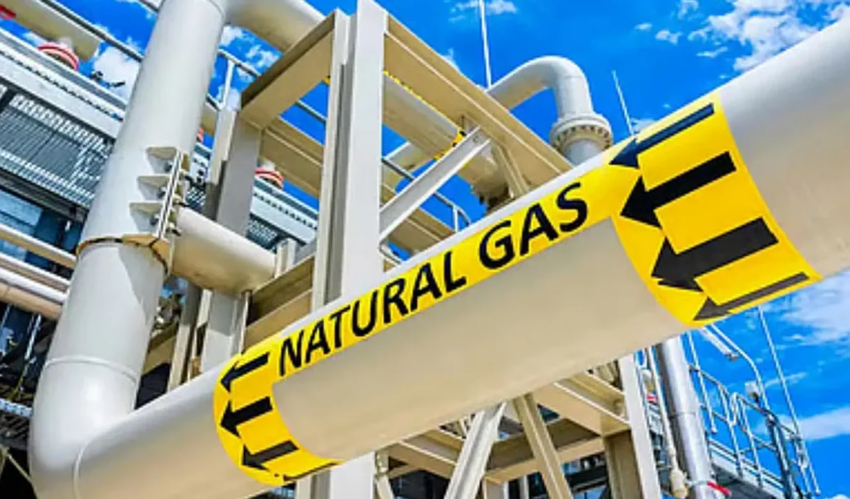
This is stated in a new Atlantic Council study entitled ‘A New Vision for the “Vertical Corridor”: Europe’s Energy Security through Infrastructure Optimisation’.
“The Vertical Corridor is a network of interconnected existing and planned gas infrastructure facilities stretching across south-eastern and eastern Europe,” the report’s authors note.
It strategically links traditional transit gas pipelines, national transmission systems, new cross-border connections, LNG import infrastructure and access to storage facilities, providing multiple routes for gas transport between Greece, Bulgaria, Romania, Moldova, Ukraine, Slovakia, Hungary, Serbia and North Macedonia.
Its main objective is to create a more flexible and redundant regional system capable of transporting gas in multiple directions, in order to reduce dependence on a single supplier, a single route or a single flow pattern, as well as to strengthen security and resilience to disruptions.
The authors point out that once gases have been mixed in the pipelines, it is no longer possible to trace the physical origin of the molecules, even if the trading documents specify a US or Azerbaijani supplier. This means that the European ban on Russian gas imports, due to come into force in 2027, loses its practical significance:
Where does Russian gas come from?
“There is a fundamental contradiction in the concept of the Vertical Corridor, as it is positioned as a measure to reduce the region’s dependence on Russian gas, yet it continues to facilitate the transport of Russian supplies.
Firstly, significant volumes of Russian gas continue to flow openly into South-Eastern Europe via the TurkStream and BalkanStream pipelines. Although this Russian gas formally transits through Bulgaria to other markets, within the interconnected network it is mixed with gas from other sources. Depending on the direction of the flows and the system’s operating mode, molecules of Russian gas may also be transported northwards via Romania, Moldova and Ukraine. Even if the gas heading north is procured as American LNG or Azerbaijani gas, the physical origin of individual molecules cannot be traced once the supplies have been blended. Therefore, the procurement of non-Russian gas does not mean that only non-Russian gas is transported via the pipelines.
Another issue is determining the origin of gas sold via Turkey and entering through the separate ‘Strandzha 1 – Malkochlar’ border crossing point. Turkey imports Russian gas alongside Azerbaijani gas and LNG from several countries, and its transit system also allows these supplies to be blended. It then re-exports this gas to Bulgaria, where contracts and documentation may indicate or even reliably confirm the commercial origin of the supply, but they do not allow individual molecules to be distinguished or guarantee that Russian gas is not being supplied alongside other supplies. “This means that Russian gas continues to reach European markets via intermediaries even after direct purchases have gradually ceased,” the study states.
The recommendations state: “Russian gas must be excluded from the energy supply structure within the Vertical Corridor — in accordance with European requirements stipulating the cessation of imports of Russian liquefied natural gas (LNG) by 1 January 2027, and of Russian pipeline gas by 1 November 2027 at the latest. This must be accompanied by thorough verification of the gas’s origin and the application of ‘know your customer’ (KYC) procedures to ensure that Russian gas imported by non-EU countries cannot enter the European Union under the guise of coming from another source.”
Follow our updates
Have information for the newsroom? Share it with Logos-Press















Comments
0No comments yet. You can start the conversation.
Comments are open to readers with a Logos Press account.
Sign in to comment