

Unions Oppose Shifting the Tax Burden…
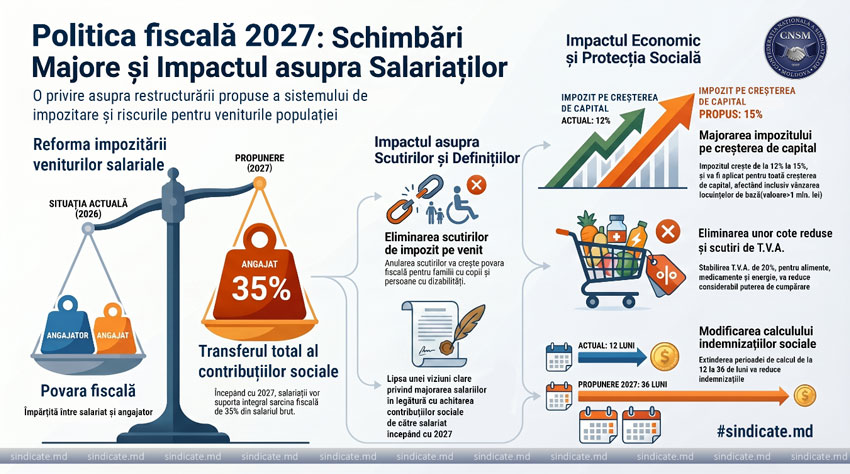
One of the main amendments concerns the complete shift, starting in 2027, of the obligation to pay state social insurance contributions from the employer to the employee. According to CNSM calculations, employees will pay 35% of their gross salary in taxes and contributions, compared to the current rate of 35.4% paid collectively by employers and employees. Unions point out that this change will not automatically lead to a reduction in the tax burden on employees and may cause confusion regarding its actual impact on take-home pay.
The CNSM opposes the elimination of income tax exemptions, noting that this measure will reduce employees’ net income. At the same time, they note that the labor incentive mechanism proposed by the Ministry of Finance — up to 500 lei per employee and up to 200 lei per child — is not sufficiently clear regarding the procedure for granting it and does not offer guarantees to compensate employees for any losses incurred.
Against the risks associated with salary recalculations…
According to the unions, the provisions regarding salary adjustments effective January 1, 2027, require further clarification. Currently, the draft law requires employers to maintain employees’ net wages at the level existing prior to the reform’s entry into force. However, it is unclear what social contribution rate will be used to recalculate gross wages, given that the legislation provides for different rates, including 24% and 18% for certain categories of employers.
Examples analyzed by the CNSM show that an employee with two dependent children and a minimum wage of 6,300 lei could see their net income decrease from 5,540 lei to 5,077.8 lei per month, even if the employer increases the gross salary by an amount equivalent to the 24% social contribution. For an employee earning the average salary of 17,400 lei projected for the current year, the estimated loss amounts to approximately 404.5 lei per month. People with disabilities or employees who have dependents with disabilities may face even greater reductions.
In this context, the CNSM is calling for the imposition of administrative sanctions on employers who fail to adjust salaries in response to the full shift of the tax burden onto employees.
Against tax and price hikes…
The Confederation also draws attention to the proposal to increase the capital gains tax from 12% to 15%, while simultaneously imposing full taxation on capital gains even in the case of the sale of a primary residence valued at over 1 million lei. According to CNSM estimates, these changes will increase the tax burden on such transactions by approximately 2.5 times and will contribute to rising prices in the real estate market. As an alternative, the labor unions propose raising the tax threshold for primary residences from 1 million to 3 million lei.
With regard to value-added tax, the CNSM does not support the elimination of the reduced 8% rate on essential goods and the application of the standard 20% rate to them. According to the trade unions, this measure will directly affect the prices of food, medicine, natural gas, electricity and heat for residential use, agricultural products, and other essential goods.
The CNSM’s arguments are supported by official statistics showing that in 2025, the absolute poverty rate in the Republic of Moldova stood at 31.1%, while the extreme poverty rate was 15.1%. According to the trade unions, raising the VAT rate on essential goods and services will increase inflationary pressure and reduce the population’s purchasing power.
The CNSM also opposes the application of a 20% VAT rate on housing, land, and lease agreements, and warns that this measure will drive up housing costs and reduce young families’ access to the real estate market.
The Confederation also considers the increase in fuel excise taxes—particularly on diesel fuel, where the expected increase is about 20%—to be unacceptable. According to the unions, this measure will trigger a chain reaction of price increases in agriculture, transportation, and other sectors of the economy.
Opposed to cuts in social benefits…
Regarding property taxation, the CNSM calls for the preservation of tax breaks for retirees and other vulnerable groups. The unions warn that the revaluation of real estate has led to a significant increase in assessed values, and data from the National Social Insurance Fund show that as of January 1, 2026, approximately 40% of old-age pensioners received pensions below 3,055 lei, while 42% receive less than 4,000 lei per month. Under these circumstances, an increase in property tax could become an unbearable burden for many older adults.
The CNSM also rejects the proposed amendments to the Law on Temporary Disability Benefits and Other Social Insurance Benefits. The Confederation does not support extending the calculation period for benefits from 12 to 36 months, believing that this contradicts the principle of proportionality and will lead to a reduction in benefits provided to individuals in situations of social risk.
Furthermore, the unions do not support changing the calculation basis from 35% of the projected average monthly wage to 35% of the minimum wage, as this change significantly reduces the amount of benefits provided to individuals in extremely vulnerable situations, including those with tuberculosis, HIV/AIDS, and cancer who lack the required length of service, thereby increasing their risk of poverty and undermining their right to effective social protection.
…and call for continued dialogue
According to CNSM Chairman Igor Zubka, increases in taxes and fees will have a detrimental effect on purchasing power and will lead to deeper poverty, rising inflation, and a decline in domestic consumption. At the same time, he believes that this will affect economic development and reduce the competitiveness of domestic economic actors, “despite the bill’s stated goal of promoting a sustainable tax policy aligned with the objectives of stimulating investment and enhancing economic competitiveness.”
“We believe that a tax reform of this complexity cannot be adopted and implemented in haste, without a thorough risk assessment. It requires an extended period of public consultation and a careful analysis of its social and economic impacts. Although the bill aims to reduce the budget deficit by approximately 6 billion lei in 2027, it is unacceptable for this fiscal consolidation to be carried out solely at the expense of taxpayers, thereby jeopardizing their social well-being,” the CNSM chair emphasized.
The National Confederation of Trade Unions of Moldova calls on the authorities to continue the dialogue with social partners and identify balanced solutions that will ensure the sustainability of public finances without shifting the burden of budget consolidation onto workers, pensioners, and other vulnerable groups.


