Emily Marin, Digital Product Manager at Axxès (an IRU member), spoke to the Association of International Road Transport Operators of Moldova (AITA) about this, highlighting solutions that could make life easier for operators.
The Issue
Starting in 2026, European social regulations will require vehicles with a maximum authorized mass of more than 3.5 metric tons to collect and store digital tachograph data. This rule applies to the entire road transport sector, not just freight transport. It affects funeral services, delivery, construction, moving services, tourism, and passenger transport.
“Many small businesses still believe that this rule applies only to freight transport. That is not the case at all,” warns Emily Marin.
The deadlines are very strict: driver card data must be downloaded every 28 days, and tachograph data every 90 days. Operators must maintain a legally required archive for one year.
For many small and medium-sized businesses, this represents a real administrative burden. “They have to keep track of different deadlines for each driver and each vehicle. It’s constant psychological pressure,” she explains.
Manual data transfer is time-consuming
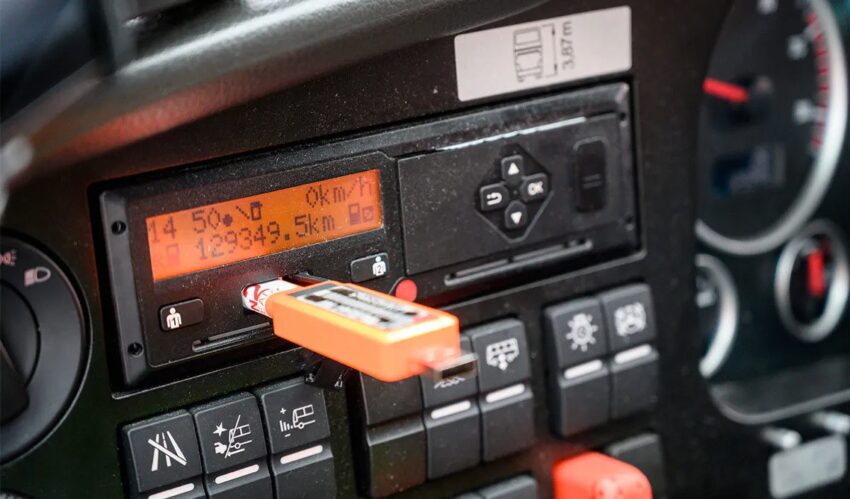
Many operators still use the manual method—downloading data via a USB drive inserted directly into the tachograph. According to Axxès customers, this process takes about 30 minutes per month per vehicle.
The process requires coordination: the vehicle must be available, the driver must come to the office with the card, and the manager must insert the card into the reader and transfer the files. “It sounds simple, but when you repeat the process for multiple vehicles and drivers, it becomes time-consuming and error-prone,” says Emily Marin. “If the USB drive is removed too quickly, the file may become corrupted, and in the event of an audit, incomplete or corrupted data may be deemed non-compliant.”
Why This Matters for Moldovan Carriers
Regulations are expanding. Starting July 1, light commercial vehicles weighing 2.5 metric tons or more that cross borders must also be equipped with a tachograph and meet the same requirements.
For many companies, this presents a new challenge. The cost of installing a tachograph can reach around 1,000 euros, and taking a vehicle out of service for installation means a loss of revenue.
A New Solution
“A remote-download solution directly connected to the tachograph can significantly simplify the situation,” says Emily Marin. “Our solution installs in about 15 minutes, with no maintenance or special technical skills required.”
Once installed, the device automatically records the vehicle’s and driver’s activities. The data is downloaded remotely and archived on servers in Europe. The operator can access everything via an online platform using a username and password—without installing any additional software.
The solution is specifically designed to help meet social compliance obligations and does not replace full-fledged telematics or fleet management systems.
This is particularly important for small operators who do not have dedicated fleet managers and prefer simple tools.
The risks of non-compliance are high: fines start at 450 euros and can easily reach 1,000–2,000 euros or more for each violation. The most common penalties are related to failing to insert the driver card into the tachograph. At the fleet level, these fines can quickly add up and even lead to the closure of some companies.
“The message is clear: don’t ignore this rule,” warns Emily Marin.
Although manual downloading can be effective when deadlines are strictly adhered to, automated solutions for remote downloading significantly reduce the administrative burden and the risk of errors.
As tachograph requirements extend to an increasing number of vehicle categories, operators need simple, secure, and efficient processes.
Follow our updates
Have information for the newsroom? Share it with Logos-Press