

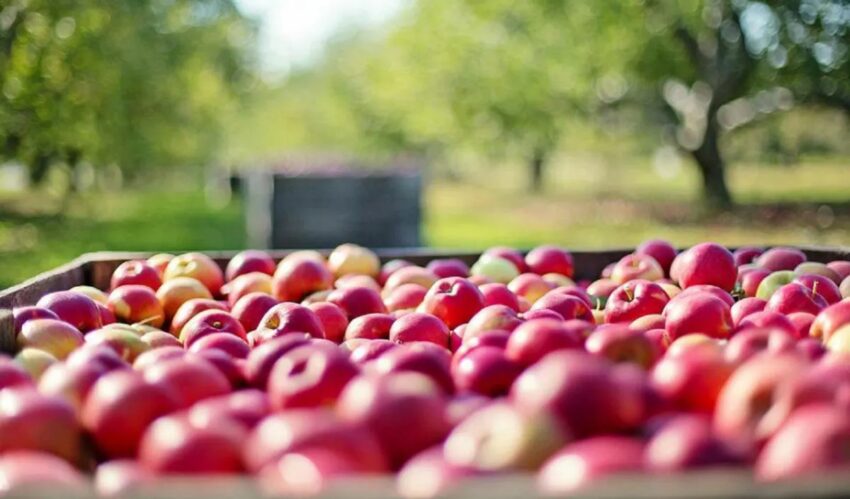
In response to an enquiry from Logos Press, Ștefan Golubchuk, chairman of the ‘Speranța Con’ Association of Fruit and Vegetable Canning Manufacturers, made his usual statement: Moldova’s canning enterprises will do everything in their power to accept the entire volume of industrial apples offered by farmers.
He noted that 325,000 tonnes is a substantial, but by no means unprecedented, volume of raw materials. Last season (between August and December), Moldovan apple concentrate producers processed around 280,000 tonnes (against an apple harvest of approximately 414,000 tonnes in 2025). However, until relatively recently, in years of high harvests, Moldovan factories processed more than 300,000 tonnes of apples.
According to the chairman of the industry association, a more important factor than the nominal capacity of canning factories is the consistency of raw material supplies throughout the processing season. The concentrate production factories currently in operation are capable of processing around 5–6 thousand tonnes of apples per day.
This means that, assuming a steady supply throughout the season and a season lasting an average of 100 days, the industry could theoretically process around 500,000 tonnes of apples. However, at the turn of summer and autumn 2026, the production lines at canning plants are operating at approximately 50–60 per cent capacity, which is slightly lower than during the same period last season.
This may be due to the fact that this year’s mass harvest of mid-season apples began slightly later than last year. However, other factors are likely to be at play as well.
Low prices or over-optimistic expectations?
According to ‘Speranța Con’, in August the price of industrial apples ‘in the orchards’ fluctuated between 2.3 and 2.5 lei/kg, whilst ‘at the factory gates’ it reached 2.60–2.75 lei/kg (including VAT). In principle, at the start of processing, the price of this raw material is slightly higher than last season.
The problem is that Moldovan farmers’ costs have risen significantly in the current agricultural year – and continue to rise. This applies to both production costs (pesticides, fertilisers, labour) and logistical costs (transport, sorting, storage). From this perspective, their hopes for a significant increase in purchase prices – for both dessert and industrial apples – are logical and reasonable.
However, this year (as is always the case, in fact), market pricing dynamics are shaped by production and commercial logic.
According to market analysts, information from the Prognosfruit-2026 conference indicates that there will be no apple shortage in the ‘Greater Europe’ market (the European Union, its eastern neighbours and Turkey) during the current marketing year.
Moreover, a significant increase (compared with last year) in apple production in countries such as Ukraine (+15 per cent) and, in particular, Turkey (+104 per cent) will play a major role in the apple segment of the European market.
A surplus of apple concentrate
It is clear that Europe’s domestic consumers alone will not be able to ‘consume’ the entire current apple harvest – part of it will need to be exported and processed into concentrate, intended for both the European market and for export. In this context, the quantity of European apple concentrate (and, crucially, at what price) that the US is prepared to purchase will be of great significance.
As noted by members of ‘Speranța Con’, who recently attended a conference of fruit industry operators in the US (USApple, Chicago), major American traders reported that they need to purchase apple concentrate – at the very least, as a means of diversifying their import flows. However, purchase volumes will depend heavily on the price ratio between European apple concentrate and the price of this product in alternative markets.
According to market operators, average prices for apple concentrate in the European Union currently range from 1,300 to 1,400 euros per tonne (including delivery to the buyer), whilst in Turkey and China they range from 1,100 to 1,200 euros per tonne. In other words, the August price of apple concentrate in 2026 is approximately 30 per cent lower than last year’s price for the same month.
At the same time, global stocks of this commodity are, according to expert estimates, quite substantial. An important point to note is that the mass harvest of late-season apples in Central and Eastern Europe has not yet begun, whilst prices in the leading producer countries have already fallen to a relatively low level.
At the end of August, the average price for industrial apples in China stood at around 0.06 euros/kg, in Turkey at 0.07–0.09 euros/kg, and in Poland at 0.12–0.13 euros/kg.
There is another important market factor: the link to quality. Representatives of ‘Speranța Con’ note that, this season in particular, due to frosts in Poland, there is significant demand for high-acidity apple concentrate. Consequently, prices for ‘wild’ apples (from unmanaged orchards) in Ukraine and sour apple varieties in Poland are currently holding at relatively high spring–summer levels.
However, as dessert apple varieties begin to arrive for processing in September and the production of low-acidity apple concentrate increases, market operators will no longer be able to secure a ‘premium for acidity’ on this product when selling it for export. Consequently, prices for ‘autumn varieties’ of apples for processing in Europe, Turkey and China will be at a more or less similar level.
Taking all these factors into account, an unpleasant conclusion suggests itself. Given the current conditions in the main markets for apple concentrate, Moldovan farmers’ hopes that purchase prices for industrial apples from the 2026 harvest will rise as the autumn harvest progresses appear doubtful.
Follow our updates
Have information for the newsroom? Share it with Logos-Press


















Comments
0No comments yet. You can start the conversation.
Comments are open to readers with a Logos Press account.
Sign in to comment