
The publication focuses on how the transition to a low-carbon economy affects economic competitiveness.
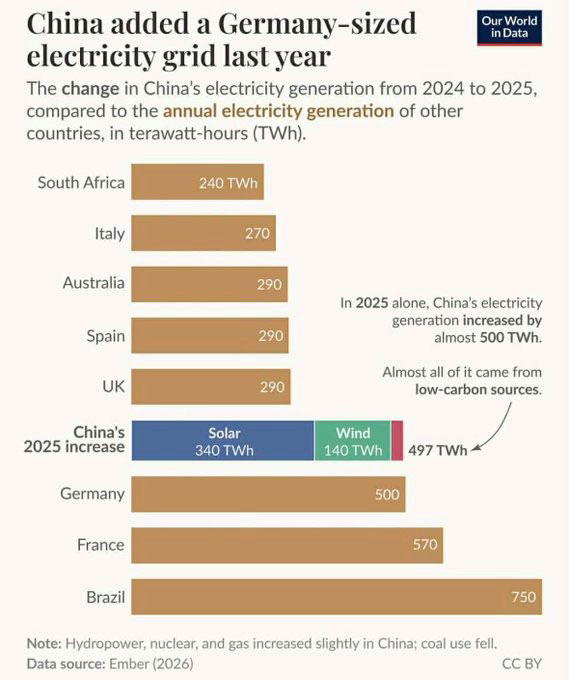
It states that by 2025, China had increased its electricity generation from solar and wind sources by nearly 500 TWh, which is comparable to the annual electricity production of a major European country.
These figures have sparked a new debate about the differences between the Chinese and European models of energy transition.
According to data cited in publications on the Chinese energy market, solar generation in the country increased by approximately 340 TWh, while wind generation increased by another approximately 140 TWh. At the same time, electricity generation from coal-fired power plants decreased by approximately 71 TWh—for the first time since 2015.
As a result, solar and wind power accounted for about 22% of China’s electricity generation.
The Chinese Model: No Sudden Moves
The main difference in China’s approach is that Beijing has not abandoned its traditional energy infrastructure while simultaneously pursuing large-scale development of renewable energy sources.
China remains the largest manufacturer of solar panels, battery systems, and wind power equipment. State industrial policy has enabled the country to establish a large-scale manufacturing base, which has reduced the cost of these technologies and accelerated their adoption.
At the same time, a significant portion of China’s industrial sector still relies on coal-fired power. This is precisely one of the main arguments put forward by critics: the development of green energy is occurring in parallel with the continued prominence of fossil fuels.
Supporters of the Chinese model believe that this approach allows for a faster increase in clean energy production and a reduction in the economy’s carbon intensity.
Germany Has Chosen a Different Path
Germany has found itself at the center of the debate, having completed its phase-out of nuclear power in 2023. After shutting down its last nuclear power plants, the country faced the need to compensate for the lost capacity with other sources.
Critics of Germany’s strategy argue that the simultaneous reduction in nuclear generation and the shift toward stricter climate policies have increased the country’s dependence on gas and coal-fired power generation during certain periods.
Supporters of Germany’s approach point out that Germany continues to actively develop solar and wind energy, and that the energy transition is a long-term process.
The main question is the speed and cost of the transition
The debate surrounding China and Germany highlights the central conflict in modern energy policy: how quickly can a transition to a low-carbon economy be achieved without compromising industrial competitiveness?
China is banking on production, scale, and government support for technologies. Europe is focusing more on regulation, climate standards, and emissions reductions.
For businesses, the issue is not only about environmental goals, but also about the cost of energy, the reliability of supply, and the ability of industry to compete in global markets.