

Veaceslav Ionita
Of course, the expert notes, if the intergovernmental agreement between Moldova and Ukraine is contingent on ensuring sufficient freight volumes. Some Logos Press columnists go even further in their arguments: a breach of these agreements (if they even exist—which is not a given, as no details of the agreement have yet been made public) could and should be linked to penalties against the Ukrainian side, which is the primary beneficiary.
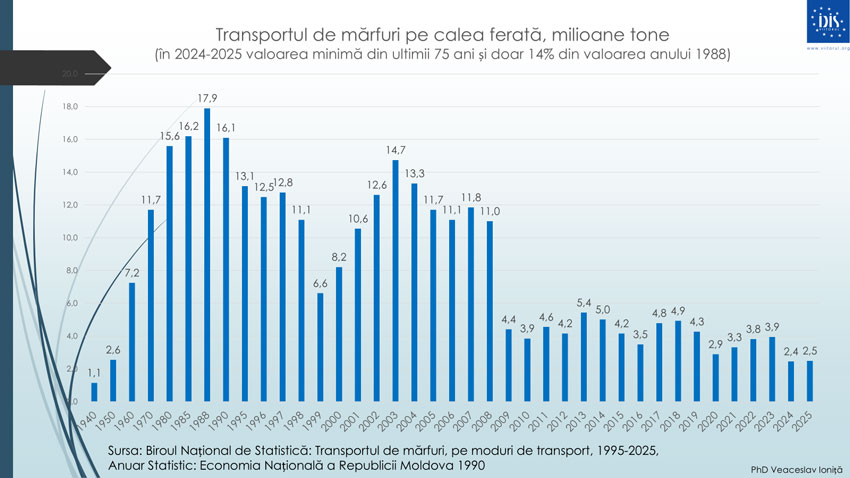
According to Ioniță, CFM currently transports seven times less cargo than it did in 1988 (17.9 million metric tons). This is one of the reasons why the company is in a difficult economic situation. In 2024–2025, only 2.4–2.5 million metric tons of cargo were transported annually by rail in the country—the lowest figure in 75 years.
Rail transport’s share of the total volume of cargo transported in the Republic of Moldova has reached approximately 5–6%, while the majority of shipments have shifted to road transport.
The transit of Ukrainian cargo has already become a source of revenue for CFM. The economist notes that at the start of the war in Ukraine, some Ukrainian goods began transiting through the Republic of Moldova. Subsequently, a significant portion of the goods was rerouted for a number of reasons, including CFM’s relatively high tariffs.
According to Ioniță, the issue of tariffs is one that carriers have been discussing for a long time. As Logos Press previously reported, citing a statement from the Agrocereale Grain Exporters Association, this organization had been engaged in lengthy negotiations with CFM and the Ministry of Infrastructure and Regional Development regarding a reduction in tariffs, which concluded with a compromise solution.
A 50% discount will make the route through the Republic of Moldova more competitive for Ukrainian carriers and, at the same time, secure Moldova’s role as a profitable transit country for the future. Ioniță explains the situation using a simple economic principle: a lower tariff can be more profitable if it ensures higher freight volumes. High tariffs, on the other hand, make the route unattractive and fail to generate sufficient freight volumes. (Logos Pressnote : This is true only if there are alternative options for shippers.)
At the same time, Ioniță emphasizes that a potential increase in freight volume of one million metric tons will not restore the railway to its historical transport levels. However, in his opinion, the sector’s revival must begin even with volumes significantly lower than before.
The economist believes that, given that the Republic of Moldova uses the railroad for only 5–6% of its freight, it would be rational to make the underutilized infrastructure available to partners who need it.
“It’s better to have traffic at lower rates than rusty rails and high rates,” Agroexpert quotes the economist as saying.
(LogosNote : Of course, “it’s better to be rich and healthy than poor and sick.” And sometimes it’s also better (if you have the courage and the will to live) to know the diagnosis. In our case—calculations justifying a 50% reduction in rates, rather than, say, 25% or 75%. But there are no calculations, nor are there any official details of the deal. What we have is the fact of a non-transparent decision—one that was not announced by the government, but by Moldovan farmers, its potential victims).
Rail freight transport: millions of metric tons.
Follow our updates