


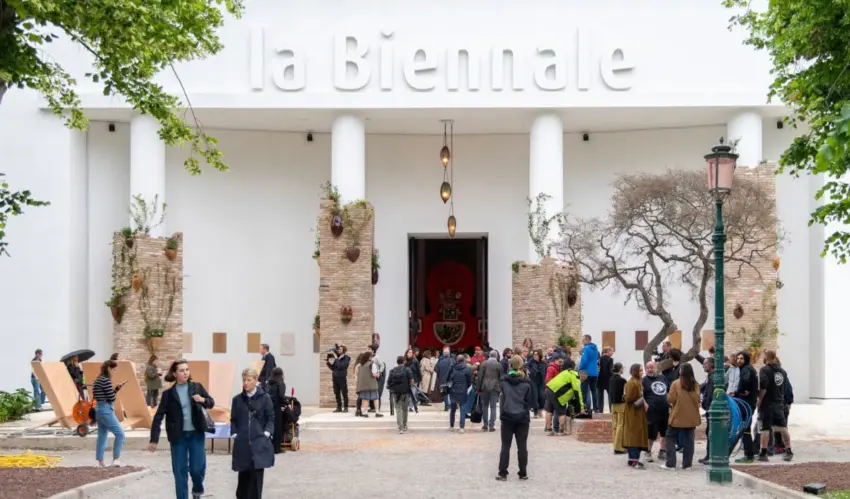
Foto Wolfgang Stahr
The central exhibition, *In Minor Keys*, became a posthumous project by curator Koyo Kuo, who passed away in May 2025, before the Biennale opened. She had managed to develop the concept for the exhibition, and a team of five curators took on the task of realising it. The Biennale’s president, Pietrangelo Buttafuoco, described the exhibition as the embodiment of Kuo’s vision and her spiritual legacy. As they bid farewell to the public, the team recalled the curator’s words: ‘People are more important than things’.
The international exhibition brought together 109 artists. Seven countries — Guinea, Equatorial Guinea, Nauru, Qatar, Sierra Leone, Somalia and Vietnam — took part in the Biennale for the first time. El Salvador presented its own national pavilion for the first time. A total of 29 national exhibitions were housed in the Giardini, 25 in the Arsenale and a further 46 in Venice’s historic centre.
However, this edition will be remembered not only for its artistic projects. Russia’s return to the Biennale for the first time since 2021 sparked an international scandal. The European Commission withdrew a grant of 2 million euros, whilst the international jury resigned on the eve of the opening amid controversy over the participation of Russia and Israel. As a result, the traditional awards were replaced by a visitors’ vote. The Russian pavilion was never opened to the public following the previews.
A particular highlight was the interest shown by the younger generation: over 161,500 visitors were under the age of 26. Educational programmes and guided tours attracted 73,264 participants, whilst the university project ‘Biennale Sessions’ brought together 4,102 students from 103 educational institutions across 19 countries.
The scale of the event was also reflected in the digital statistics. Posts about the Biennale on social media garnered 144.9 million views and generated 1.7 million user interactions – likes, comments and shares. The international media also showed considerable interest: during the preview days alone, 3,831 journalists were accredited, and the number of articles about the exhibition exceeded 5,500.
Follow our updates
Have information for the newsroom? Share it with Logos-Press















Comments
0No comments yet. You can start the conversation.
Comments are open to readers with a Logos Press account.
Sign in to comment