


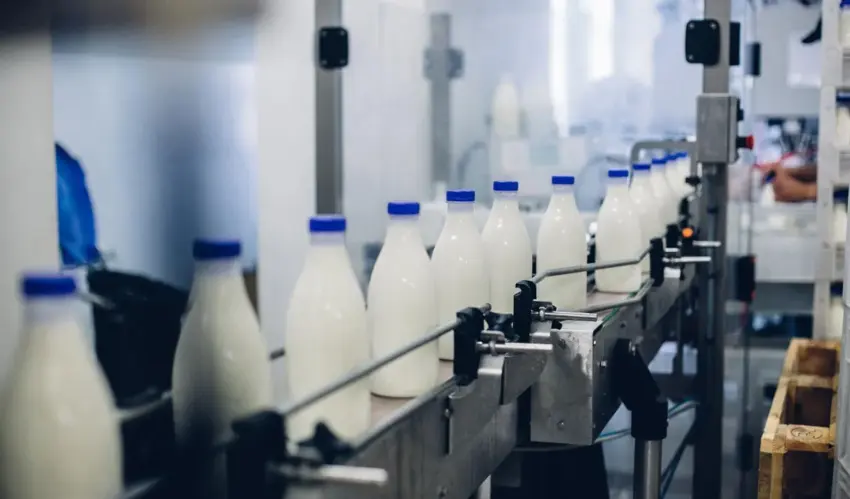
Gennady Ivashchenko, founder and chief consultant of the consultancy firm Europolis, writes about this in a social media post. He emphasises that neighbouring countries are taking full advantage of the opportunity to operate in the Moldovan market, whilst our local producers are being forced to gradually lose ground due to unequal competitive conditions.
Scale matters
The expert notes that Ukraine has made Moldova its primary export market. Almost a third of Ukrainian dairy products sold abroad are shipped to us. Since 2017, supplies have increased 3.7-fold.
Meanwhile, Romania has taken a slightly different approach to trade with Moldova. Previously, it sold us milk in tankers so that we could process it ourselves. Now it sells us yoghurt and ready-made cheese under its own brand. Volumes of bulk milk supplies have fallen by more than three times, whilst those of yoghurt and cheese have tripled. Romania has gone from being a supplier of raw materials to a direct competitor on the shop shelves.
Over the same eight-year period, we have lost our traditional markets in Russia and Kazakhstan, notes Gennadiy Ivashchenko. Meanwhile, on the domestic market, dairy products from our neighbours in Romania and Ukraine circulate almost exclusively in one direction.
‘Of course, our neighbours have a significant advantage — economies of scale. The Ukrainian industry is 12 times larger than ours. Romania also has a much larger domestic market and industry. The costs, volumes and investment opportunities are incomparable. That is precisely the problem. Our neighbours are exploiting their advantages in our market, whilst we are unable to capitalise on our own,” notes the expert.
As a result, over the past eight years, the share of imports in Moldova’s dairy consumption has risen from 24 per cent to 44 per cent.
However, for our industry, the problem begins long before the shop shelf. Milk production has fallen by 42 per cent over eight years. Factories are operating on a margin of around 2 per cent, using increasingly scarce raw materials.
Ice cream sets an example
Ivashchenko believes that the success of ice cream exports points the way forward for Moldova’s dairy sector. Exports of ice cream have almost doubled, reaching $12 million. Where we have a competitive product and brand, we are winning over foreign markets. Admittedly, we export exclusively to Africa and the Middle East.
‘That is why I do not think the solution lies in stopping imports. Nor does it lie in attempts to outdo Ukraine or Romania in terms of volume and price. Moldova cannot afford the luxury of being a “smaller Ukraine” or a “cheaper Romania”. We need to think more creatively, make wiser investment choices and, yes, sometimes be more ‘selfish’ and ‘aggressive’ as a country. Let’s create those enterprises and value chains where we can truly succeed,” the expert concludes.
The sector is not ready for EU accession
In comments on the article, industry experts note that the analysis fairly accurately reflects the state of affairs, but does not fully reveal the less than rosy prospects facing Moldovan dairy producers.
“The worst and most difficult situation right now is not for the farmer, but for the processor. And with EU accession, it will spell the end for the farmer too,” says a user going by the nickname Caşcavalul Regal. “Today, processors are forced to buy raw materials at a price twice as high as in Europe. Looking at the Romanian market, we see that the base price for milk is currently 0.25 cents per litre. In Moldova, the base price per litre of milk is as high as 0.50 cents. That is where the burden lies, because with such expensive milk, it is impossible to put competitive products on the shelves. In this way, we are undermining the processor, because this is where the economy lies, this is where added value is created, and this is where the erosion of national income begins. Moreover, imports of dairy products, including milk, into Moldova are subject to no high taxes, and it is unclear how this can be countered.”
Another commentary notes that there are two problems in the sector which, from the new year, could have a threefold effect due to fiscal changes – a shortage of productive livestock and, consequently, a large-scale milk shortage. However, even this volume cannot undergo full certification to EU standards. At the same time, producers currently have almost no incentives to switch to certified production.
Follow our updates
Have information for the newsroom? Share it with Logos-Press




















Comments
0No comments yet. You can start the conversation.
Comments are open to readers with a Logos Press account.
Sign in to comment