

According to the USDA’s International Agricultural Service, the International Coffee Organization, and analytics platforms Colipse Coffee and StatRanker, Brazil’s coffee production in 2025 will reach approximately 63 million bags of 60 kilograms each. This is more than double that of Vietnam, which ranks second with 30.8 million bags.
Brazil’s exports will also remain the world’s largest, with the country planning to supply over 40 million bags of coffee to the global market in 2026, reaffirming its role as the backbone of the global coffee industry. Today, Brazil accounts for about a third of the world’s coffee production. The country remains the main supplier of Arabica, a variety widely used in premium coffee blends and espresso.
Vietnam, which ranks second in the global ranking of coffee market players, expects to export about 27.9 million bags, but mainly at the expense of Robusta. This variety contains more caffeine and is actively used in the production of instant coffee. Against the backdrop of rising prices for Arabica, global demand for Robusta continues to increase.
The third place is occupied by Colombia with production of 13.8 million bags. This is followed by Indonesia and Ethiopia – the historical homeland of coffee – with volumes of 12.45 and 11.56 million bags respectively.
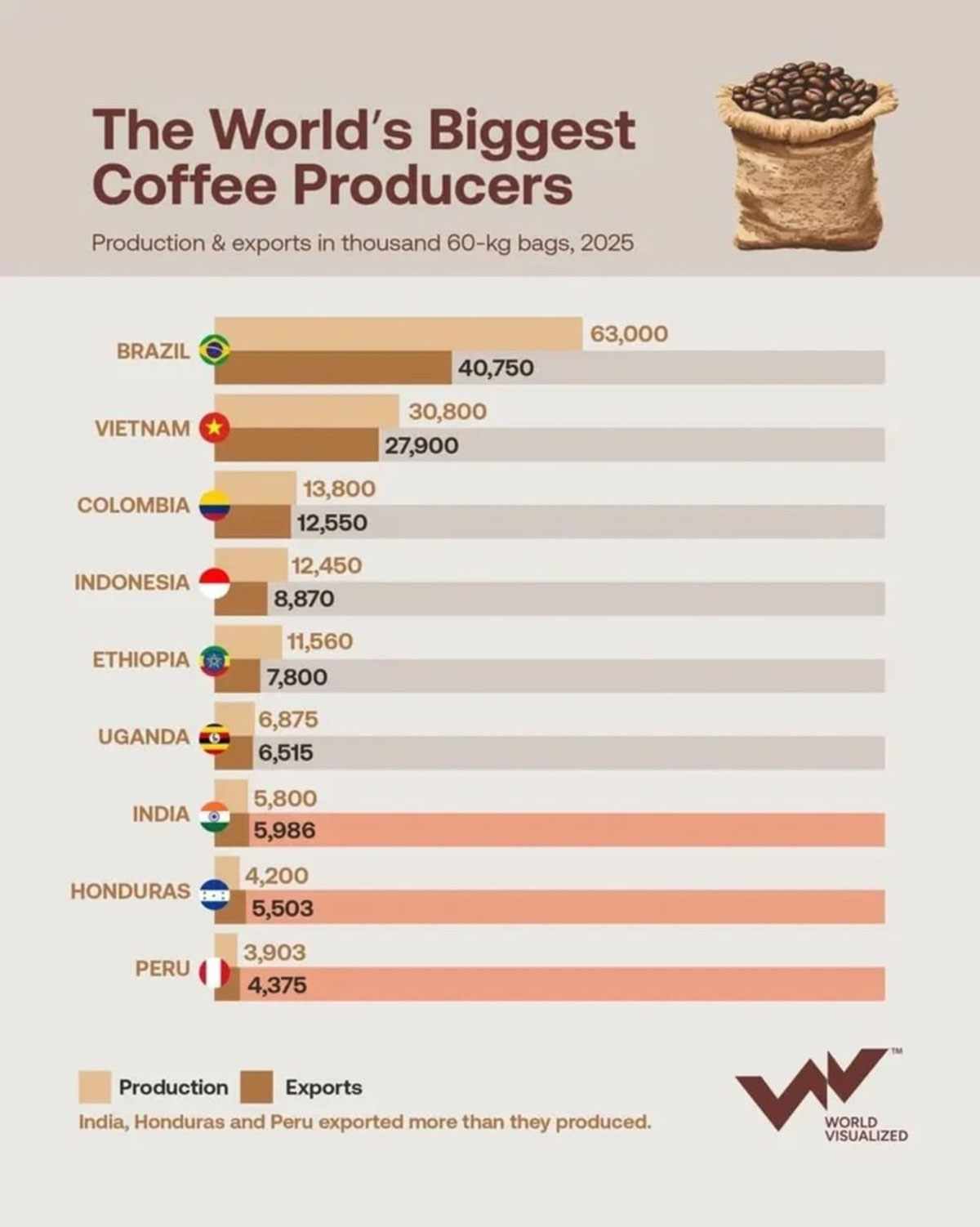
In Africa, Uganda is gaining ground, where coffee production is expected to approach 6.9 million bags, according to USDA estimates.
An interesting feature of the statistics was that countries such as India, Honduras and Peru may export more coffee than they produce. According to analysts, this situation is possible due to carryover stocks of past harvests, re-exports and bringing previously accumulated reserves to the market.
Coffee market development forecast
The global coffee industry has been facing increasing pressure in recent years due to extreme weather events related to climate change. Brazil has experienced severe droughts and freezes between 2021 and 2023. Similar problems have affected Colombia and Vietnam, where changing rainfall patterns have had a negative impact on crop yields.
The International Coffee Organization has repeatedly warned that climate instability is becoming one of the main long-term threats to the world’s coffee-growing regions – especially for Arabica, which is extremely sensitive to temperature changes. According to industry analysts, it is the reduced supply and weather problems that have been one of the reasons for high global coffee prices over the past two years.
Despite the supply risks, global coffee consumption continues to grow steadily. USDA forecasts further demand growth in Asia and emerging markets, while Europe and North America remain the world’s largest coffee consumers.
Overall, the situation shows how much the global coffee market remains dependent on a limited number of producing countries – and how increasingly serious climate risks could affect the future of one of the most sought-after crops on the planet.


