



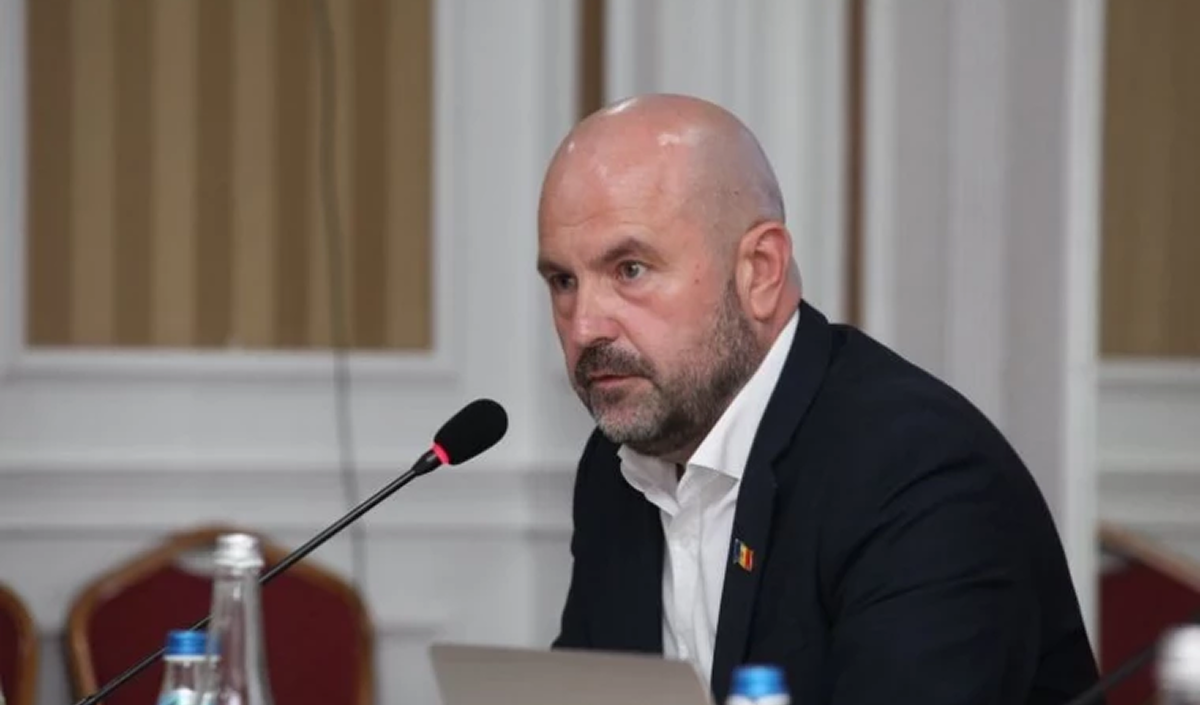
Laurențiu Pleșca
Supporters of this decision insist: regular incidents involving drones entering the country’s airspace show that security vulnerabilities can no longer be ignored.
This is also the view expressed by Laurențiu Pleșca, PhD, programme officer at the German Marshall Fund and researcher at the Romanian Centre for Russian Studies.
When asked by Logos Press, the expert noted that the authorities must move more swiftly to adopt the necessary legislative framework for the domestic production of defensive equipment, arguing that every delay leaves the country exposed to concrete risks.
“Are we to stand idly by whilst seven drones fly over Moldova and most of them explode on our territory? The answer is obvious. The authorities must act more swiftly and adopt the necessary legislation for the domestic production of defence equipment, before it is too late and before we suffer casualties. Every month of delay is a month in which our skies remain unprotected,” said Pleșca.
Domestic production: a necessity for national security
In his view, the Republic of Moldova must develop the capacity to produce for its own needs, rather than relying exclusively on foreign procurement. Given that demand for defence equipment is rising across Europe, imports can entail high costs, long delivery times and dependence on the availability of external suppliers:
“The aim is for Moldova to produce for itself rather than buying everything from abroad. Importing is expensive, time-consuming and makes the country dependent on the availability and priorities of other states, at a time when demand for such equipment is huge across Europe. Domestic production means faster delivery, lower costs, adaptation to the army’s actual needs and, last but not least, jobs, skills and investment for the national economy.”
Thus, the development of a national production capacity could have effects that extend beyond the defence sector. According to the authorities, setting up production facilities would mean investment, jobs, the development of technological skills and the strengthening of an industry that could contribute to the national economy.
Pleșca points out that the experience of the war in Ukraine has demonstrated just how important it is to be able to rapidly produce equipment adapted to new threats, including on a smaller scale.
“The war in Ukraine has shown very clearly that drones can be produced efficiently on a small scale and that this capability makes all the difference in defence,” the expert notes.
Interceptor drones: a response to threats in the region
One of the areas in which the Republic of Moldova, in the expert’s view, should develop its own capabilities is the production of interceptor drones, designed to protect its airspace. The need for such defensive capabilities is driven by security developments in the region and by repeated incidents in which drones have entered the territory of the Republic of Moldova.
In this context, the expert believes that the discussion on domestic production of defence equipment must be based on the real risks facing the country, not on assumptions regarding possible offensive intentions.
The development of such capabilities would aim to protect the territory and the population, not to involve the Republic of Moldova in military conflicts or to threaten other states.
Moldova does not produce weapons to attack, but to defend itself
Laurențiu Pleșca rejects the idea that the development of a national defence industry should be interpreted as a cause for diplomatic tension. According to him, no state should regard the Republic of Moldova’s efforts to protect its own airspace as a threat.
“No country will have any reason to take offence at Moldova for defending its airspace. Moldova does not produce weapons to attack anyone, but to defend itself. And if, at some point, it does export them, it will do so in accordance with the same strict rules as the European Union member states, of which it wishes to become a part.”
The expert thus also highlights the European dimension of this initiative. Any exports of military equipment should be carried out in accordance with strict rules, similar to those applied in European Union member states. Consequently, the development of domestic production does not preclude oversight and accountability, but rather requires a clear legal framework.
“The comparison with 2011 is not relevant”
In the context of MP Grigore Novac’s warnings regarding the risk of a repeat of the 2011 diplomatic scandal, triggered by arms deliveries to Armenia and Azerbaijan’s reaction, Laurențiu Pleșca believes that the situation at that time cannot be compared with the Republic of Moldova’s current plans to develop its own defence industry. The expert argues that there is a fundamental difference between the export of offensive systems to a state involved in an armed conflict and the domestic production of defensive equipment intended to protect the airspace and population of the Republic of Moldova.
“The ‘Uragan’ case concerned the transfer of offensive systems from stocks inherited from the Soviet army to a state engaged in an active armed conflict with its neighbour. It was only natural that this should provoke a diplomatic reaction from Azerbaijan. What the Republic of Moldova is discussing now is something entirely different. We are talking about the domestic production of defence equipment, primarily interceptor drones, intended to protect our own airspace and population. The need is very real, if we recall the repeated incidents involving Russian drones entering Moldova’s airspace in the context of the war in Ukraine. To juxtapose the two situations is to shift the discussion from a real need to a fabricated risk,” said Pleșca.
Through this comparison, the researcher highlights the difference between the transfer of offensive systems to a state involved in an armed conflict and the development of defensive capabilities to protect one’s own territory.
In his view, the Republic of Moldova must not confuse the responsibility to strengthen its own security with the intention of becoming a threat to other states. The aim is to develop a national capability that reduces dependence on imports, responds more swiftly to security incidents and offers the population better protection.
Follow our updates
Have information for the newsroom? Share it with Logos-Press




















Comments
0No comments yet. You can start the conversation.
Comments are open to readers with a Logos Press account.
Sign in to comment