

As a reminder, on August 17, the “Forța Fermierilor” Association essentially issued an ultimatum to Vasile Tofan’s government: “If there is no progress by Friday on issues related to transit controls and import licensing for Ukrainian grain, as well as maintaining the reduced VAT rate on agricultural products, the organization reserves the right to organize mass protests.”
In this context, Stas Madan suggests looking back at the consequences of this policy, which was already implemented during the 2024–2025 period, using sunflower seeds and sunflower oil as examples.
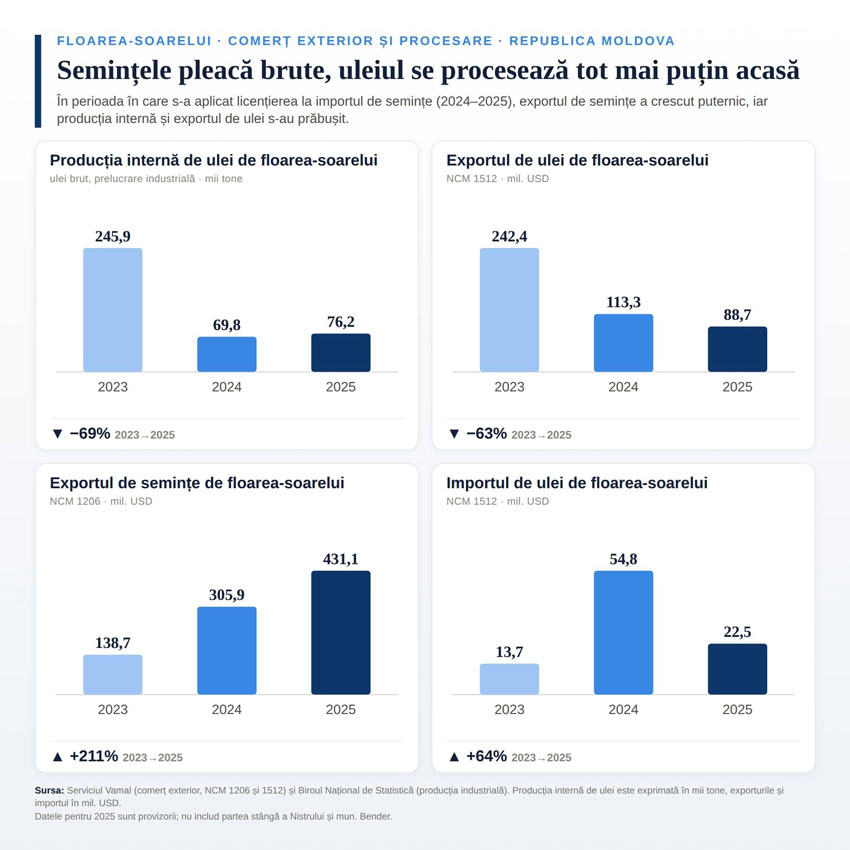
“And the figures—for those who care to look at them—show this more than clearly: sunflower seeds are increasingly leaving Moldova in their raw form. Between 2023 and 2025, seed exports tripled (from $139 million to $431 million), while domestic oil production fell by 69% and oil exports by 63%,” the economist noted in his Facebook post.
He also pointed out that in 2023, Moldova had a positive trade balance in sunflower oil amounting to $228.7 million. A year later, this surplus shrank by a factor of 3.9 to just $58.5 million.
We Need Added Value Instead of a “Banana Republic Economy”
The economist notes that the issue is not simply a matter of “whether or not to allow Ukrainian sunflower seeds into the country.” Rather, it concerns the deep processing of the product and ensuring that processing plants have sufficient raw materials for high-profit production.
“Fewer seeds processed domestically mean less value added remaining in the country,” writes Stas Madan. “Do we want to have a ‘banana republic’ economy where only raw materials are exported? Then let’s go back to doing what we did before…”.
At the same time, Madan emphasizes that these changes in sunflower seed and oil exports are not solely due to the licensing procedure. Other factors also played a role, such as annual harvests, international price trends, regional demand, the impact of other policies, and so on. But even so, the figures speak volumes.
Follow our updates