

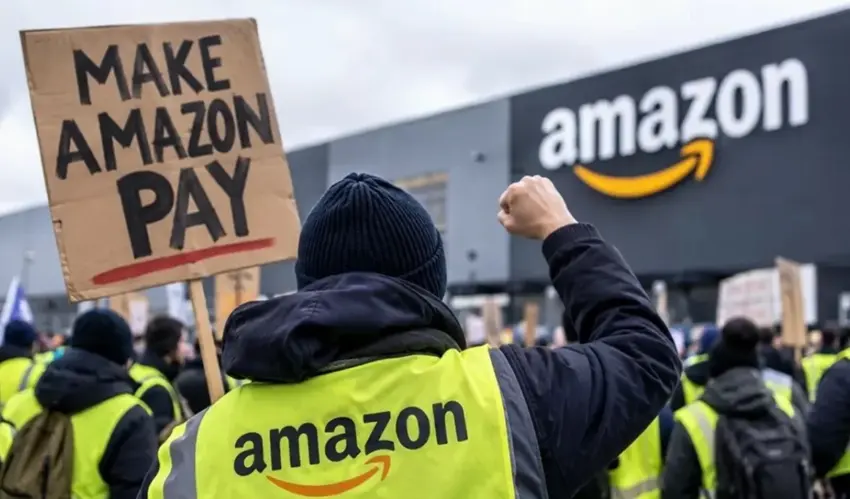
Protests are taking place in France, Germany, Poland, the UK, the US, Japan, Brazil, South Africa and other countries, reports Euronews. Participants include staff from Amazon’s warehouses, sorting and distribution centres, as well as its offices.
The international ‘Make Amazon Pay’ campaign is now in its seventh consecutive year. It involves trade unions, environmental movements and organisations campaigning for tax justice. Around 50 organisations have joined the campaign.
In Germany, the service sector trade union ver.di has called on staff to strike at 11 Amazon sites. In India, trade unions have managed to organise protests at at least 23 locations. In Poland, protests are planned at four of the company’s warehouses. Solidarity actions are also taking place in other countries.
The trade unions are demanding that Amazon recognise employees’ right to form trade unions and engage in collective bargaining, as well as ensure safe working conditions. Specific grievances relate to pressure arising from production quotas and increased monitoring of workers.
Wages, safety and collective agreements
In some countries, workers’ demands have remained unresolved for many years. In Germany, for example, the ver.di trade union has been campaigning for a collective agreement with Amazon since 2013.
In Frankenthal, around 150 Amazon employees walked out for 24 hours. They are demanding an end to the pressure associated with meeting production targets and that the collective agreement for retail workers be extended to cover them, according to the EUobserver.
In Bangladesh, workers in the garment industry, which supplies goods to Amazon, are demanding higher wages and guarantees of workplace safety. Following the Rana Plaza factory disaster in 2013, in which over a thousand people died, trade unions have been pressing the company to sign binding safety agreements.
According to Euronews, workers currently earn around 128 euros a month, whilst the trade unions are demanding that pay be raised to 220 euros. Campaign organisers also report ongoing protests against the low minimum wage.
“Amazon is building a future in which fewer and fewer workers generate ever-greater profits under ever-tighter surveillance,” said Varsa Gandikota-Nellutla, coordinator at Progressive International.
Trade union representatives also claim that staff fear the consequences of taking part in strikes. Yet in most countries, such industrial action is legal.
“We’ve had other demands for ages, but they’re unlikely to be heard if we can’t go on strike,” Magda Malinowska of the Polish trade union Inicjatywa Pracownicza told EUobserver. – The trade unions want Amazon to cover the costs associated with the impact of its operations on workers, including healthcare costs.
Amazon rejects the allegations of poor working conditions. A company spokesperson told Sky News that it offers employees high wages, good social benefits and extensive opportunities for professional development from their very first day at work.
According to the spokesperson, Amazon directly employs more than 1.5 million people worldwide and provides them with modern, safe and comfortable working conditions, both in offices and at fulfilment centres. In Europe, Amazon has more than 230,000 employees, mainly engaged in packing and delivering orders. In addition, the company employs around 40,000 contract workers, reports EUobserver.
According to the source, Amazon’s revenue reached €678 billion in 2026. The publication ranks the company second in the world after JPMorgan Chase in terms of combined sales, profits, assets and market capitalisation.
This story was translated with the assistance of artificial intelligence.
Follow our updates
Have information for the newsroom? Share it with Logos-Press














Comments
0No comments yet. You can start the conversation.
Comments are open to readers with a Logos Press account.
Sign in to comment