


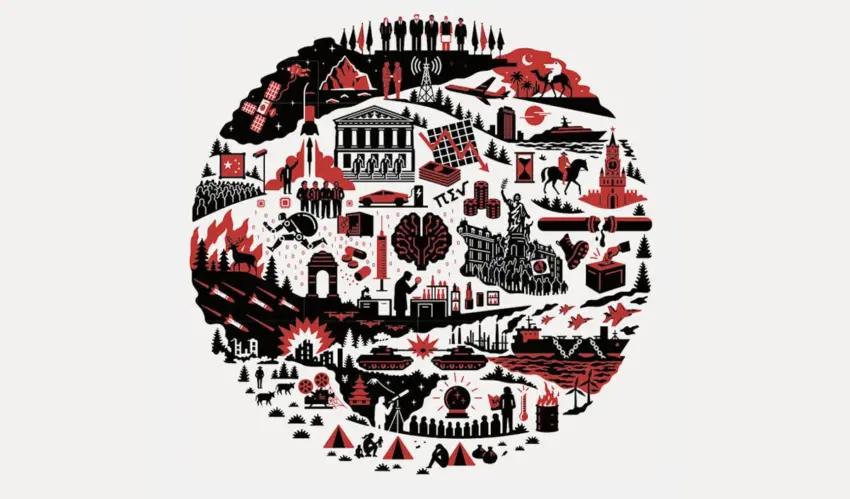
These forecasts are set out in the annual review *The World Ahead 2027*, prepared by the British magazine *The Economist*. Other key topics include the political future of the US, the rise of right-wing populists in Europe and the escalating situation surrounding Taiwan.
Between debt and technological risks
According to The Economist, one of the central themes in the global economy will be mounting pressure on government bond markets. The authors highlight rising bond yields and problems with public finances in developed countries. Particular attention is paid to France, whose financial situation could become an additional source of tension for European markets.
Political changes could exacerbate these risks. According to the review’s editor, Tom Standage, the dawn of the post-Donald Trump political era does not mean that the US president will lose his influence. On the contrary, The Economist suggests that Trump’s desire to cement his political legacy may be accompanied by new conflicts surrounding the executive branch, legal disputes and foreign policy decisions.
For the global economy, this means continued uncertainty regarding international trade, security and energy.
Financial risks of AI and political influence
Artificial intelligence features prominently in the forecast. The Economist expects a heightened public and political reaction to the activities of major technology companies against a backdrop of concerns about the consequences of AI implementation.
The review highlights the risk of financial turmoil if companies developing artificial intelligence continue to increase their debt burden through complex and opaque financial transactions. In such a scenario, the problems faced by individual players in the technology market could extend beyond the sector.
At the same time, the authors believe that concerns regarding the political, financial and cyber risks of AI are more justified than some forecasts regarding its impact on employment and the environment.
Consequently, the focus is not only on technological progress, but also on the question of how sustainable the industry’s financial development model will prove to be.
For businesses, this means they must simultaneously take into account the potential for automation, the cost of technological investment, cyber risks and regulatory changes.
Europe: political choices and public debt
On the European agenda, *The Economist* highlights the possible rise of right-wing populist forces and the presidential election in France. The authors consider a victory for Marine Le Pen as one of the scenarios capable of significantly altering the political balance within the EU.
According to the publication, such a turn of events could complicate Franco-German cooperation – which plays a key role in European integration – and heighten investors’ concerns about the state of France’s public finances.
The problem, however, is not confined to France. The review emphasises that many developed economies are facing growing pressure from debt obligations, whilst rising government bond yields are increasing the cost of borrowing.
For companies and investors, this is one of the most significant economic issues of 2027: changes in the cost of public financing can influence credit conditions, investment decisions and the scope for fiscal policy.
Iran, energy and food security
Another section of the forecast concerns the consequences of a war with Iran. According to The Economist’s assessment, the fallout could alter the regional political balance, international energy flows and the conditions for food security.
In particular, the authors highlight a potential fertiliser shortage. This poses risks to agricultural production and food markets, especially if supply disruptions persist.
In the energy sector, the magazine anticipates both a continuation of extreme weather events – droughts, wildfires and heatwaves – and growing interest in renewable energy sources. Among the reasons cited for this interest are not only climate challenges but also the desire to reduce dependence on fluctuations in global energy markets.
For small economies dependent on imports of fuel, fertilisers and other critical resources, the combination of geopolitical and climate factors remains a significant external risk. The impact of these developments on Moldova will depend on price trends, the availability of supplies and companies’ ability to adapt to change.
Taiwan, space and new markets
Among the ten key themes for 2027, *The Economist* also highlights the situation surrounding Taiwan. The authors examine the possible consequences of increased military pressure from China and note that technological developments are shifting the balance of power between large and small states.
Technological changes will also be evident in the space sector. The review anticipates an expansion in commercial satellite launches, the emergence of the first private space station and further discussion of the possibility of placing data centres in orbit.
The impact of weight-loss drugs on consumer behaviour and the pharmaceutical industry is examined separately. According to the magazine’s forecast, changes in demand for clothing, cosmetics and fitness services may be accompanied by growing interest from pharmaceutical companies in research into longevity.
Finally, the authors anticipate changes in Hollywood and other segments of the entertainment industry, where traditional franchises are competing with new formats of content production.
What the forecasts for 2027 have in common
In The Economist’s review, political, financial, technological and climatic developments are viewed as interlinked sources of uncertainty. Rising public debt may limit the scope for economic policy, geopolitical conflicts may alter the conditions for energy and food supplies, whilst the development of AI may simultaneously create new business opportunities and additional financial risks.
*The World Ahead 2027* will be published in the 21 November print edition of *The Economist* and will go on sale as a standalone publication on 26 November. Articles on the year’s ten key themes are also available on the magazine’s website.
Contributors to this issue include Japanese Prime Minister Sanae Takaichi, Finnish President Alexander Stubb, International Energy Agency Executive Director Fatih Birol, Anthropic co-founder Jack Clark, and other figures from the worlds of politics, business and academia.
Follow our updates
Have information for the newsroom? Share it with Logos-Press















Comments
0No comments yet. You can start the conversation.
Comments are open to readers with a Logos Press account.
Sign in to comment