

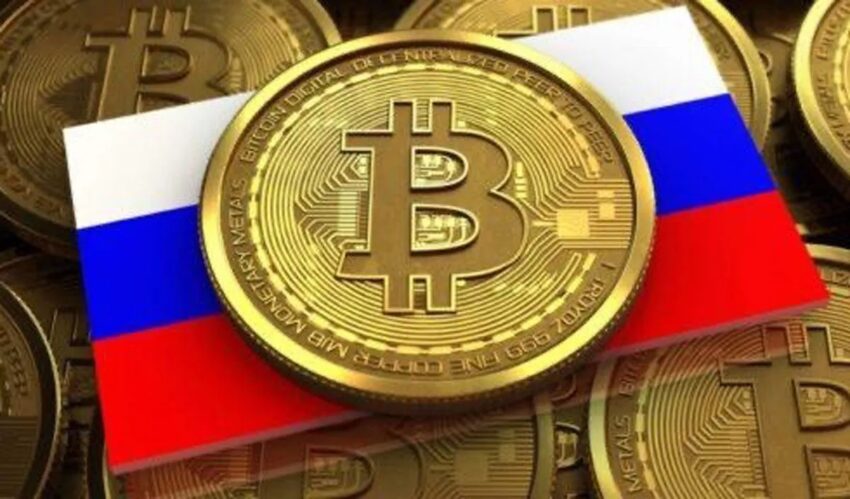
Three months ago, the Bank of Russia estimated the average monthly volume of Russians’ funds on foreign centralised crypto-exchanges at ₽720 billion. A further ₽3.8 billion was accounted for by synthetic investments via Russian instruments, including structured bonds, futures and digital financial assets. In an earlier review, the Central Bank estimated the volume of transactions by Russians from October 2024 to March 2025 at ₽7.3 trillion, reports RBC.
Where do the figures come from?
₽3.7 trillion is an expert estimate rather than the result of direct statistical measurement, explained Matvey Voitov, director of the Web3 Tech research centre. According to him, this figure is plausible as an order of magnitude but requires a number of caveats.
The gap between ₽720 billion (the average monthly balance according to Central Bank data) and ₽3.7 trillion (the Ministry of Finance’s aggregate estimate) is explained by the fact that the Central Bank only takes into account balances on trading platforms, whilst the Ministry of Finance includes other forms of ownership and assesses the market more broadly, the expert says. He noted that the Ministry of Finance’s estimate of $44 billion at the current exchange rate is comparable to data from the blockchain analytics firm Chainalysis.
In 2025, Chainalysis published a report stating that the volume of crypto transactions entering Russia over the course of the year totalled $376.3 billion, placing the country in first place in Europe in terms of cryptocurrency usage. These are turnover figures, but they indirectly confirm the scale of the market, Voytov clarified.
According to Dmitry Tsarkov, director of the trading operations department at GBIG Holdings, the figure cited by the Ministry of Finance is a conservative lower limit of the actual volume of assets. Most likely, this figure was obtained by extrapolating the share of Russian web traffic on the largest international exchanges to their total user balances, as well as through the analysis of indirect sociological metrics, the expert suggested.
“Given that, historically, Russia has generated between five and ten per cent of activity on leading centralised trading platforms, and taking into account the acute need of businesses and private capital for cross-border settlements against the backdrop of the current geopolitical climate, the actual volume of accumulated capital may turn out to be significantly higher than the stated figure,” said Tsarkov.
He pointed out that Rosfinmonitoring’s analytical tools, including the ‘Transparent Blockchain’ software suite relied upon by the Central Bank, are effective for cluster analysis of transactions and the de-anonymisation of addresses interacting with local fiat gateways. Nevertheless, Tsarkov believes this architecture has conceptual limitations. He explained that the tool is primarily geared towards compliance monitoring and the detection of illicit flows, whilst being unable to reliably assess funds held in non-custodial wallets or those involved in DeFi (decentralised finance).
The Bank of Russia does indeed emphasise the importance of such analytical tools specifically in identifying illicit cryptocurrency linked to any criminal activity. More than 80 Russian banks have already joined the ‘Transparent Blockchain’ programme, Rosfinmonitoring reported on 25 September.
Additional methods employed by the regulators include a comprehensive analysis of banking statistics, in particular the monitoring of acquiring and P2P transfers classified by banking scoring systems as transactions involving digital assets, said Tsarkov. However, according to the expert, this only allows for the tracking of liquidity turnover, rather than investors’ balances.
How to accurately calculate crypto volumes
Given that cryptocurrency users can remain anonymous, estimating their numbers is always a complex task, says Voitov. He suggests that a technical approach to such an assessment could involve combining on-chain analysis with an analysis of users’ online behaviour – including their IP addresses and app data (many apps store settings regarding the time and location of use).
Such an analysis would be based on identifying real users after filtering out unnecessary addresses: custodial wallets, Sybil addresses (multiple addresses belonging to a single user) and technical wallets belonging to exchanges or applications, the expert explained. For example, for the TON blockchain, there are already public databases that allow exchange wallets, trading bots and Sybil addresses to be excluded from the analysis.
“Nevertheless, absolute accuracy is unattainable due to the very nature of crypto-assets: non-custodial wallets are not linked to a specific individual, P2P transactions are not reflected in fiat accounting, and cross-border flows are difficult to link to a specific jurisdiction,” said Voitov.
In his view, a realistic goal is not a precise figure, but an agreed range, which will be refined as regulation and analytical tools develop.
Tsarkov agreed that it is impossible to obtain an absolutely accurate picture. However, in his view, the most relevant approach to assessment lies in a comprehensive audit of liquidity bottlenecks — points where cryptocurrency and fiat currency are converted, including institutional over-the-counter markets and data from platforms that comply with customer identification procedures.
In the medium term, the assessment toolkit will become more accurate through the implementation of standards set by the Financial Action Task Force (FATF), the expert believes. However, he adds that, under a scenario of strict regulatory policy, there is a high probability that a significant portion of capital will migrate to anonymous networks and non-custodial solutions, which will maintain the gap between official statistics and the actual cryptocurrency holdings of Russians.
At the end of 2025, when the Bank of Russia presented its concept for regulating the crypto market, the Central Bank’s First Deputy Chairman, Vladimir Chistyukhin, stated that this issue was “the focus of serious international attention, primarily from the FATF”. According to him, regulation in Russia “needs to be adopted as quickly as possible”, precisely “given how scrupulously they scrutinise our rules”.
In the spring, the FATF called for the regulation of non-custodial crypto wallets, which allow direct transfers between users without the involvement of regulated intermediaries. Under Russian law, users must report their assets held in non-custodial wallets to the Federal Tax Service. This week, the Ministry of Finance reiterated that tax residents must report all cryptocurrency transactions outside the regulated framework.
Moldova has not yet been included
According to EBRD research, at least 2 per cent of Moldovan citizens own cryptocurrency.
The exact total value of digital assets held by the population has not been officially calculated, but experts note a high level of engagement: the country ranks among the leaders in terms of cryptocurrency adoption per capita (for example, according to Chainalysis, Moldova was among the top two global hubs when adjusted for population size), and in a single year, residents earned around $150 million from crypto assets.
This story was translated with the assistance of artificial intelligence.The translation was also reviewed by the Logos Press editorial team.
Follow our updates
Have information for the newsroom? Share it with Logos-Press

















Comments
0No comments yet. You can start the conversation.
Comments are open to readers with a Logos Press account.
Sign in to comment