

This was reported by xAI owner Elon Musk, who noted that the system “has always been very strong in the field of law.”
An independent test evaluated the AI’s performance in legal practice
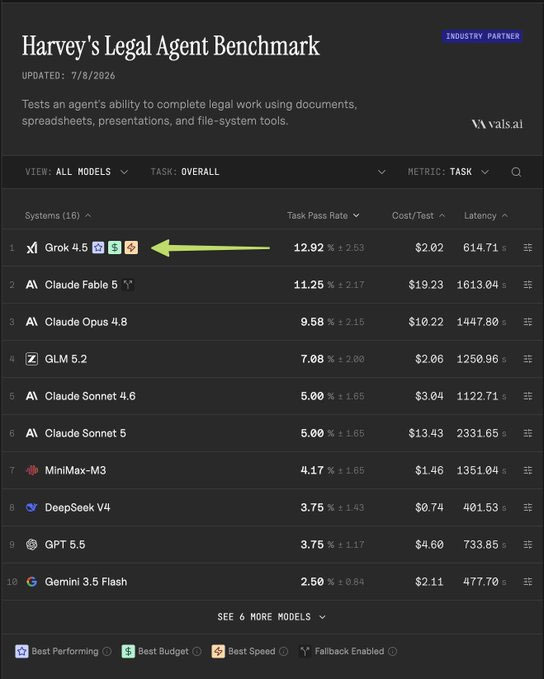
Musk commented on the test results on the social network X, citing a report that Grok 4.5 had taken the lead in the Harvey Legal Agent Benchmark (LAB)—an open evaluation system for AI agents performing real-world legal tasks.
“Grok has always been very strong on law,” Musk wrote.
Harvey LAB is considered one of the most comprehensive open tests for evaluating specialized AI systems in the legal field. The benchmark includes more than 1,200 practical tasks across 24 areas of law. The models’ responses are evaluated against more than 75,000 expert criteria, which allows for the analysis not only of the accuracy of individual responses but also of the AI’s ability to perform lengthy, multi-step legal tasks.
According to the benchmark’s developers, Grok 4.5 ranked first among the tested models.
AI Specialization
In recent months, competition among generative AI developers has been shifting increasingly from general-purpose chatbots to specialized professional systems.
One of the most promising areas is the legal industry, where artificial intelligence is used to analyze documents, draft contracts, search for case law, and conduct legal research.
The post cited by Musk also includes user testimonials claiming that Grok is already being used to review legal documents, independently prepare court filings, conduct legal research, and resolve certain consumer disputes.
However, such examples reflect the experiences of individual users and do not constitute an official assessment of the system’s effectiveness in judicial practice.
Legal AI agents are becoming one of the fastest-growing segments of the artificial intelligence market. In addition to xAI, specialized solutions for lawyers are being developed by OpenAI, Anthropic, Google, and a number of other industry-specific companies.
Grok 4.5’s high score in the Harvey LAB demonstrates that competition among leading AI developers is increasingly shifting toward professional industry-specific solutions, where the model’s ability to perform complex expert tasks—rather than the speed of text generation—is of key importance.