

Andrian Gavrilita
Among the key changes are a simplified process for switching banks—which will now be handled directly by service providers—as well as the introduction of a standardized information form so that customers can easily compare fees before signing a contract. The regulatory authority will also launch a dedicated webpage for comparing rates.
At the same time, the law guarantees the right of all citizens, including vulnerable groups, to a payment account with basic services, which will be provided free of charge or for a reasonable fee, without any discrimination.
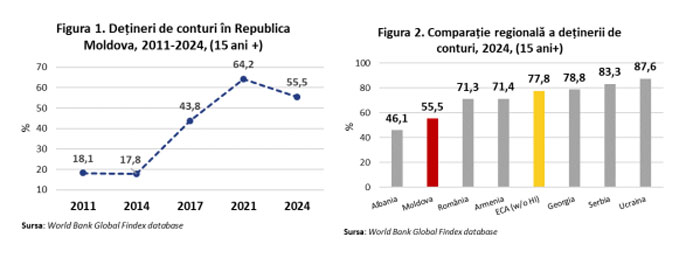
The National Commission for the Financial Market notes that the level of financial inclusion in the Republic of Moldova has declined in recent years, reaching 55.5% in 2024 compared to 64.2% in 2021, according to data from the Global Findex Database.
This 8.7 percentage point decline places our country 22.3 percentage points below the regional average for Europe and Central Asia. In terms of access to banking services, Moldova lags behind most countries in the region, with the exception of Albania.
Authorities have identified the main reasons for this situation as a lack of trust in financial institutions—cited by 40% of people without a bank account—as well as a lack of products tailored to the needs of low-income customers who require transactions involving small amounts and minimal administrative documentation.
The proposed bill aims to address this imbalance and promote financial inclusion among the population.


