

The Ministry Proposes Changes to the Industry’s Structure
The upcoming increase in gas rates for end users continues to spark heated debate.
Energy Minister Dorin Junghiu published a post on social media explaining the situation on international markets and the inevitability of the rate hike due to rising gas purchase prices.
“Today, the price of natural gas on European markets has reached 64 euros/MWh. This is the clearest sign that the market remains under pressure from geopolitical tensions and intensifying competition for liquefied natural gas.
In recent days, we have heard many questions about the reasons for adjusting gas rates for Moldovan consumers. The answer is simple: the Republic of Moldova cannot isolate itself from developments in the European market,” the minister noted.
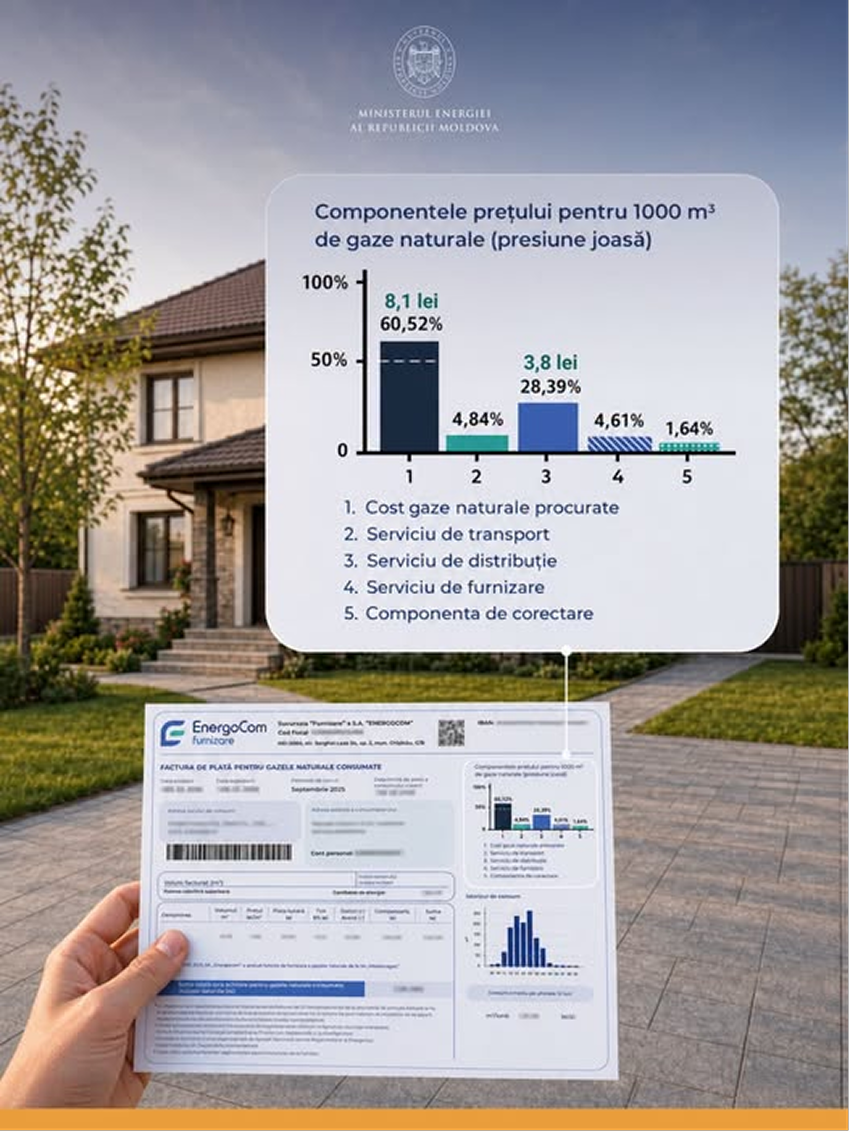
At the same time, he pointed out that, after the cost of purchased gas, the distribution service remains the largest component of the final tariff. According to him, it costs consumers nearly 4 lei per cubic meter, or about 30% of the final price.
In this regard, the ministry proposes merging the 12 gas distribution companies that are part of the “Moldovagaz” group into a single company. According to the ministry’s assessment, a more centralized structure will reduce administrative costs and improve the system’s efficiency.
In addition, the Ministry of Energy proposes changing the regulatory methodology by allowing the National Energy Regulatory Authority (NARE) to review natural gas tariffs on a quarterly basis depending on the situation on the European market.
“Moldovagaz”: We Are Ready, but the Impact on Rates Will Be Limited
Vadim Cheban, Chairman of the Board of JSC “Moldovagaz,” stated that the company supports the initiative to reorganize distribution companies. According to him, the necessary documents have already been prepared and will be submitted to the group’s management in the near future.
At the same time, he noted that the final decision must be made by the company’s shareholders—PJSC “Gazprom” and the Government of the Republic of Moldova.
Cheban also emphasized that the reorganization itself will not have an immediate or significant impact on natural gas tariffs. In his assessment, the effect will not be significant in the future either, given the reduction in gas volumes distributed following the market liberalization on April 1, 2026.
Tariff Share and Service Cost
The Ministry of Energy emphasizes that gas distribution accounts for about 30% of the final tariff for consumers. This indirectly suggests that this is where “reserves” for lowering the tariff can be found.
However, this share alone does not indicate that the cost of the service is inflated. Simple calculations show that this is not entirely the case.
The chart presented by Dorin Jungietu, showing the breakdown of various tariff components, indicates that the share of natural gas transportation services is only 4.84%. This is significantly less than the 28.39% accounted for by distribution.
But absolute figures do not always paint an accurate picture. Let’s perform some basic calculations to demonstrate this. We should note right away, however, that these are our own calculations, which may not take certain additional circumstances into account.
Both gas transportation and distribution are carried out via gas pipeline networks
Main gas transportation in Moldova is carried out by VestMoldTransgaz, which operates a network spanning approximately 1,500 km. The gas distribution networks, managed by the “Moldovagaz” group, exceed 26,000 km in length and deliver fuel directly to end users.
The average regulated transmission tariff is about 600 lei per 1,000 cubic meters, while the average distribution tariff is approximately 2,400 lei per 1,000 cubic meters.
The higher cost of distribution is due not only to administrative expenses but also to the significantly greater length of the network, the need to operate tens of thousands of kilometers of gas pipelines, maintain hundreds of thousands of connection points, carry out emergency repairs, perform routine maintenance, and invest in infrastructure.
In other words, comparing only the shares in the final tariff does not allow us to conclude that distribution is economically inefficient or that its cost is inflated.
In other words, from the chart presented, we can see that in the final tariff for consumers:
– gas procurement – 8.1 lei/m³ (60.52%);
– transportation – approximately 0.65 lei/m³ (4.84%);
– distribution—3.8 lei/m³ (28.39%);
(we’ll set aside the other components).
But if we roughly divide the tariff by the number of kilometers of the network, we get:
– transmission: 600 / 1,500 km ≈ 0.40 lei per km;
– distribution: 2,400 / 26,000 km ≈ 0.09 lei per km.
Of course, this calculation greatly simplifies reality, because networks have different capacities and loads, but it illustrates an important point: the high distribution tariff itself is explained by the fact that the distribution network is nearly 17 times longer than the transmission network.
The price of gas purchases remains the determining factor
None of this means that the optimization of “Moldovagaz’s” structure, as discussed by Minister Dorin Jungietu, should not be carried out. The initiative to merge 12 distribution companies could yield economic benefits by reducing duplicated administrative functions—such as management, accounting, legal support, procurement, and other services.
However, even if such a reform is successfully implemented, the bulk of distribution costs—network maintenance and operation, repairs, depreciation, investments, and emergency services—will remain. This is precisely why MoldovaGas management does not expect that the merger of the companies will, in and of itself, lead to a noticeable reduction in rates for end consumers.
Therefore, the price of gas purchased on external markets will remain the determining factor in setting the final rate for consumers. Winter is approaching. When and at what prices we purchase fuel for the cold season will determine how much consumers will pay.


