
Of course, the war in the Middle East has demonstrated that energy and fertilizers, as one of their derivatives of natural resource processing, can quickly and significantly push up agricultural prices. But as millennia of human history have shown, drought destroys food sources even more effectively.
Who’s first?
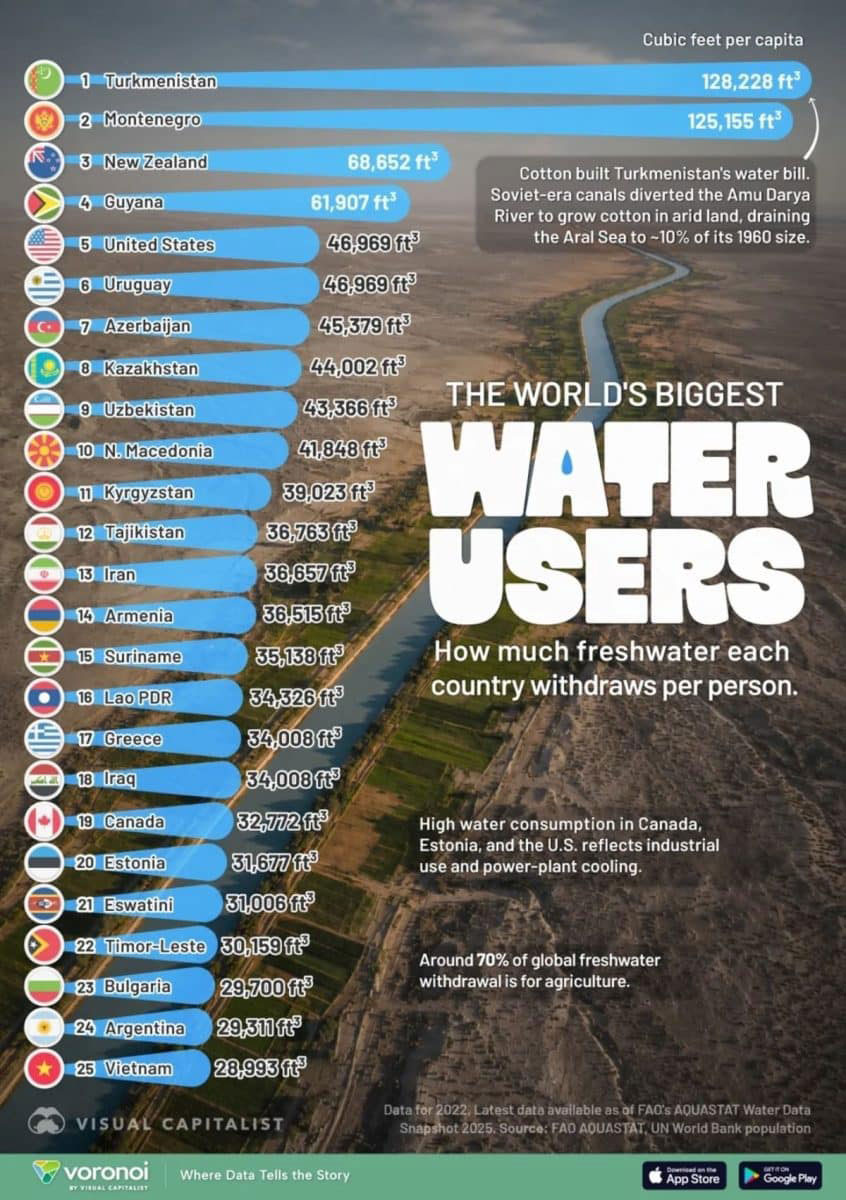
Data from the Food and Agriculture Organization of the United Nations/FAO global information system on water resources and water use in agriculture, as well as World Bank statistics on population, show a rather unexpected picture of global water withdrawal.
Turkmenistan ranks first in the world ranking by a huge margin. The country consumes 128,228 cubic feet of water (more than 3,631 cubic meters) per person per year. This high level is due to the giant irrigation network created for cotton farming in one of the driest regions of Central Asia. Back in Soviet times, canals began diverting water from the Amu Darya River to dry farmland. It was these projects that became one of the reasons for the catastrophic shallowing of the Aral Sea.
Today, agriculture accounts for about 70% of the world’s freshwater consumption. That is why among the countries with the highest water consumption there are many states with arid or semi-arid climate and developed irrigated agriculture. The list of the first fifteen countries of the rating includes Azerbaijan, Kazakhstan, Uzbekistan, Kyrgyzstan, Tajikistan and Iran. In all these countries, water demand is largely determined by agriculture and large-scale river water diversion systems. And with relatively small populations, per capita consumption rates are increasing dramatically.
Not only agricultural countries
However, not all countries on the list owe their performance solely to agriculture. Montenegro comes in second because of its extremely high water consumption with a relatively small population. Per capita water consumption rankings can rise sharply in smaller countries if large irrigation or industrial systems are distributed over a relatively small population. For example, Montenegro, with a population of only 627,702, ranks second with 125,155 cubic feet of water (3,543 cubic meters) per person.
The United States ranks fifth, and Canada and Estonia are also in the top 20. In these countries, high water withdrawals are often associated with industrial production and power plant cooling. This water use differs from domestic consumption. Much of the water used for cooling is later returned to rivers and lakes, but the system itself still puts a serious strain on local water resources.