
Vlad Filat
This was stated by former Prime Minister Vladimir Filat. On his page in social networks, he presented the dynamics of Moldova’s financing from different international structures, on the basis of which he draws his conclusions. They touch upon a serious problem, so Logos Press publishes this post practically unchanged.
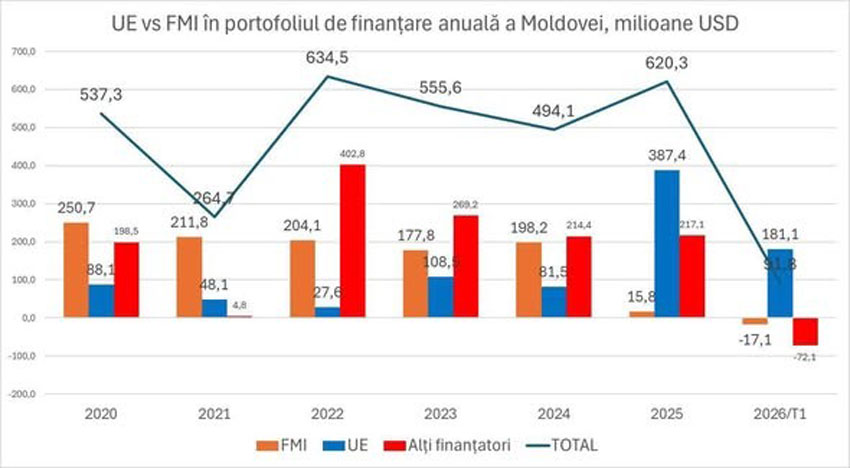
EU vs. IMF in annual funding portfolio
A clear signal from the IMF
The government obsessively repeats that Moldova benefits from external support, trying to create an impression of economic stability, which in reality rests on fragile foundations.
For the first time in its relations with Moldova, the International Monetary Fund decided to stop financing under the active program, which is interpreted as a clear signal of distrust in the current government’s ability to implement the ongoing reforms.
The IMF does not work with political perceptions or sympathies, but with performance indicators. And when these conditions are not met, the reaction is harsh. Traditionally, the IMF’s position has served as a benchmark for other external partners as a barometer of a country’s economic and institutional health.
Paradoxically, just when this barometer indicates a deteriorating situation, the European Union decided to continue and even intensify financing of Moldova not as a result of internal progress, but as a result of a political decision.
This discrepancy between the IMF technical assessment and the EU political decision defines the current period. The share of European financing in the total external debt is rapidly increasing, while the role of traditional performance-oriented and conditionality-oriented financiers is markedly diminishing.
What are the dangers of this approach
This change has a structural impact on the state. In the absence of reform pressure, external financing ceases to act as a catalyst for modernization, becoming a mechanism for maintaining the status quo. Money no longer determines conditions, but only postpones them.
Thus, infrastructure projects risk becoming instruments of resource redistribution, energy subsidies are transformed into instruments of political management, and state-owned enterprises continue to operate inefficiently without restructuring pressure.
The most serious signal appears in the structure of recent financing, especially in 2026, when Moldova ends up entering into loan agreements with the EU not for investment or development, but to fulfill its obligations to other creditors. This refinancing mechanism points to entering a vicious circle in which loans no longer generate economic growth but only cover existing imbalances.
In the absence of real reforms, this model becomes unsustainable, as each new financing postpones inevitable adjustments.
In parallel, the dependence on external financing masks the fundamental problems of the real economy, which suffers from a lack of productive investment, weakened institutional capacity and a deteriorating economic environment. The state budget is supported by external inflows, but this apparent stability does not reflect internal consolidation, but shows an increasingly pronounced dependence on external decisions.
Risks of unconditional financing
In this context, it needs to be made clear that unconditional financing is not an advantage but a serious risk because it removes the adjustment mechanism that forces governments to undertake difficult but necessary reforms. When money continues to flow regardless of results, incentives for change disappear and the system tends to degenerate.
The Republic of Moldova today is no longer funded because it works, being considered politically relevant, and this reality changes the nature of relations with external partners.
Economic history provides enough examples showing that major crises do not arise from a lack of money, but from its irresponsible use and without reforms.
In this sense, the main risk for the Republic of Moldova is not the cessation of funding, but its continuation in the absence of real changes, because this type of support does not solve problems, but only prolongs and deepens them.


