Send us a message, and we will definitely consider your suggestions and comments.
All
Accidents
Agribusiness & Winemaking
Art & Culture
Artificial Intelligence
Banks & Finance
Business & Companies
City & Regions
Culture
Digitalization
Economy & Law
Education
Electricity
Energy
European Integration
Events
Export & Import
FinTech
Gas
Global Economy
Global Markets
Green Economy
Healthcare
Infrastructure
International Trade
Investments & Markets
IT Market
Logos Press Exclusive
Moldova’s Economy
Municipalities
Point of View
Politics & Economy
Pro Business
Renewable Energy
Retail & HoReCa
Social Sphere
Society
Sport & Tourism
Technology & Innovation
Territorial Reform
Top News
Tourism
News
The draft tax policy for 2027 proposes raising the corporate income tax rate for the financial sector from 12% to 18% for the entire tax year. This proposal has drawn comments from both experts and the general public.

Moldova needs to start finding common ground. Not about everything at once, and not about the past. But at least on what kind of country we are trying to build and whether there is a place in it for people with different experiences, languages and views of what is happening.

At the end of last week, the National Bureau of Statistics published a study titled “Trends in Economic Activity in the Third Quarter of 2026.” The survey results prompted comments in the press that sparked a debate.

At the next stage, strategic communication should move beyond explaining reforms and contribute to building internal partnerships, which are essential for a successful European transition.

In Moldova, a total of 1,601 thousand dwellings were counted, of which 995 thousand (or 62%) were occupied, while 38% were vacant. In Chisinau, the number of occupied dwellings is 301,942; the number of vacant dwellings is not specified, but given the stated proportion, it is not difficult to make an approximate estimate.
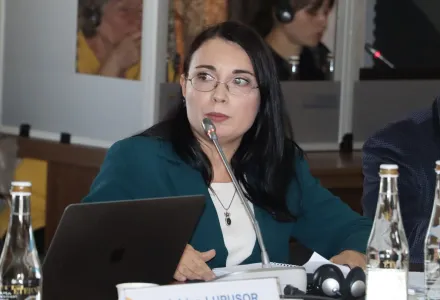
It was a typical hot summer month. The public seemed to be in good spirits. People had finally recovered from the winter’s hardships and were calmly working in their gardens or, if they were lucky, relaxing at resorts. But Prime Minister Alexandru Munteanu announced his resignation. Trouble came to the authorities from an unexpected source—from within their own ranks—and if Prime Minister Alexandru Munteanu hadn’t decided to resign on his own, it’s quite likely that others would have forced him out.

It appears that the role of trees in combating climate change has been overestimated. Trees may not be capable of absorbing as much of the carbon that is warming the planet as previously thought.

“The European Union cannot ‘kill its own industry because of climate change,'” said Manfred Weber, chairman of the European People’s Party, amid a grueling heat wave that has swept across Europe, claimed about 1,300 lives, and reignited the debate over the bloc’s climate policy.

Anna Paula criticized the ban on the use of the Russian language in public spaces. She posted her opinion on social media.

“We can’t sell a traditional blouse for 400 lei when our labor alone is valued at 400 lei,” says a craftswoman at Mirabela.

Over the past four years, the staff of government agencies and ministries has nearly doubled. As part of the administrative reform, the authorities are curtailing local power with one hand while expanding central power with the other.

Logos Press continues Alexandru Bejenari’s series of articles on transition communication in Moldova. The first article discussed why good news about the country’s future doesn’t always become a common thread.

In the first quarter of 2026, value added in the “Information Services and Communications” sector decreased by 8% compared to the first quarter of 2025. This reduced total GDP by 0.7%. These figures are provided by Marina Solovyova, Program Director at Expert Grup.

Global food prices remain near three-year highs due to logistical disruptions and unfavorable weather conditions.

Major investors are predicting the collapse of the neural network economy in its current form. Billionaire Ray Dalio, founder of Bridgewater Associates, has predicted the deflation of the artificial intelligence bubble. The reasons will be related not so much to the financial failure of companies working in this field, but to the banal desire of investors to lock in profits. All the signs of retreat are already in place. Meanwhile, a downturn in the AI sector could hit the broader economy: first of all, the American economy, but eventually the global economy as well.

The initiative of German Chancellor Friedrich Merz, proposing to introduce the status of “associate member” for Moldova, Ukraine and Western Balkan countries, is regarded by experts as a creative but purely political solution, which risks turning the path to full membership into a “receivership” for an indefinite period of time.

Moldovan Foreign Minister and Deputy Prime Minister Mihai Popşoi, who is a Romanian citizen, supports unification with this country and is ready to vote for it if a referendum is held. He made this statement on air on the Vocea Basarabiei radio station.

The government is establishing territorial education agencies, which will take over the management of schools from the district councils. These agencies will report directly to the Ministry of Education and Enlightenment. The authorities explain the reform by the need to, among other things, “depoliticize” the local education system, while the opposition calls it “centralization”.

This opinion was expressed by Moldovan economist and analyst Sergei Banari in the project of the Belarusian news agency BelTA “In theme.

A cryptoblogger under the pseudonym The Smart Ape has published a detailed analysis of the economic consequences of mass AI automation. The starting point was the forecast of Microsoft AI head Mustafa Suleiman, who told the Financial Times back in February: AI will automate most office professions in 12-18 months.