
Map: countries with the highest debt to the International Monetary Fund / © Visual Capitalist
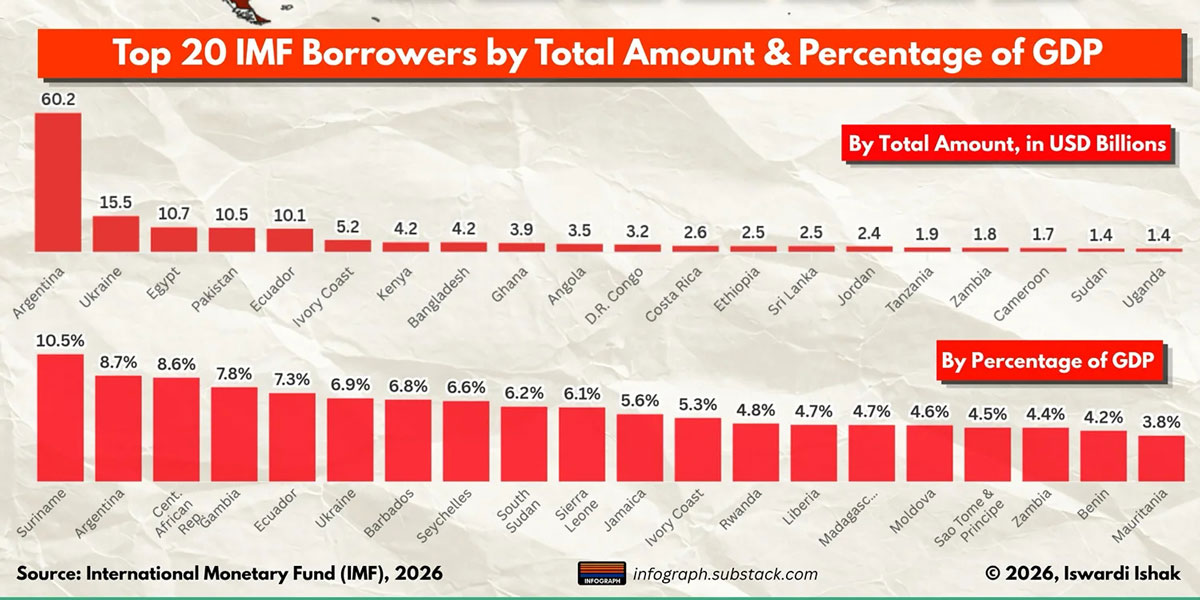
The amount owed to the IMF is about $1.016 billion, equivalent to about 4.6 percent of GDP, according to the data Visual Capitalist.
In the ranking Moldova is between Benin and Madagascar.
On April 28, 2026, the analytical publication Visual Capitalist published a fresh visualization of countries’ debt to the International Monetary Fund. The platform specializes in processing complex economic data in visual form and is widely used by investors and analysts to quickly assess global trends.
The new data are important because they show the pattern of nations’ dependence on external financing in the face of rising global debt burdens and market volatility. It shows which economies are most vulnerable and most dependent on IMF support.
Most at risk are developing countries
Argentina remains the absolute leader in debt to the IMF, with more than $60 billion in liabilities, almost four times as much as the next largest borrower. This reflects the country’s chronic macroeconomic problems, ranging from inflation to currency crises.
Other major debtors include Egypt, Ukraine and Pakistan, which have traditionally been active in attracting Fund financing to stabilize their economies. At the same time, the geography of borrowers is shifted towards developing countries: the largest number of debtor countries is in Africa, although their debts, as a rule, are smaller in absolute terms, the publication notes.
If we look at the debt burden relative to GDP, among the most dependent on the IMF are small and vulnerable economies, where the Fund’s loans account for a significant share of the national product. It is this indicator, rather than the absolute amount, that is more often used to assess debt sustainability risks.
In Eastern Europe, the situation is not uniform. Ukraine remains one of the largest recipients of IMF financing amid military and economic challenges. Romania and Russia are virtually independent of fund lending, and Belarus has limited interaction with the IMF.
Visual Capitalist’s new visualization confirms a key trend: the IMF remains a critical source of financing primarily for developing and crisis economies. At the same time, the concentration of debt in individual countries, such as Argentina, underscores structural imbalances in the global financial system, where sustainability increasingly depends not on the size of an economy but on its ability to service external liabilities.