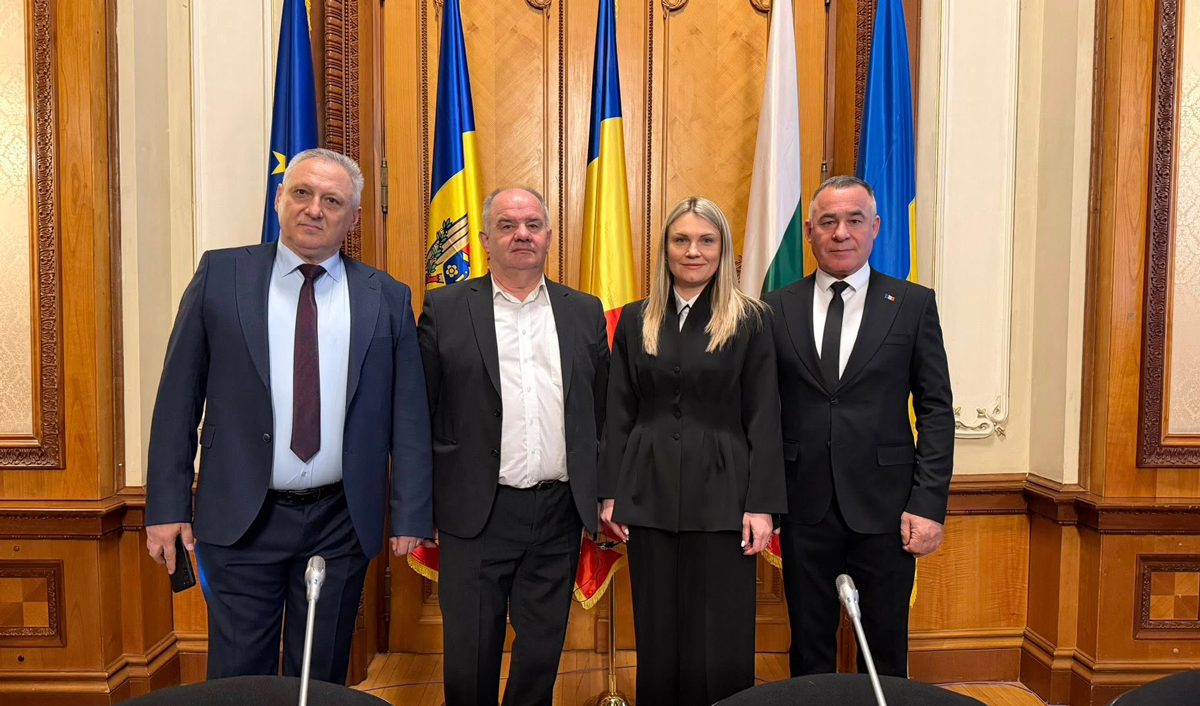

Environment Minister Gheorghe Hajder presented the first detailed report on the incident in Parliament, including the official version of the chronology of events:
March 7 – Russian attack on the hydroelectric power plant in Novodnestrovsk (Ukraine) caused a massive discharge of oil products into the Dniester;
March 10 – the first signs of pollution were recorded on the territory of Moldova; laboratories were sent to take samples. Official information is requested from the relevant Ministry of Ukraine to assess the scale of the situation;
March 11 – the first filter was installed on the river in the village of Kureshnitsa (Soroca district); an appeal was sent to the Ukrainian side with a request to reduce water discharge to 80 m³/s to slow down the spread of pollution;
March 11-12 – due to the movement of the polluted wave, water intake from the Dniester was temporarily suspended;
March 12 – the Dniester Commission was convened in online format; assistance was requested from Romania, which responded on the same day;
March 13 – laboratory analyses showed that the permissible norms of oil products were exceeded; a fishing ban was introduced. Activation of the EU Civil Protection Mechanism was initiated and requests were sent through diplomatic missions;
March 14 – water intake in the Naslavca-Soroka section was completely stopped;
March 15 – the Government declared a 15-day high alert regime in the Dniester basin;
March 16 – the Ministry of Environment issued an order with special requirements for local authorities, economic agents and water supply operators;
March 17 – at a meeting with the Ukrainian ambassador, the stopping of the pollution source was confirmed; a new request for operational information was sent; a regular meeting of the Dniester Commission was held;
March 18 – joint sampling was conducted; analysis continues;
March 19 – water supply was restored in Soroca, Floresti, Singerei and Balti after the water quality was confirmed by laboratories.
Inaccessibility of information
The report does not contain information about what happened on March 8 and 9. The authorities explain the delay in informing by the difficulty of obtaining data: the facility belongs to Ukraine’s critical infrastructure and is protected by the martial law regime.
The director of the National Crisis Management Center, Serhiy Diaconu, said: “We did not know how much and from where the discharge occurred, but from the first day we activated the mechanisms provided for crisis management and contacted our colleagues from Ukraine to provide us with information. The result was simple: in the first two days, they did not have access to that hydroelectric power plant because there were unexploded shells left there, and they had to send teams to clear it. They could not verify exactly what had been dropped and only gave rough estimates on the rockets that fell and were neutralized. After the 10th, President Zielenski’s office confirmed that it could not give a full assessment of the leaks, but that steps were being taken to ensure that these discharges were stopped.”
Crisis of communication and trust
Amid the lack of official information, the public filled the vacuum with rumors and contradictory versions, which increased anxiety and distrust. The source and nature of the contamination raised especially many questions. According to preliminary official data, it is about oil products and their derivatives. Citizens heard the information clearly only on Friday, March 20, thanks to parliamentary hearings.
Nicu Belitei, Director of the Environment Agency, said:
“Reference Laboratory specialists analyzed the samples taken, including those of the National Public Health Agency, and four chemicals are present in all samples: benzene, toluene, methylbenzene and xylene. All are derivatives of light petroleum products, namely gasoline or diesel fuel. They dissolve in water and reappear as stains on the surface. The stains are rainbow-colored, which means that they are light oil products”.
PCRM deputy Inga Sibova asked why the data of laboratories are not published: people do not understand how correct the analyses are.
Minister Hajder: “Yes, the information comes in waves and inconsistently. We waited for an average positive trend and decided then to inform people that everything is in order”.
Blurred chain of command
The environment minister admitted that during this period, instructions to government agencies came from the National Crisis Management Center. This is because the ministry is uncomfortable “giving orders” to entities that are not subordinate to it. This raised questions about the constitutionality of the governance mechanism when there is a full government in place.
The reaction of state structures to the deputies’ requests also raised separate questions. Olena Hrytsko on the water supply to Balti:
“In order to discuss a national security issue with the IRB director, I, as a deputy, need to submit an official request, which will be considered so that the IRB director will receive me for discussion.”
Alternativa bloc MP Mark Tkachuk pointed to “a flow of very murky and contradictory information.” He asked the minister a number of questions about what tests and on what date allowed to finally declare the Dniester water clean and free of rocket fuel and transformer oil impurities and to connect the municipality of Balti to the water supply system.
From the inconsistent answers, Tcaciuc concluded that Chisinau made decisions to limit and start water supply in the north of the republic without scientific and laboratory grounds:
“On the basis of 0.2 ppm of petroleum products in the water, you stopped the Soroca-Bălţi water pipeline? This is a very interesting position. Was it a PR campaign to punish Balti?”.
Dependence on external factors
The environmental safety of the Dniester directly depends on the situation in Ukraine. At the same time, Moldovan specialists are still not allowed to enter the territory of the plant.
Ilya Trombitsky, Executive Director of the Association of Dniester River Keepers “Eco-TIRAS”, Doctor of Biological Sciences, said:
“I keep insisting that we need to better understand what happened and, accordingly, conduct all the necessary analyses – even if in the European Union or anywhere else. Water should be safe not only in terms of hydrocarbons contained in the oil, but also in terms of other substances that may have accompanied the pollution,” Trombitsky shared on the air of one of the TV channels.
Weak international response
As a reminder, on March 13, Moldova initiated the activation of the EU Civil Protection Mechanism to respond to the oil spill in Dniester. So far, the only public reaction to the authorities’ appeal was the declaration of the European Commissioner for Enlargement and Neighborhood Policy Marta Koss on March 16 that she was ready to help.
The government also requested assistance through diplomatic missions, claiming to have received confirmations from a number of countries. Only Romania has so far provided actual assistance in the aftermath.
Outdated protocols
The current crisis is one of many that Moldova has faced for the first time in recent years. It has highlighted the need to revise approaches to responding to natural emergencies.
“It is necessary to revise certain protocols in order to be much more resilient in such situations – and we will definitely do that,” the minister said.
Vulnerability of reserves
The crisis has shown how vulnerable alternative water sources are. Even existing reserves need to be inventoried, cleaned and regularly maintained – something almost no one is doing. Every local government is required by law to maintain alternative water supplies and conduct annual maintenance. Now additional resources have been allocated to clean and commission some of the wells that have been sitting abandoned for decades.
Renato Usatii, chairman of Our Party, drew attention to the Gidigichi reservoir, a strategic site for the capital’s water supply in case of emergency.
“We will certainly return to these issues when we understand what happened and how we can improve this process in the future. This is a very good lesson, we will make an inventory and control of all alternative sources – be it reservoirs or artesian wells,” Gheorghe Hajder said.
Long-term consequences
Moldova has yet to assess the true cost of the damage to the Dniester. As long as the wave of pollution continues, it is impossible to do so.
At the same time, experts note that the river is already experiencing low water levels: the ecosystem, of course, is gradually adapting to such changes, but the state of the Dniester is no longer as “healthy” as it used to be.
In any unclear situation…
The Moldovan authorities at all levels blamed Russia for the pollution of water in the Dniester. The Parliament did this officially – by adopting the “Declaration of condemnation of the Russian Federation for the transboundary pollution of the Dniester River and the damage caused to the safety of water supply and health of the population of the Republic of Moldova”.
It is still unclear whether such politicization of the situation with the Dniester will help, but at least let it not prevent specialists from doing their work. The work on pollution elimination has shown that Moldova has professionals devoted to their country and society.