The current image of the banking system as a “showcase” is very convenient—it makes it clear who to blame and where to run. But I have some bad news for you: the next crisis will most likely look nothing like the ones before. ATMs will continue to work. Deposits won’t go anywhere. The National Bank will calmly talk about high liquidity and capital adequacy.

Before wrapping up the topic of the bid price index, it’s worth adding something specific to Moldova—something that explains not why this methodological error occurs (this is a universal issue; regulators make this mistake almost everywhere), but why, specifically in Moldova, there is no one to correct it in time.

Imagine a Sunday breakfast. Two people are sitting at the table. One has spent his entire life studying bubbles, irrational expectations, and how crowds can turn price into a religion. The other has spent his entire life explaining how reputable institutions pretend to manage risk, when in reality they simply package it nicely in their financial statements so it doesn’t scare off investors prematurely.

Dumitru Taraburca, a regular contributor to Logos Press, has presented a new series of articles in which he reveals the “inner workings” of the Republic of Moldova’s banking system and its interconnection with the state of the country’s economy as a whole. One may debate, disagree with, or reject the author’s specific opinions and conclusions. However, they are of unquestionable interest to the expert community and anyone who wants to understand the realities of Moldova.

If you were to trace the entire course of the Moldovan crisis as a single chain of events, it would look like a closed system without a single safety mechanism.

The diagnosis of “construction without development” explains the origins of the current housing market crisis. But the diagnosis alone doesn’t change anything, and the Moldovan debate on real estate gets stuck at this very point every time: the problem is identified, reforms are listed, and the participants go their separate ways.

There has been a lot of discussion lately about the real estate market crisis and its causes. But these discussions are fragmented and not always logically connected. The problem, however, is complex and interconnected. That is precisely why “picking out” individual facts or statistical data and commenting on them without considering the broader chain of factors can lead us down the wrong path in our search for the causes of the crisis.

A region develops not when it adopts a new administrative structure, but when it develops its own economic function. In other words, a clear answer to the question: what does this region produce, and how can it finance its future? The budget, the council, the autonomy charter, and even the university—these are all just a shell.

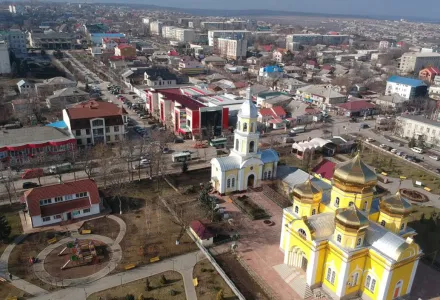
Comrat is the administrative center of the Gagauz Autonomous Region, a university hub in the south of the country, and the second-largest of Moldova’s small towns with special status.
One of the most convenient illusions of modern administrative policy is the notion that digitalization can replace development. Whereas in the past, a poor region was promised roads, water, schools, factories, a labor market, and jobs, it is now increasingly promised e-services, platforms, digital offices, online applications, integrated registries, and a reduction in administrative burdens.

Moldovan regional thinking follows a simple pattern: the farther away from Chișinău, the worse it is; the closer to the border, the better the prospects. This holds true on the map, but not in the economy.

The administrative reform proposed by the authorities seeks a one-size-fits-all solution for different regions. The government looks at a map and sees city administrations, budgets, and population sizes—and is tempted to think: if the problem looks the same, it can be solved the same way. That is a mistake.

Poverty is a state of being. Depression is a mechanism—one that operates over a long period of time. It is no longer merely stagnation or a recession. Depression reflects the absence of any possibility for change. Poverty shows how much a region has today. Depression shows whether it is capable of shaping its own future. These are fundamentally different questions that require fundamentally different answers.

A depressed region has another dangerous characteristic. Over time, it ceases to be merely an economic problem and becomes a model of governance.

Logos Press continues its series of articles by journalist Evgeny Perestoronin and expert Dmitry Tereburke on local self-government and administrative-territorial reform.

One of the main illusions of the administrative reform is that local self-government can be created legally. It is enough to transfer powers to the territory, elect a local council, approve the budget, appoint the staff, write a strategy, hold public hearings – and the territory supposedly becomes a subject of development.

One of the main mistakes of Moldovan territorial development policy is that territory is too often seen as an administrative unit rather than a historically established economic system. The authorities look at a map and see districts, mayoralties, settlements, budgets, roads, schools, hospitals, population. But this map almost always hides another, much more important map – the map of lost functions.

When they talk about local elections in Moldova, they almost always discuss people. Who will win, who will lose, which party will be strengthened, who is behind whom, who has made a deal with whom, and how this will affect the big political game. Then the elections pass, the passions gradually subside, the elected mayors return to their daily work – and it turns out that the main issue has been left aside again.

Today, against the background of the possible opening of negotiations on Moldova’s accession to the European Union, discussions on the quality of public administration, opportunities and risks of economic development and, consequently, the need to reintegrate the country are intensifying in the public space.

When talking about Moldovan sovereignty, the usual categories come into play – borders, energy, foreign policy, relations with Brussels, Moscow, Washington or Bucharest.