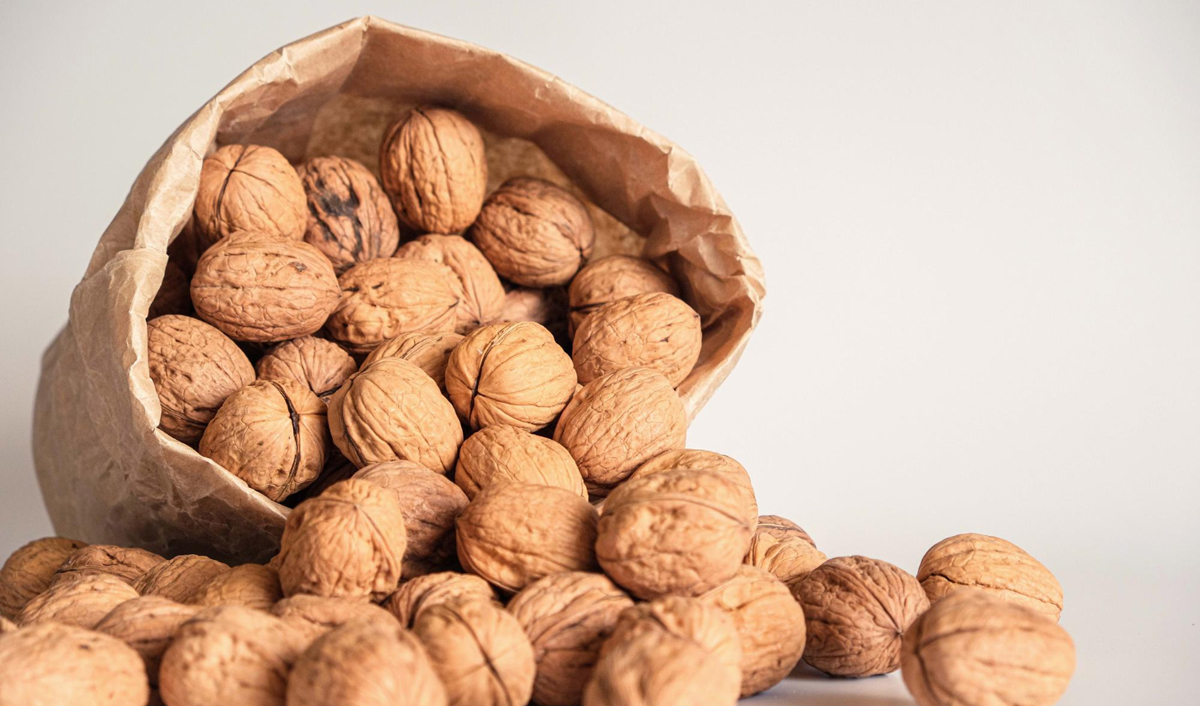

Over the past two decades, Ukraine has consistently ranked third or fourth in the world ranking of walnut exporters – after the United States, China and Chile.
Over the previous five years, the country exported more than 160,000 tons of walnut products worth $461.4m, AgroTimes reported, citing a Facebook post by the president of the Ukrainian Walnut Association, Hennadiy Yudin.
According to the expert, foreign consumers “appreciate Ukrainian nuts for their rich quality flavor, which they have due to growing on fertile Ukrainian chernozems, rather simple logistics in the EU, low price and high quality of their processing”.
The balance on the European walnut market has changed
However, in 2025 the situation has changed dramatically. If earlier the average annual export of walnuts brought $92.2 million to the budget of Ukraine, last year this figure fell by an order of magnitude – to $9.2 million. Exports of walnut kernels fell by 97%, and nuts in shell – by 76%, says Gennady Yudin.
Of the more than 1 billion euros that the EU spent on walnut imports last season, Ukraine’s share amounted to only 6.8 million euros.
The main suppliers to the EU were the same USA, Chile and China. Moreover, the increase in the share of the top three leaders in the European walnut market was due to a reduction in the shares of market players from Central European countries, primarily Ukraine.
The reason for this evolution is the introduction in Ukraine of the “export security” regime (with the establishment of minimum prices) and unregulated legislation in the field of legalization of walnut harvest from households. All of this combined to collapse official sales of Ukrainian walnut by 90% in 2025. “New powerful nut players are growing in the global market. But at this time Ukraine is losing its global nut status, which will be willingly taken by others,” emphasized the head of the Ukrainian Nut Association.
Growing contribution of China
Earlier Logos Press wrote that Chinese walnuts are becoming a familiar “variant of the norm” for the EU market. By the way, last year it was walnuts from China that squeezed Ukrainian and other Eastern European walnuts on the European market.
There are many reasons for this, but the main reason is the favorable price/quality ratio. Over the last decade the Chinese nut industry has done a very serious (and successful) work on quality and assortment. In the structure of the latter, “numbered” varieties have appeared, including early varieties, which successfully compete in the EU market with European analogs (in particular, the Moldovan-Ukrainian variety “Peschansky”).
Experts note that in terms of taste they are still inferior to walnuts of European and American selection – although this is subjective. But in terms of technology they are already comparable or even superior to them. And certainly few other products can compete on the European market with Chinese walnuts offered in bulk at a price range of 2-3 euros/kg (fruits in hard shell).
Prospects on the European market for nuts from Moldova
They are ambiguous and not guaranteed. Like Ukraine, Moldova is shifting downward in the world ranking of walnut exporters. A decade ago the country was in the top 5 of this rating – with the export indicator of more than 40 thousand tons of walnuts in hard shell (about 17 thousand tons of walnut kernel). Then the volume of external supplies of Moldovan walnuts fell into the range of 9-13 thousand tons (in terms of kernel), the country in the ranking of exporters was near the bottom of the TOP-10.
In the last few years, according to the estimation of Oleg Tirsine, Chairman of the Association of Nut Growers of Moldova, the annual export of Moldovan walnuts fluctuates within the range of 7-8 thousand tons (kernel) or about 20-24 thousand tons of fruits in shell.
At the same time, the commodity structure of external supplies has changed over the last five years. Whereas before the nuts in shell accounted for only 10-20% of the export volume, now the share of this commodity has grown to about 50-60%.
This happened due to the increase in the supply of varietal nuts grown on specialized garden-type plantations and, on the contrary, due to the decrease in the supply of products from forest belts and nut alleys along the roads. In a certain sense, this is an indicator of technological modernization and general “domestication” of the nut industry in Moldova.
In parallel, the geography of Moldovan walnut export is changing – its borders are expanding. Buyers from Turkey and the Balkans are gradually moving to the first positions among the buyers. In the European Union, the not very long list of large buyers of walnuts from Moldova has been supplemented in recent seasons by Italy.
“In case of purposeful work on quality, Italy could become the main European buyer of Moldovan walnuts,” states Oleg Tirsine. – I have repeatedly heard Italian traders saying that if they were satisfied with the policy of Moldovan nut growers regarding quality and pricing, they could buy all the nuts offered by Moldova in the short term. At the moment, Moldovan walnut exporters are responding to offers – for example, from buyers from Albania – to sell them relatively small quantities at a relatively high price. However, I believe that the operators of the nut industry in Moldova need to think about who they can sell nuts to when large quantities of stable quality are available in the country. In this case, Italy is a very interesting option.