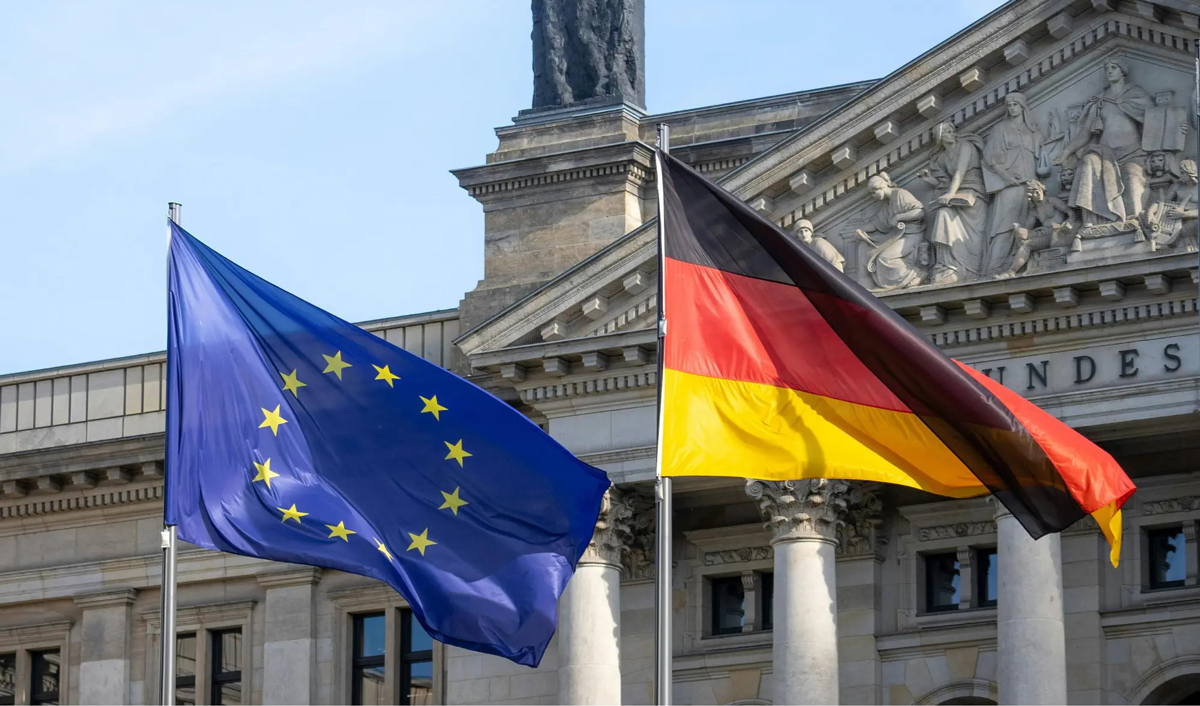

The EU has finally unveiled its “Made in Europe” industrial plan after repeated delays. Earlier Logos Press reported that state support and procurement were envisioned for sectors such as microchips, automobiles, chemicals and IT, which would be limited to products made in the European Union to give an advantage to European manufacturers.
By imposing localization of production (“Made in the EU”) requirements in key sectors of the EU economy, the EC seeks to strengthen industrial sovereignty and the economies’ dependence on external supplies, especially cheap Chinese imports.
The measures were in particular due to the fact that the European auto industry has asked for relaxation, DW specifies. Under pressure from the auto industry, the European Commission abandoned plans to completely ban sales of new cars with internal combustion engines in the EU by 2035, postponing the transition to “green energy” to a later date.
What will be included in the “Made in Europe” program
The EC’s Industrial Acceleration Bill was published on March 3 and covers sectors such as electric vehicles, solar and wind energy, setting thresholds for how much of the relevant products must be made in Europe to be eligible for government contracts or state support.
For electric vehicles, at least 70% of components (excluding the battery) must be manufactured in Europe, and the share of European-made components in batteries and solar panels must gradually increase over three years.
The program is planned to include battery production, solar and wind power, hydrogen, nuclear power, electric vehicles, as well as the chemical industry, artificial intelligence and space.
Localization requirements are defined by thresholds of origin of products from the EU: about 70% for electric cars, 25% for aluminum and 30% for plastic used in construction.
Plans to ban non-EU manufacturers from participating in government contracts and financing have been postponed for six months, euobserver.com details, citing sources in Brussels.
Between protectionism and competitiveness
The publication of Brussels’ new rules under the Made in Europe program (formalized through the Industrial Accelerator Act) was expected at the end of February, but was delayed due to fierce disagreement over how broad the legislation should be. Much of the criticism centered on a perceived departure from the traditional commitment to an open European market.
Some member states, including Finland, Ireland and Germany, objected to the Made in Europe plans, fearing they could disrupt trade with other blocs, most notably the United States and China. And rightly so.
The Brussels-based think tank Bruegel recently warned that “Made in Europe” requirements could raise costs for export-oriented industries and actually slow Europe’s industrial transformation and eventual transition to clean energy.
However, as entire industries have been excluded, the current version of the act is essentially left unfinished and significant changes are expected to be made to the final text by the time it is approved by the Council representing the Member States and the European Parliament.
Key elements of the new rules
It was originally planned that from 2035, only CO₂ emission-free vehicles would be allowed to be registered in the EU. In fact, this means a complete transition to electric vehicles. Now the European Commission, instead of requiring carbon dioxide (CO₂) emissions to reach zero, envisages their reduction from 100% to 90% compared to 2021.
Manufacturers will be able to offset the remaining 10% by using so-called “green” (low-carbon) steel, synthetic fuels, and biofuels from non-food raw materials such as agricultural waste or used cooking oil. This will keep hybrids and even some internal combustion engine models on the market.
In order to receive state support and participate in public procurement, electric cars must consist of 70% (excluding the battery) of components manufactured in the EU.
The share of European components in the production of batteries and solar panels must gradually increase over three years.
When allocating government contracts (the total volume of which in the EU is about 2 trillion euros), preference will be given to products labeled “Made in Europe”.
Simplifications for business and for following environmental standards are also envisaged. Consumer support measures are being considered, such as special parking rights for small cars with the “Made in Europe” label.
In parallel, the “EU Inc” status (28th legal regime) is being developed, which will allow startups to register online under uniform EU rules in order to scale up faster and compete on the global market.