A month after the vernissage, the works of Moldovan artists are still visible on Chisinau’s billboards. The second edition of Moldova Art Week officially closed on February 28, 2026, but the city has been in no hurry to take them down. That detail says more than any statistic.
Moldova Art Week was founded and personally financed by Andrei Jicol — an entrepreneur with over 15 years of experience in the outdoor advertising industry, involved in shaping national advertising legislation, and the initiator of urban design codes for both Chisinau and Balti. The scale of the project is best captured by one figure: four million billboard impressions across two cities. And 17 partners — 11 radio stations and six outdoor advertising companies — who participated voluntarily, without a single euro in return.
The second edition brought together 104 participating artists — compared to just 25 in the first edition. Around 200 billboards across the two cities displayed artworks, covering roughly 2500 square meters of space and generating an estimated four million impressions. Eleven radio stations broadcast around 1,000 minutes of audio artwork descriptions, while six OOH companies donated advertising space with an estimated commercial value of 78,000 euros. The vernissage was held at the National Palace “Nicolae Sulac” between February 26 and 28, 2026, where five artworks were sold at prices ranging from 250 to 9,000 euros — all without a single partner receiving financial remuneration in return.
An Idea Years in the Making
Andrei Jicol did not build Moldova Art Week overnight. The idea was shaped over years of uncertainty: would the artistic community participate? Would people really look at a painting on a billboard differently than at an ad?
“It took time to understand that a project like this is achievable,” he says. “I had doubts that it would be accepted — by the artists, by the public, by anyone.”
At the core of the project is a conviction Jicol articulates clearly: any business operating in a country has a moral obligation toward the society it works in. For someone who spent 15 years building the city’s advertising infrastructure — and who helped define the rules governing the visual character of public space through urban design codes for Chisinau and Balti — this obligation takes on a concrete and logical form.
“The outdoor advertising business works with people’s attention. With so much of the city’s attention at our disposal, it would be wrong not to bring art closer to people. People are caught up in the demands of daily life and rarely make time to visit galleries — so the gallery has to come to them.”
Edition 1, in December 2024, was modest in scale — 25 artists, a few dozen billboards in Chisinau. But it validated the hypothesis: people do look at a painting on a billboard differently. Partners responded. Artists came forward.
An economic model built on conviction, not contracts
Moldova Art Week does not rely on a traditional sponsorship model. All cost are covered by Andrei Jicol. Partners receive nothing in financial return. They simply chose to participate.
“All 17 partners participated voluntarily, without any remuneration,” Jicol confirms. “The only thing holding it together is the will to do it and the belief that it’s worth doing.”
The commercial value of the donated advertising space in edition 2 amounts to approximately 78,000 euros — money the partner companies could have earned by selling those same surfaces to commercial clients. They chose otherwise. To this add approximately 1,000 minutes of free radio airtime across 11 stations, broadcasting audio descriptions of the works displayed on billboards — a hybrid format combining sound and image that Jicol claims as his own invention.
“We wanted to create an exhibition that mixes audio with visual, to make art more accessible. When the Minister of Culture heard the explanation, he reacted with enormous joy and deep respect for this format we had invented.”
Business lessons from two editions
For Andrei Jicol, Moldova Art Week is not only a cultural project. It is equally an experiment that tested several assumptions about how Moldovan business relates to culture and art.
First conclusion: the local business community is far more open than generally assumed. Second: the impact inside companies of a project like this is substantial — employees relate differently to a company that initiates something with genuine social meaning.
“Employees increasingly take pride in working for a company that creates projects important to society, not just profitable ones. That speaks to values — and values matter enormously to the new generation of employees.”
Institutional validation: the Ministry of Culture and the National Palace
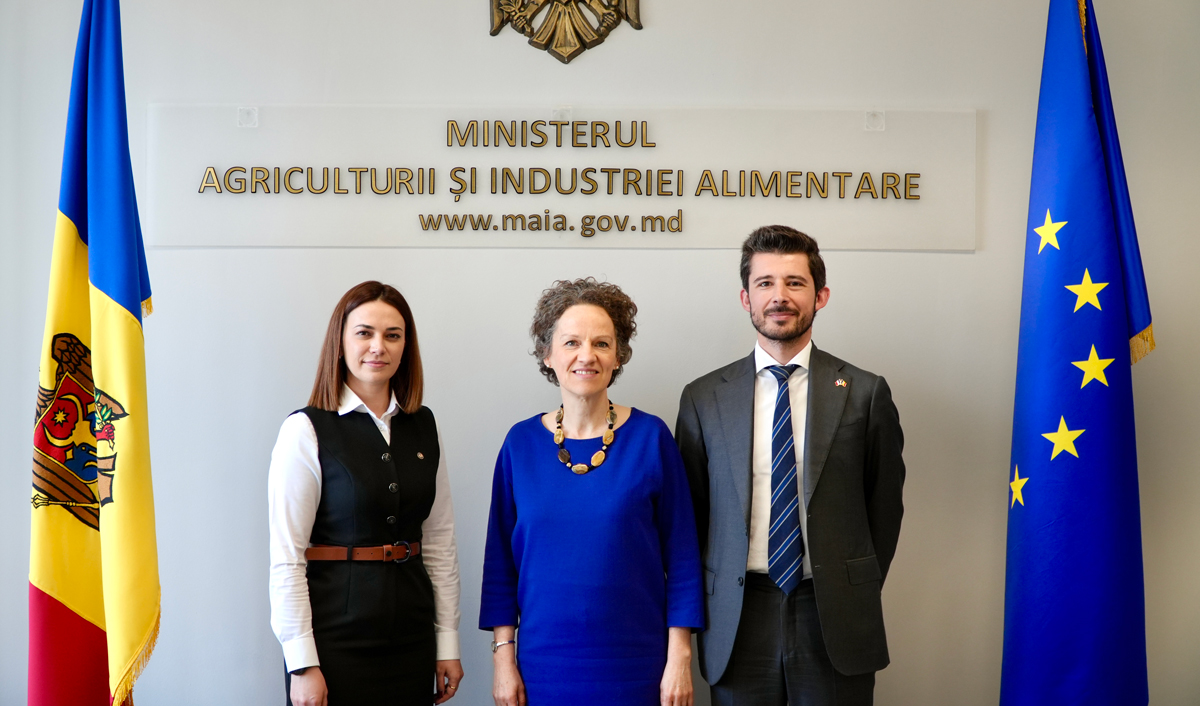
Moldova Art Week received the formal support of the Ministry of Culture and was hosted, free of charge, at the National Palace — one of Moldova’s most representative venues. Minister Cristian Jardan attended the vernissage personally and stated publicly: “The Ministry is fully open to supporting initiatives like this. If we continue at this pace, I am confident Chisinau can become the cultural capital of Europe.”
National Palace director Andrei Locoman went further, confirming the venue’s availability for future editions and proposing the project’s expansion to regional centers, colleges, schools, and cultural houses across the country.
This institutional validation is not incidental to Jicol’s professional profile. Someone who has spent years working on the legislative framework of advertising and on the visual design codes of urban space has, naturally, a relationship of substantive dialogue with public institutions — not dependence, but collaboration on the basis of competence.
The artists: from closed studios to billboards in the city center
The growth from 25 to 104 participants between editions 1 and 2 reflects a real phenomenon: Moldovan artists lack adequate visibility platforms. In two years, MAW has become one of the broadest exhibition of contemporary Moldovan art ever staged — not in a gallery, but across an entire city.
In edition 2, every artist who submitted to the open call was accepted — no jury, no criteria beyond the willingness to participate. Five works were sold at prices between 250 and 9,000 euros. Artists have already requested the creation of a marketplace platform for Moldovan art.
“An artist told me he has over 100 works in his studio. Potentially, this man is a millionaire many times over — but in reality he barely covers his daily expenses. That is the gap Moldova Art Week is trying to fill.”
MAW 2027: from city to country, from country to region
The third edition, planned for February 2027, marks a major step forward. Three hundred advertising surfaces, art at the airport and land border crossings, the MAW Friendly network, invited international artists, and MAW Residence — a permanent artistic residency in Chisinau. Requests have already arrived from Romania and other countries.
“We want people landing at Chisinau airport to see art immediately. Those entering by land border — the same. During MAW week, wherever you are in Chisinau — at a cafe, a restaurant, in a park or underground passage — you should feel that the city is a living gallery.”
The long-term vision extends to 2031: Chisinau as a regional reference point for contemporary art. A goal built step by step — 25 artists in 2024, 104 in 2026, 300 surfaces and airport presence in 2027. The trajectory is clear.