

Walnut market in Moldova: February growth, March decline
In this regard, it is worth recalling that, as Logos Press wrote earlier, in the second half of February, the demand and prices for large quantities of walnuts in shell on the Moldovan walnut market increased sharply. Such market evolution during this period of the season is traditional. What was unusual was that at the end of this winter, the Moldovan market quite unexpectedly saw a demand for large quantities at a relatively high price.
The last price for Moldovan variety walnuts in shell at the end of 2025 fell just below 2 euros/kg, and in February 2026, traders from Albania and Italy offered about 2.8-3.5 euros/kg for nuts of the American variety “Chandler” and nuts of European (French) varieties. As a result, deals were concluded to export hundreds of tons of the commodity, with demand exceeding supply.
The leadership of the industry association even suggested that the commodity stocks of walnuts at its major producers and local trading companies had dried up. However, apparently, the situation was not quite like that. Some traders decided to hold back some part of the goods – not so much the nuts in the shell as the expensive nut kernel – in the hope of further price increase and export activation in spring.
However, this did not happen. The reason is obvious – the war in the Middle East and the sharp rise in prices of energy resources, packaging materials and logistics provoked by it. As usual in such situations, during the first weeks of a large-scale (far beyond the region) armed conflict, global food prices jumped up. Moreover, the prices went up mainly for exchange-traded food products (with a high energy component), as well as for essential and daily consumption products. Such products as honey, dried fruits, nuts do not belong to this category. Demand and purchase (wholesale) prices for them “sat down”.
Traders say that in spring the pressure on nut prices on the European market is exerted by re-export of Chinese nuts and intensified supplies of nut kernels from Ukraine. Moreover, Ukrainian products are on average 10-20% cheaper than Moldovan ones, which, apparently, caused a decrease in demand for the latter.
This assumption is quite confirmed by the data of price monitoring portal east-fruit.com.
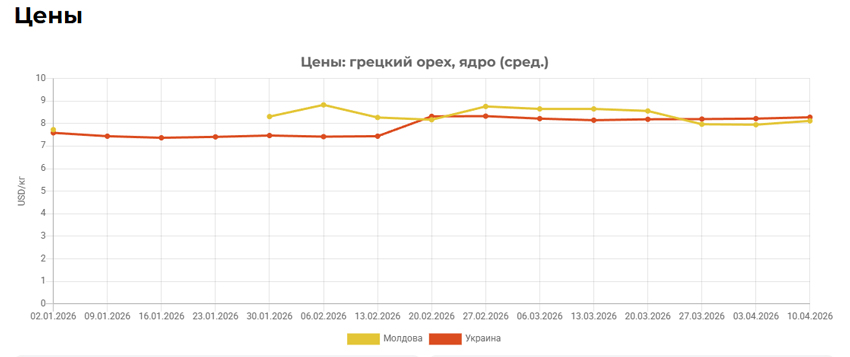
It shows that since the last decade of February, the wholesale price for walnut kernel in Moldova increased from 140 lei/kg to 150 lei/kg and kept at this level for the most part of March. After that, the average price for this product returned to February levels. Obviously, this fact reflects the European decrease in demand and restrains external sales.
However, it should be taken into account that the current price for walnut kernel in Moldova is about 15-20 lei/kg above the April level in 2025, and it is the highest for this time of the year for five years.
What could happen next?
According to Oleg Tirsină, Chairman of the Association of Nut Growers of Moldova (ANRM), until fresh (new harvest) walnuts from Chile start to arrive on the EU market, exporters from the Northern Hemisphere have at least another month to try to sell last year’s walnuts on the European market. They will probably have to make some price cuts (or maybe they won’t even have to – at the end of the marketing season the supply will not necessarily increase, so it is possible that the European walnut market will return to pre-war levels in the Middle East).
In principle, Oleg Tirsine believes that Moldovan walnut farming should activate the trend of the past years – reorientation to export of varietal walnuts in hard shell. This product is less susceptible to seasonal market volatility.