
The score is given on a scale from 0 to 100, where 100 is the maximum freedom and 0 is its absence. The index assesses the absence of government interference in the production, distribution and consumption of goods and services.
The average global level of economic freedom this year is 59.9, the regional (Europe) – 68.9.
A country with a relatively unfree economy
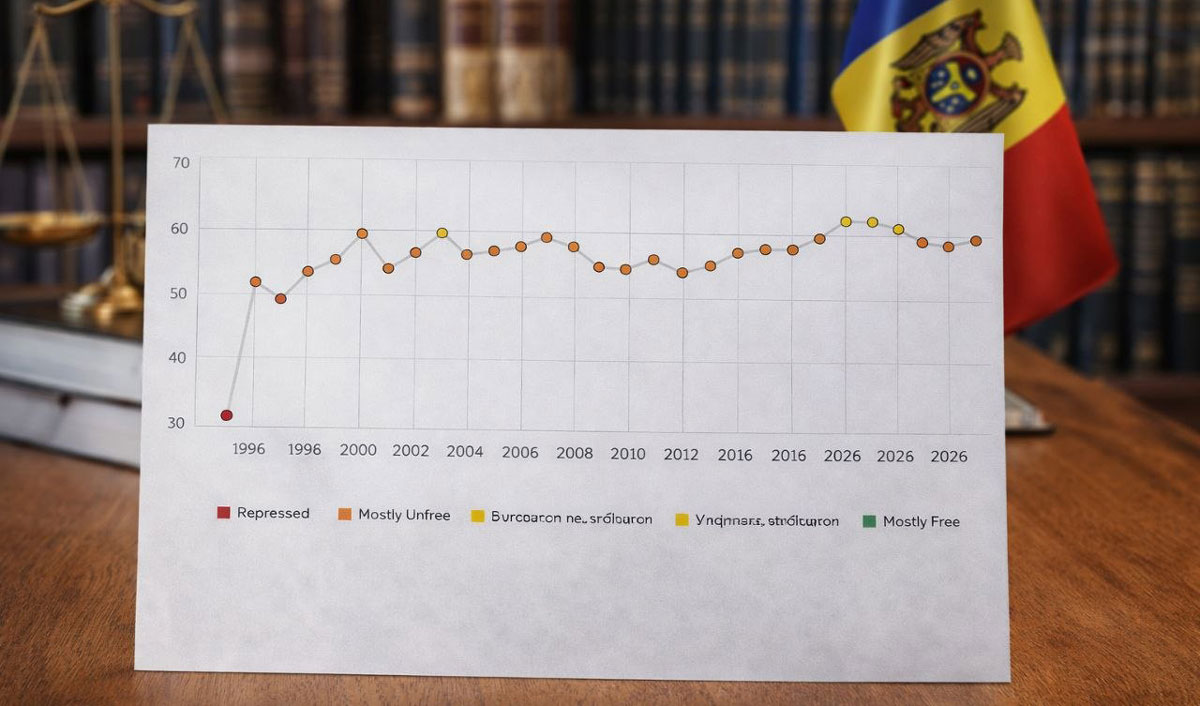
Moldova’s economic freedom index this year is 58.1, which puts its economy at 101st place among the freest economies in the Index of Economic Freedom 2026. The ranking decreased by 0.2 points compared to last year.
At the same time, Moldova ranks 41st out of 44 countries in the European region. The country’s economic freedom index is below the world and regional averages. According to the 2026 Index, Moldova’s economy is considered “mostly unfree” (mostly unfree), the authors of the study said.
“The foundations of economic freedom in Moldova are neither well laid nor well protected. Overall, progress in achieving effective macroeconomic management and improving the business climate is uneven. The country’s economic performance is below potential, and weak rule of law undermines prospects for greater and more dynamic long-term economic development. Moldova has undertaken some regulatory reforms, but bureaucracy and lack of transparency continue to impede the creation and operation of private enterprises,” The Heritage Foundation analysts point out.
Gradual decline again
An economy below 50% is considered repressed. Unfortunately, Moldova has been heading in this direction for several years.
During all the years of its independent existence, Moldova’s economy, according to the economists of The Heritage Foundation, has been in the category of “mostly unfree”, even falling into the category of “repressed” in 1995 and 1997. Except for 2003 and the period 2020-2022, when it managed to rise to the category of states with “moderately free” economy. In 2021, the country was ranked 85th in the world with 62.5 points. Then again, it began a gradual decline to the current level, and from 2023 it became “moderately free” again.
It should be taken into account that the authors of the rating set two more levels of economic freedom, to which our country has never risen: “mostly free” (mostly free) and simply “free” (free).
What hinders the freedom of the Moldovan economy
The authors of the index point out the key reasons for the problems and downgrade:
– Weak rule of law;
– a judicial system that lacks credibility;
– insufficient protection of property rights;
– low level of economic transparency;
– unpredictable investment environment;
– regulations changing faster than businesses can adapt;
– quality of justice is below the global average.
At the same time, by some criteria Moldova exceeds the world average. These are:
– tax burden (Moldova has 87.9 points on this indicator). That is, in most countries, taxes are higher and the discipline of their collection is stricter than in our country;
– fiscal health – 70.3.
The maximum income tax rate for individuals is 12%, and the maximum corporate tax rate is also 12%. The tax burden is 30.3% of GDP. The three-year averages of public expenditure and fiscal balance are 37.8% and -4.1% of GDP, respectively. Public debt stands at 38.8% of GDP.
– Business freedom is 68.3;
– monetary freedom – 66.
In general, Moldova’s regulatory environment is relatively well institutionalized, but it lacks efficiency. The indicator of business freedom in the country is above the world average; the indicators of freedom of labor relations and freedom of monetary policy are below the world average, the analysts of the American Foundation note.
– Freedom of trade – 76.8.
The trade-weighted average customs duty rate is 4.1%, and eight non-tariff measures are in place.
However, the investment system lacks transparency and efficiency. Long-term financing remains difficult. About 45% of Moldovan adults have access to an account at a formal banking institution, economists note.
There is a need to move from rhetoric to real reforms
“We are down compared to previous years. And not because no actions were taken, but because they were insufficient, unsystematic and, in some cases, wrong,” said former Moldovan Prime Minister Vlad Filat. – The problem is not limited to numbers. The problem is at the core. It is impossible to build a competitive economy on weak institutions. It is impossible to attract investments when the rules of the game are not clear and are constantly changing. And it is impossible to talk about development if the economic environment remains vulnerable.”
A functional state and a free economy should not depend on external circumstances or political agendas. These are basic conditions for any society seeking stability, prosperity and trust. The reality is simple: Moldova has potential. But potential is no substitute for results.
Moldova needs to move from rhetoric to real reforms. Not cosmetic. Not selective. But to reforms that strengthen state institutions and restore confidence – both on the part of citizens and investors, says Filat.