

Demographic challenges
“What we are witnessing in the country’s demography is not unique – it is part of the demographic transformation that the entire European continent is going through.”
With this the Minister of Labor and Social Protection Natalia Plougarou started her speech in the context of the project of a simple vote of no confidence in the policy in the social sphere. She immediately “consoled” the deputies: the birth rate is 1.66 children per woman and significantly exceeds the European average (1.34).
Valentina Mesina, a member of the “Democrația Acasă” faction, recalled the demographic forecasts, according to which Moldova will lose more than 19% of its population by 2040. She also hinted at the “most classical” way to raise the birth rate in the country.
“The youth segment is shrinking at an alarming rate. In these conditions, we are talking about fertility and the future of the country. In a situation of such accelerated demographic decline, can Moldova be “saved” by a clear, renewed and consistent strategy to increase the birth rate? Or the extension of the state of emergency in the energy sector for another year, let’s say? After all, if the lights are cut off, the birth rate rises,” the MP said.
Social protection in figures
The minister’s report says that the state’s spending on social protection, in relation to the GDP, has increased significantly – from 10.9 per cent in 2016 to 15.3 per cent in 2025, reaching over 54 billion lei. In this context, Moldova is between North Macedonia (14%) and Sweden (19% of GDP).
The minimum wage increased from 2,935 lei in 2021 to 6,300 lei in 2026 (+115%), while the average wage increased from 9,116 to 16,700 lei (+83%).
The lump-sum allowance at childbirth increased from 9,459 lei in 2021 to 21,886 lei at present. Monthly allowance of 1,000 lei for child care up to 2 years of age is received by 78,233 children. In 2015, 2,214 children were in orphanages, while in 2025 only 360 children will be in orphanages.
The minimum pension increased from 1,188 lei in 2021 to 3,263 lei in 2026 (2.7 times), while the average pension increased from 2,067 to 4,824 lei (2.3 times).
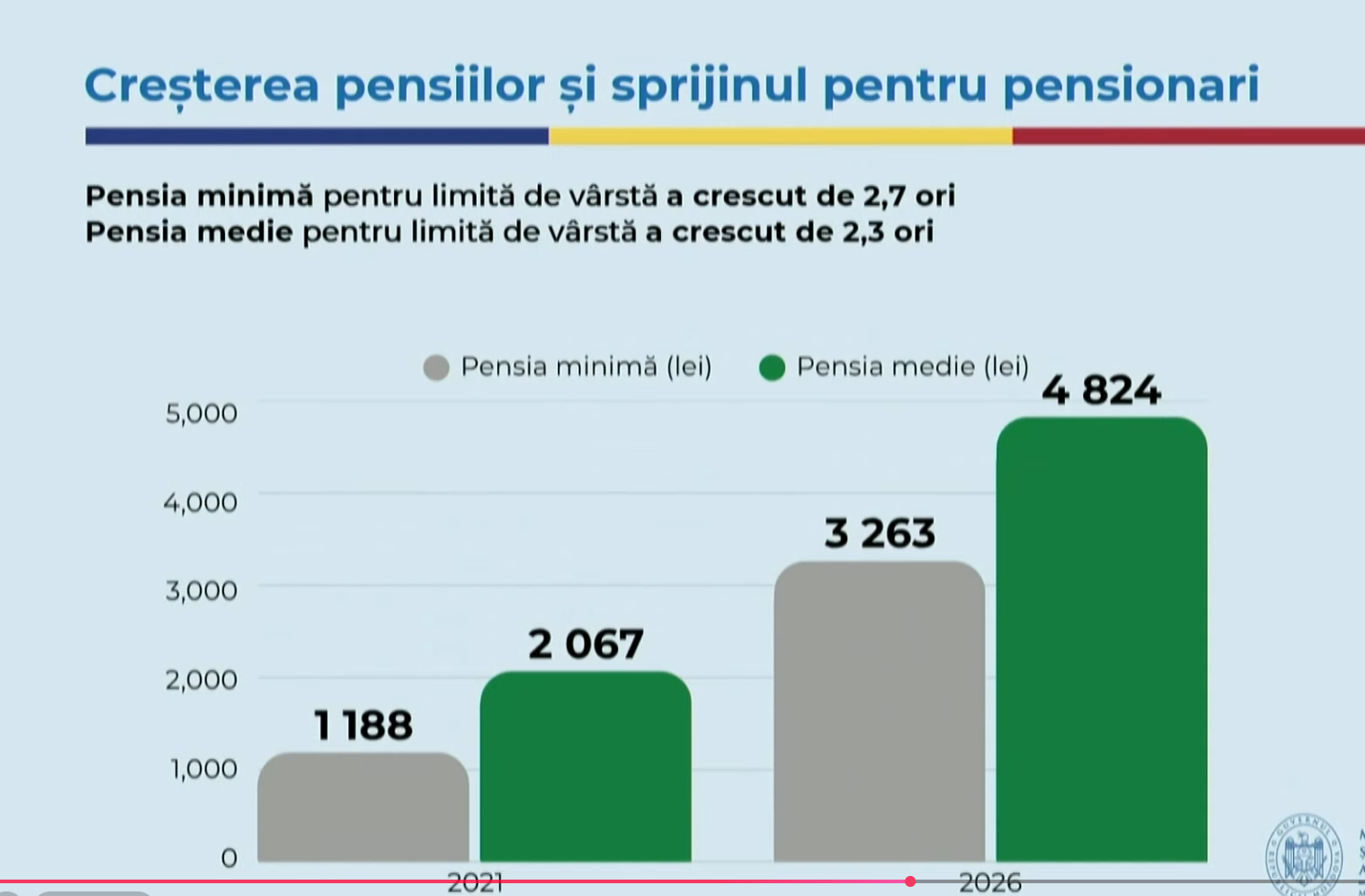
“This is not much, but it concerns only those citizens who fulfilled the conditions for retirement, but unfortunately had low incomes or did not declare all their earnings,” the minister said.
The Minister also said that in 2025 the average pension in real terms (adjusted for inflation) was 21.6% higher than in 2020.
PCRM deputy Diana Caraman reminded the minister that the state “owes” the 15% difference: in 2022, when inflation was 30%, the indexation was twice lower.
Supply and demand: “Towards each other”
The vision of how higher pensions can be resented is the following: first of all, to broaden the base of contributors. But doing so with the continuing aging of the population is not easy.
“Today we have about 820,000 payers in the Social Security system. On the other hand, the employment rate remains quite low: only 57% of the population that could work is actually working. Thus, we have a significant potential of people who do not work or do not declare income, but could contribute to the social insurance budget,” said Minister Natalia Plougarou.
The state wants “supply and demand to meet”: through training programs, requalification, recognition of competences acquired both abroad and in the Republic of Moldova, as well as through grants and subsidies for starting a business.
The draft of a simple vote of no confidence traditionally failed to get the necessary number of votes. This was not the first attempt of the opposition factions – previously, the Minister of Agriculture and Food Industry, the Minister of Energy, and the Minister of Defense went through similar procedures.