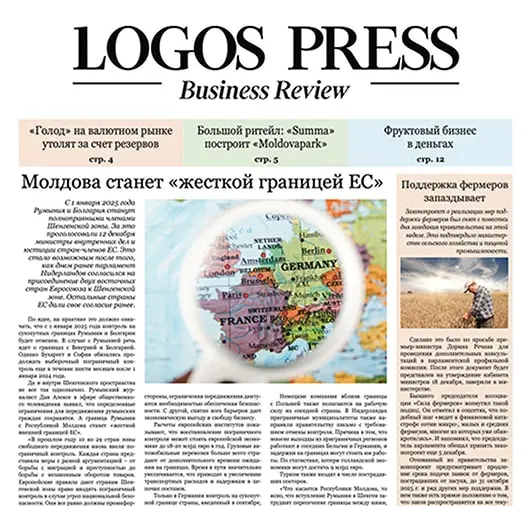
Moldova has made significant progress towards European economic integration, reflected in an increasingly pronounced orientation of exports towards the European Union market. Preliminary results and an analysis of the country’s prospects in the context of the economic policies pursued by the authorities was presented by the Organization for Economic Cooperation and Development (OECD) within the framework of the project “Strengthening Trade and Competitiveness in the Eastern Partnership Countries”, funded by the European Union with the support of the consulting company Civitta.

Central banks of the world are preparing for a “stable state of affairs” against the backdrop of worsening volatility in the energy market and are in no hurry to change the cost of borrowing. Many financial analysts come to this conclusion in their publications, considering this position to be fundamentally different from the inflationary crisis of 2022.

The National Bank releases into numismatic circulation the commemorative coin “Eleonora Romanescu – 100 years since her birth”, which continues the series “Famous Women”.

The world’s largest manufacturer, the Malaysian company Karex (which produces Durex, Trojan and other brands), has announced its intention to raise prices by 20-30% or more. Some countries (e.g. Russia) have already seen an increase in retail prices for condoms, including due to logistics costs associated with the Middle East conflict.

Business leaders do not expect a surge in business activity in the second quarter: the outlook is relatively stable, both in terms of price growth and sales revenue. Economic activity in the second quarter of 2026, according to surveys, will also be accompanied by a reduction in the number of employees in trade and services.

After a decline in previous years, diaspora remittances have shown an upward trend since the beginning of 2026, remaining an important source of support for the solvency of the Moldovan population. In March, $175 million was received. This is more than in January and February and even surpassed the record of the traditionally peak December 2025 ($173.77 million).
European Council President António Costa has said that it is necessary to prepare for the official opening of the first clusters of negotiations on Ukraine’s accession to the European Union.

Numerous violations of financial discipline in the accounting of state assets of the Ministry of Defense were revealed in the course of an external audit. Understatement of value, misstatement of costs, and other reporting shortcomings prevented the Accounts Chamber from issuing a final opinion without reservations about the legality of the ministry’s use of state appropriations in 2025.

On Wednesday, April 22, Ukraine resumed transit of Russian oil through the Druzhba oil pipeline to Hungary and Slovakia after almost three months of downtime. The resumption of oil transit through the pipeline was announced by Hungarian energy giant MOL on Wednesday. And on Thursday morning, Bratislava confirmed that crude oil pumping had begun. This allowed Budapest and Bratislava to lift their “veto” on a €90 billion EU loan to Kiev.

A Chisinau court yesterday sentenced former Democratic Party leader and fugitive oligarch Vladimir Plahotniuc to 19 years. He was found guilty of bank fraud, organizing a criminal group and money laundering.

Experts discussed with government and business representatives the labor market forecast for 2026, noting the gap between qualifications and employer demand, which is increasingly shifting towards low-skilled labor.

JPMorgan raised its market capitalization target for 2026, reversing a previous downgrade in its forecast due to the war against Iran. Analysts said Anthropic’s new model breathes new life into the artificial intelligence industry. JPMorgan said expected first-quarter earnings growth will also boost the stock.

Economist Vladimir Golovatiuc notes that the active sale of foreign currency by the Moldovan population has recently become a significant support for the family budget. In his opinion, this indicates the forced use of currency receipts due to the fall in real incomes.

A Greek company that deals with maritime risk management has warned that some shipping companies have received fraudulent messages from unknown individuals posing as Iranian authorities. The messages offer safe passage through the Strait of Hormuz in exchange for cryptocurrency.

As of spring 2026, the foreign exchange market of Moldova is characterized by high volatility and instability. At the same time, the situation with meeting the demand for currency is difficult, but does not indicate a complete deficit.
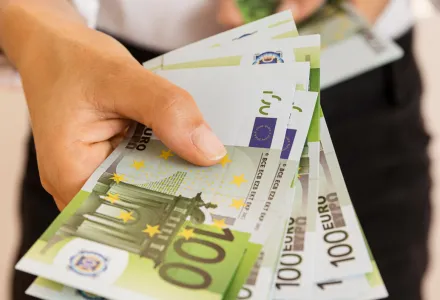
According to the data of the National Bank of Moldova (NBM), in March 2026, the volume of new loans issued amounted to 9,039 million lei. Of these, 70.8% of loans were issued to enterprises (business sector), and 29.2% to individuals. Lending was performed mainly in Moldovan lei (MDL).

According to the IMF’s April 2026 World Economic Outlook (WEO) report, Moldova ranks last in Europe in terms of GDP per capita at purchasing power parity (PPP).

The dollar, considered a defensive asset, rebounded amid renewed tensions between the US and Iran. Hopes for a peace agreement are fading as Iran has said it will not participate in the talks. The Strait of Hormuz in the spotlight: Iran has once again blocked this crucial waterway.
Oil and natural gas prices rose sharply at the start of the week after the U.S. Navy seized an Iranian vessel during a weekend of Tehran shelling ships and reimposing controls in the Strait of Hormuz.

The spring meetings of the International Monetary Fund (IMF) and the World Bank Group in Washington, DC (April 13-19, 2026) concluded with a focus on supporting the hardest hit countries in the face of global uncertainty and necessary structural reforms.