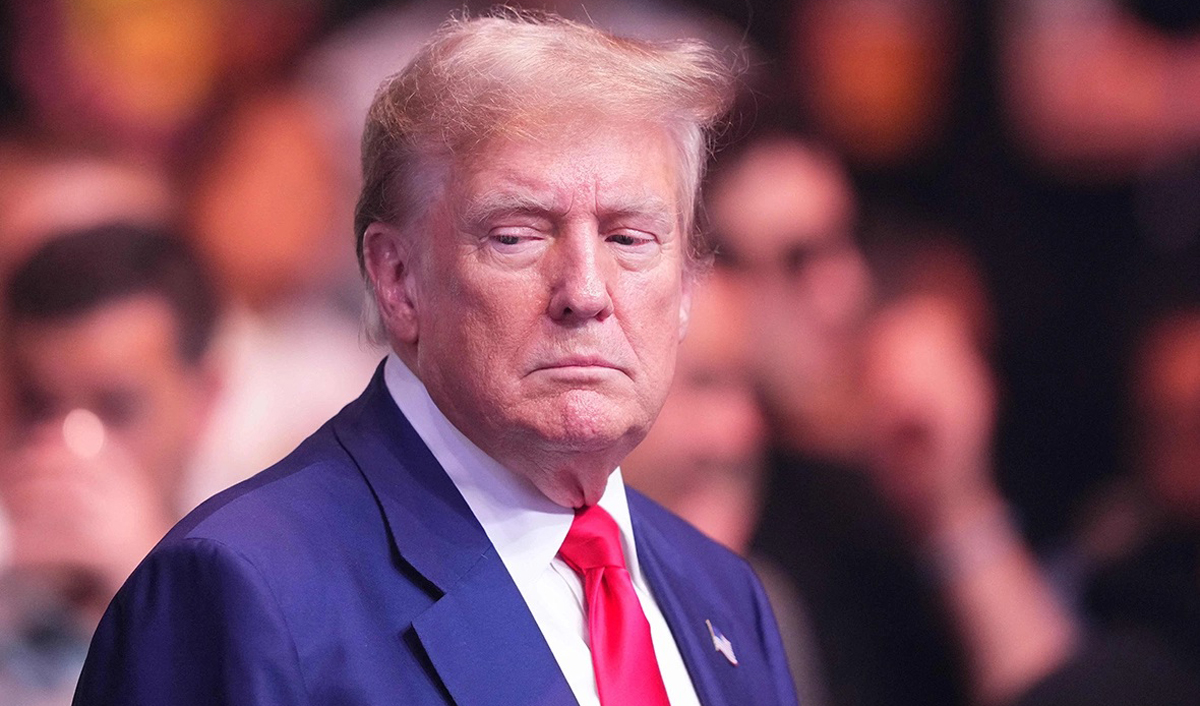
Marco Rubio, U.S. Secretary of State
This barb reminded me as I watched the foreign minister in Donald Trump’s administration, U.S. Secretary of State Marco Rubio, speak at the Munich Security Conference.
Last year, U.S. Vice President J.D. Vance flew to Munich to personally admonish European leaders. He criticized the European Union’s immigration policies, its crackdown on hate speech, and its efforts to keep the far right out of power.
Rubio is the same Vance, but in silk stockings. He said pretty much the same thing, wrapping his words in diplomatic gauze.
In 2016, Rubio called Trump a “crook” who can’t be trusted with nuclear launch codes. And now Rubio is serving as Trump’s chief diplomat – he just let the last working Russian-U.S. nuclear arms limitation agreement expire without protest.
Rubio betrayed himself, and that betrayal was so complete that it secured him high office. In Donald Trump’s Washington, having principles in the past and publicly renouncing them is a more reliable proof of loyalty than having no principles at all.
Civilizational blood ties instead of cooperation
In Munich, Rubio embellished his speech with theatrical assurances. The U.S. and Europe “belong together.” Their destinies are “intertwined.” America wants a “revitalized alliance” and a “strong Europe.” But, he said, it is not common institutions, a shared commitment to the rule of law, or the postwar architecture of treaties and multilateral cooperation that hold the West together. What holds it together is “a common history, Christian faith, culture, heritage, language, origin and the sacrifices our ancestors made together.”
The key words here are “Christian faith” and “ancestors.” Rubio defined transatlantic ties not as a political alliance but as a civilizational blood bond – an affinity that is rooted in religion and bloodlines. “We will always be the children of Europe,” he said. This formulation defines the relationship not as a contract between equals and sovereigns, but as a family bond, inherited rather than chosen. Loyalty is determined by biology, not by shared principles and goals.
This is not the language of NATO. It is the language of the late Samuel Huntington, who argued for a “clash of civilizations.” According to this idea, the West is defined not by its beliefs but by who it is; not by principles but by blood ties and faith. This formulation erects an imaginary wall around Christian Europe and its diaspora, leaving out the Muslim citizens of Europe, the secular traditions of the French Republic, and the multi-faith realities of modern European life.
After promising a future “as proud, sovereign, and vital as our civilization’s past,” Rubio has revealed the cards. The future he describes is not a concept of what needs to be built. It is a projection of the past into the future – nostalgia packaged as a goal.
Hidden beneath the silk were the same lamentations Vance delivered last year, but presented with slightly better manners. Europe has outsourced its sovereignty to multilateral institutions. Europe is ensnared in a “climate cult” that is leading to the impoverishment of its citizens. Mass immigration threatens to “erase civilization”.
“Civilizational erasure” is certainly not a neutral description of demographic change. It is the vocabulary of the European extreme right, obsessed with the idea of “the great replacement” of white people. In Munich, Rubio, representing the world’s most powerful government, gave legitimacy to ideas that present immigration not as a political problem to be solved but as an existential threat to the survival of Western civilization. In this case, compromise becomes impossible, and so does democratic restraint.
Rubio’s silkiness made the phrase more dangerous, not less: embedded in a discourse of shared anxieties about Europe’s future, it sounded like concern – as if the Trump administration was merely trying to save its friends from a danger they, being too polite, had not named. But the result is that the space for pragmatic cooperation on asylum, labor mobility, and integration (the real work that Europe’s governments need to do) is shrinking, while giving Europe’s nationalist parties support they could hardly have dreamed of before Trump.
“Climate Cult” and a subjugated Europe
Rubio’s careless use of the contemptuous term “climate cult” is also noteworthy. But not because it has anything to do with climate policy, but because it exposes the hollowness of Rubio’s talk about the glorious future his boss is supposedly building. Climate policy, by definition, is an investment in the future, and perhaps the most important one of all for any generation. Calling it a cult, dismissing the fight against climate change as a religious delusion, is a spectacular way of emphasizing that it’s not worth investing in the future habitability of our planet.
Rubio’s meeting schedule didn’t match his rhetoric. On Friday, the day before the speech, he skipped Ukrainian talks in the “Berlin format,” which included Ukrainian President Volodymyr Zelensky, French President Emmanuel Macron, German Chancellor Friedrich Merz, and the heads of the European Commission, European Council and NATO.
And after speaking, he flew to Bratislava and Budapest to meet with Robert Fitzo in Slovakia and Viktor Orban in Hungary, two of the most pro-Russian leaders in the EU. Trump calls them ideological allies and recently hosted them at Mar-a-Lago.
While Rubio told the Munich audience that America wants a “strong Europe,” he has publicly endorsed leaders who have made careers of attacking European institutions from within, blocking collective action, and developing ties to Russian President Vladimir Putin. When pressed about Ukraine in an interview after the speech, Rubio let slip: the U.S. wants an agreement that Ukraine can “live with” and that Russia can “accept.” The point is asymmetry. Ukraine is expected to tolerate and Russia is expected to be satisfied.
Rubio didn’t fly from Munich to Bratislava and Budapest to strengthen the transatlantic alliance. He went to show what kind of Europe the U.S. prefers: not a Europe of collective defense and collective sovereignty, but a Europe of governments that defy the EU, flirt with the Kremlin, and call it all sovereignty.
Russia and China were absent from Rubio’s speech. The enemies he spoke of were not authoritarian great powers, but immigration, climate policy and the multilateralism on which the Western alliance has relied since 1945.
Wang Yi, China’s foreign minister, happily seized the opportunity, saying that “some countries” undermining multilateral cooperation and reviving the Cold War mentality were primarily responsible for the current global paralysis. Such rebukes would have been harder to utter had Rubio not rejected the postwar institutional order from the same podium.
Rubio is no Talleyrand. Talleyrand served French interests by changing the balance of power in Europe, while Rubio serves a president who confuses destruction with strength and nostalgia with renewal. The silk stockings helped soften the tone and flatter the audience. But beneath them are the same ideas Vance spoke directly about last year: Europe is useful when it is subjugated; Western civilization is defined by the method of exclusion; a collective future is possible, but only under conditions that guarantee it will never exist.
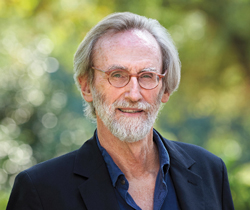
Stephen Holmes
Stephen Holmes is a professor of law at New York University and a member of the Richard Holbrook Fellows Program. Richard Holbrooke Program at the American Academy in Berlin (AAB), and co-author (with Ivan Krastev) of TheLight that Fooled Hopes(Penguin Books, 2019).
© Project Syndicate, 2026.
www.project-syndicate.org