

Another study conducted by the staff of the Demographic Research Department found that emigration is more common among men, young people aged about 19 and those with higher education. Naturally, this reduction in the able-bodied, tertiary-educated population risks leading to an acute shortage of skilled labor. The Ministry of Economic Development and Digitalization has its own vision for solving the problem of labor shortages in a shrinking population.
“We plan to attract workers from abroad, not only from EU countries, in promising sectors where skilled and unskilled labor is needed. Skilled labor is especially important. For this purpose, it is necessary to adapt legislation and institutions regulating migration and issuing permits. For example, cheaper labor comes from Asia, which we need because there is a shortage of workers on the market – even for road construction companies cannot find staff. Some investors would like to bring their own specialists, which we do not have,” said Minister Eugeniu Osmokescu.
Who, where from and why…
At the same time, experts warn about the risks associated with the liberalization of the labor market and open immigration. And to understand these risks, it is necessary to know the “profile” of an immigrant.
Logos Press thanks the General Inspectorate for Migration (GIM) for a detailed analysis of the profile and the number of foreigners, including immigrants, choosing Moldova in recent years. According to the institution, by the end of 2024, the total number of foreign citizens (including stateless persons) staying on the territory of the Republic of Moldova amounted to 24,437 people – about 0.6% of the country’s population. The dynamics of their number directly depends on external factors. Last year, the combined share of citizens of Ukraine and the Russian Federation reached 53% (28% and 25% respectively). Next come the citizens of Turkey and India – 6% each.
As for immigrants, their number increased from 2,875 in 2020 (the beginning of COVID-19) to 7,203 in 2023. In 2024, 6,565 immigrants arrive, the most from the Russian Federation (18.5%) and Ukraine (13.6%), as well as from Turkey (12.9%) and India (8%). The most frequent arrivals are for work, family reunification and study.
Immigration to Moldova is characterized by the predominance of men – about 66% of them. In terms of education level, the share of persons with specialized secondary, higher education or academic degrees is less than half. In recent years there has been a decrease in the share of immigrants with higher education. Thus, the Republic of Moldova is mainly immigrated by foreigners with general secondary level of education, which indicates an increase in the inflow of students and unskilled workers. On the contrary, educated people leave the country.
“These trends confirm the diversification of migration motives and testify to the constant strengthening of foreigners’ flows to the Republic of Moldova,” the GIM said.
The institution calls the situation “unprecedented”. In the period from 01.03.2023 to 31.12.2024, 84,955 people were pre-registered on the territory of the country for temporary protection. Of these, 66,456 were documented as temporary protection recipients. In this category, the largest number – 65,893 persons – are citizens of Ukraine, followed by Russians and Azerbaijanis by a large margin.
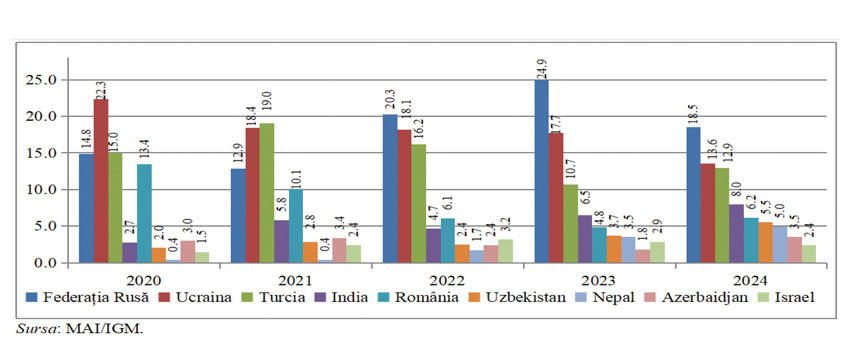
Distribution of immigrants by country of citizenship in 2020-2024, in percent
“Good job!” But risks remain
Meanwhile, European partners rated as “good” the implementation of the national program for the management of migration flows, asylum and integration of foreigners for 2022-2025 and its action plan. In 2024, almost half of all actions from the plan have been implemented. “The legal framework for managing legal and illegal migration is partly harmonized with EU legislation, but needs improvement,” the European Commission report said.
But the risks are growing – and so is the flow of foreigners. According to the Border Police, in the first six months of this year the flow of people crossing the state border increased by more than 9% compared to the same period last year, almost 9.6 million crossings were recorded. More than 4,200 attempts of unauthorized border crossing were prevented. Just recently, the Border Police reported the exposure of another network engaged in illegal migration. Two Moldovan citizens were detained, who for money transported migrants from Afro-Asian countries to the Moldovan-Romanian border. Among the victims was a 31-year-old Nepalese citizen who paid 4,500 euros for “transit” to Europe.
The Inspectorate General of Migration (IGM) and the Border Police (IGPF) are stepping up staff training to manage mass flows of foreign nationals and asylum seekers. Such a joint exercise “AFLUX-2025” recently took place in the Oknica region near the border with Ukraine. The exercise practiced field coordination, operational skills and inter-agency cooperation.
At the same time, Moldova is tightening the rules for obtaining citizenship. The new procedure comes into force on December 24, it provides for a compulsory examination in Romanian language and a test of knowledge of the Constitution of the Republic of Moldova. The law on citizenship of the Republic of Moldova was described by the competent authorities as a document of “fundamental importance for national security”.
From a sick head to a healthy one?
Experts consider the problem of emigration of Moldovans from the country and migration of foreigners to Moldova as one of the central topics of national security. And they do not consider it right to follow external recommendations. According to Elena Merjineanu, Doctor of Law, Associate Professor, European partners will welcome any liberalization for foreign migrants and their integration in Moldova, but this assessment should not impress or please us:
“It is important for EU countries to reduce the number of migrants on their territory, which means that the Europeans tend to transfer part of their problem to other states, to the periphery of the EU. The more Moldova adapts its legislation to the EU requirements, the more likely it is that we will end up with their migrants on our territory. I repeat, the positive assessments of foreigners regarding Moldova’s migration policy should not mislead us”.
According to the expert, Moldova may subsequently face partnerships in this field, “beautifully framed in the narrative of labor shortage”.
“The new EU Pact on Migration and Asylum envisages partnerships with non-EU states as well. Germany is also interested in this issue. If EU partners had taken Moldova’s interest into account, they would have supported the demographic policy and the industrialization plan to keep Moldovans at home. Unfortunately, by no means discriminating against anyone, the Europeans realize that for them a Moldovan migrant with education is more convenient than a non-EU citizen without education and deeply religious. Here the interests of the Republic of Moldova and the EU do not coincide,” says Merjineanu.
Elena Merjineanu also speaks about the consequences of “liberalization” of migration:
“First, entrepreneurs who benefit from cheap migrant labor will defend short-term economic interests and criticize any attempts to tighten the migration regime.
Second, after the inevitable failure of labor migration liberalization, an attempt to return to a normal strict regime will draw very harsh criticism from the EU. An example here is the conflict Hungary is in for refusing to accept a quota of illegal migrants and paying a fine of 20,000 euros for each unaccepted migrant. This is an example of the tensions in which a state defending the national interest can find itself.
Third, the birth rate of migrants is higher than that of Moldovans, and with the country’s small population, even in the short term, the culture and social composition of the country and, in fact, the very essence of Moldova will be eroded and destroyed.”
This is especially important because Moldova is located at the crossroads of the West and the East,” the expert believes. Any economic growth of BRICS countries will lead to a shift of geographical interest of migrants from Europe to the East, which is a potential threat for the country. In addition, the inevitable major economic crisis in Europe (cited as cyclical, but with overlapping contemporary factors) makes the EU more vulnerable and increases interest in countries with fertile land.
“Moldova does not realize its potential, we are geopolitically and climatically in an exceptional zone. If we allow our cultural essence to be destroyed now, we will suffer greatly. The future economic crisis should be seen as an opportunity to bring Moldovans back home, not as an excuse to liberalize the regime for foreigners! Moldova is for the descendants of our descendants, not for immigrants”, concluded Elena Merjineanu.

