

Donald Trump
But the latest effort may shed light on how the U.S. sees Russia’s place in the international system, particularly what bilateral relations might look like after the war. Like much of U.S. President Donald Trump’s foreign policy, this vision appears to be driven by commercial considerations.
Deals instead of foreign policy
Trump’s willingness to set aside human rights or respect for the rule of law in his pursuit of business deals from Pakistan to the Gulf states may look like realpolitik. But Trump’s transactional approach should not be confused with realism.
While realistic foreign policy considers constraints, power dynamics, and long-term interests, the transactional approach reduces international politics to a mosaic of narrow deals. And while realism calls for maximizing the use of norms, alliances, and institutions, transactionalism advises circumventing or even destroying them.
At a time when the postwar order seems to be crumbling, this traditional conception of realism may seem idealistic and transactionalism more pragmatic. Unencumbered by the responsibility of building institutions or maintaining alliances and unconstrained by principles, the transactional leader, according to this logic, can achieve results even under difficult conditions. But the long-term results are likely to be far from desirable.
The end of war is the beginning of business
This is almost certainly the case with America’s new approach to Russia. The Trump administration seems to view the cessation of active hostilities in Ukraine less as an end goal than as an opportunity to begin rebuilding economic and geopolitical relations with the Kremlin. The gradual lifting of sanctions, technological restrictions, and market barriers will allow the U.S. to continue to shape outcomes as it sees fit.
Crucially, however, these changes will be applied selectively and participants will be forced to negotiate agreements individually. What were intended as tools of broad deterrence – mechanisms to force a rogue entity back into a rules-based system – will be used to shape incentives within elite structures. This “pay and play” approach, devoid of institutional ambition, can hardly be considered economic statecraft, and it is unlikely to work.
Since commercial considerations are always paramount for Trump, he assumes that the same is true for leaders like Russian President Vladimir Putin. And thus, political agreements are more likely to work if they are embedded in commercial arrangements that increase the cost of backing out or violating them. It also explains the administration’s belief that a partial normalization of U.S.-Russian relations will automatically weaken Russia’s relations with China.
According to this “reverse Nixon” strategy, it does not matter that no ideological realignment is planned; Russia’s return to certain Western-related infrastructures-financial clearing, technological standards, supply chains-will be enough to weaken Russia’s alliance with China.
From this perspective, power lies not so much in alliances as in controlling the architecture of interconnectedness. Thus, Russian elites need to be drawn into Western economic and trade structures through a large number of narrow, overlapping agreements.
It is not at all clear that these assumptions are true of Russia. Nearly four years of war, harsh sanctions, and asset redistribution have further strengthened an already highly personalized regime. Personalization increases the intrinsic cost of compromise and narrows the space for long-term agreements. What looks attractive on the balance sheet may be politically unacceptable to the Kremlin, which must reckon with a population that has suffered nearly a million casualties in the war in Ukraine.
How Europe should adapt to this
Even if deals are struck, the idea that they can form the basis of a stable and prosperous system is far-fetched. By favoring individuals over processes, influence over legitimacy, and speed over sustainability, transactional decision-making undermines predictability and creates room for rule-breaking.
This is not good news for the US: it is precisely because America has acted as a trusted guarantor of shared rules that it has been able to secure and maintain the global leadership that has brought it so many advantages over the past few decades.
But it is even worse news for Europe.
The gradual integration of Ukraine is a central geopolitical project for the European Union. A U.S.-Russia agreement in which Ukraine is little more than a bargaining chip risks devastating this project before it can be consolidated. How can the EU anchor Ukraine in its institutional order if Ukraine’s future reflects a transactional settlement negotiated by external forces?
Europe is trying to adapt to this new, more chaotic world by diversifying and “de-risking.” Recent trade agreements with India and Mercosur (Argentina, Brazil, Paraguay and Uruguay) reflect this approach.
But while these partnerships are strategically necessary, they come with political costs. Social resistance to trade agreements such as the one with Mercosur und erscores the limitations of the “narrow path” of globalization, which promises sustainability but generates domestic anxiety.
More importantly, diversification does not eliminate dependence. The US remains the EU’s largest market, absorbing a fifth of EU exports. Moreover, Europe remains dependent on U.S. capabilities in defense, intelligence, finance, internet technology, cloud computing, artificial intelligence, and advanced semiconductors. Attempts to overcome this dependence by introducing European alternatives or by building coalitions of middle powers will not bear fruit anytime soon.
Not everyone is worse off in this new era of transactional international politics. While Trump is looking for reasons to declare quick wins, China is playing the long game by strengthening Chinese technological standards, consolidating supply chains, expanding financial and digital infrastructure, and building up its military and innovation capabilities. This will put it in a favorable position to capitalize on the disruption of the U.S.-led global order.
In a world of asymmetric power dynamics and deep interdependence, the only path to stability lies through binding rules, robust institutions, and strong alliances. Trump’s refusal to recognize this simple truth, reflected in his administration’s relationship with Russia, portends an era of instability from which China will emerge as the clear winner.
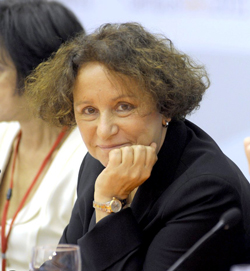
Ana Palacio
Ana Palacio,
former Spanish Foreign Minister and former Senior Vice President and General Counsel of the World Bank Group, is a visiting lecturer at Georgetown University.
© Project Syndicate, 2026.
www.project-syndicate.org


