

Dmitri Tereburke
The Republican Stadium as a mirror of Moldovan geopolitics
Logos Press No. 46 of 12.12.2025 published an article “A new scandal around the sale of the Republican Stadium”. In it, Irina Durlestian, founder of the company “INCO-Gratie” S.R.L., which owns the squash club Kangaroo, located on the territory of the former Republican Stadium, told about the problems the company faced in the evaluation of its property.
Irina Durleshtyan informed that the winner of the tender held by APS for the evaluation of the property of “INCO-Gratie” S.R.L. and 12 other owners did not meet the requirements of the Law “On Public Procurement”. And the property was valued at about 15% of its real market value.
This publication was responded to by a well-known expert in the field of real estate valuation Dmitri Tereburke and the Public Property Agency, which manages the Republican Stadium until its transfer to the new owners. Here are the expert’s opinion and the APS response to the Logos Press publication.
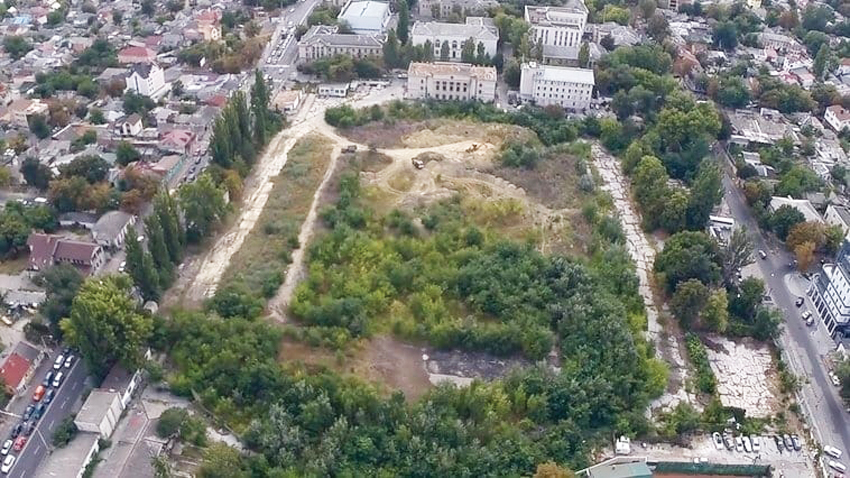
Citizens’ interests are not measured by square meters
Price is not the main argument in the story of the Republican Stadium at all. Price reflects only the market – if it exists – and even this market was ignored here. But the interests of Moldova and its citizens are not measured by square meters or euros per meter. They are measured by the possibility for Moldovans to use this land. And this is where a separate story begins, much more unpleasant than talking about price.
The land in the center of the capital is not just an asset that can be profitably sold or unfavorably given away. It is a strategic urban space. It is a place where there could be parks, stadiums, cultural clusters, normal urban life. This is a territory that should work for the citizens, not turn into a closed zone with fences, cordons and access regimes. When such a plot is given to a foreign embassy, we are not talking about a deal, but about taking the land out of public circulation for decades. The state receives a one-time payment, while society loses the city forever.
And this is where the systemic problem manifests itself. The state in this construction can win only the minimum – at the expense of the formal price of the transaction. But it can lose the maximum: public space, urban planning potential, the future development of the center, the tax base around, the trust of citizens and legal positions for years to come. Because the system does not count value, it only counts the figure for the report.
Taxpayers lost more than a stadium and more than money. They lost the right to use their own city. Instead of public space they were offered geopolitics, instead of urban development – security perimeters, instead of a vibrant center – concrete and guards. And all this is presented as an inevitability, as a “civilized choice”, which for some reason is always made without the participation of those who pay for it.
This whole story was made possible because Moldova lacks a coherent system for protecting the public interest. The law on expropriation allows for the quick seizure of property, but offers little or no protection for the fairness of compensation. The law on valuation formally exists, but is methodologically incapable of dealing with unique assets of this level. There is no evaluation of alternatives for use, no calculation of lost profits, no analysis of long-term consequences. There is a formal assessment “for the transaction” and an administrative decision that conveniently fits into the necessary scenario.
A separate and key problem is the evaluation system. International money was spent, but instead of a strong institution, a closed structure appeared. Control was replaced by corporate logic. A public structure appeared, which was initially conceived as a filter, but in the end became a screen. The law was rewritten so that peer review became a club procedure, and external professional criticism was removed from the brackets. This was done ostensibly for the purity of the process, but in practice for the manageability of the result.
And this is where the whole story ceases to be analytical and finally turns into a farce. Paladi (Alexandru), the person who made the key decisions in spending the loan on the formation of the assessment market, at some point managed to drive himself into a situation with no normal way out. By law, which they themselves engineered, a public organization is only allowed to review its own members. The very organization that did the review is from the old nomenclature, and includes characters who participated in the evaluation of Air Moldova and even in the review of Banca Sociala’s defaults. At the same time, Paladi was not a member of this organization. And in order to maintain the semblance of a legal platform, he simply wrote an authorization to review his own work.
At that point, the legal construct ceases to pretend to be serious. Because, either the law is directly violated, or its enforcement is taken to the point of absurdity, where personal authorization supersedes the legal standard. In both cases, it is no longer governance or reform, but pure amateurism with state consequences. Gentlemen, we are not just governed by idiots – we are governed by fabulous cretins.
The most striking thing is not even that. The most striking thing is the ease with which the worst possible solution was chosen: to order an assessment from a structure with a toxic plume, to question the legitimacy of the result in advance, to present all opponents with a ready-made argument and to pretend that this was the plan. This is not the pressure of circumstance or “it just so happened”. This is the moment when a person signs a problem for himself and, at the same time, for the state. And at this moment I would like to ask not as a lawyer or an economist, but as an ordinary citizen: what was it all about?
As a result, the state is trapped in its own system. It cannot prove that the price is fair. It cannot prove that the compensation is adequate. It cannot prove that the public interest has been taken into account. But it can get litigation, international complaints, political backlash and a long history of distrust. For what? For a one-off payment and a nice report.
The problem is not that the land was given away cheaply or expensively. The problem is that the system was originally set up so that the state could not win more than the minimum, but was guaranteed the maximum loss. Because when evaluation serves the decision, law serves the procedure, and control serves itself, the country always pays more than it receives.
Because the market can be counted. A lost city can’t.
Dumitru Tărăburcă,
expert in real estate valuation

